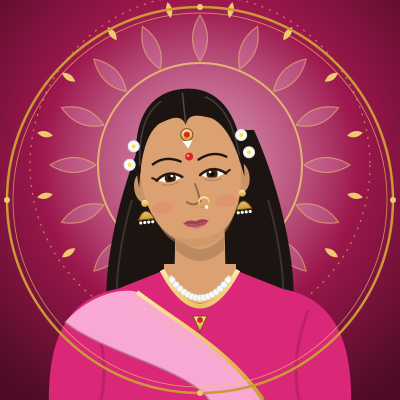
Uttara was the princess of Matsya, the daughter of King Virata and Queen Sudeshna. Her brother was Prince Uttar. During the Pandavas' last year of exile, when they lived in disguise in her father's palace, Arjuna — hidden as Brihannala — became her teacher of dance and music. After the Pandavas revealed themselves, she married Abhimanyu, the son of Arjuna and Subhadra. Their married life was very short: Abhimanyu fell in the war while she was expecting their child. After the war, Ashwatthama's weapon struck that unborn child, and the baby was born lifeless. Krishna brought him back to life. That child was Parikshit, who carried the Pandava family forward. Uttara's story is one of innocence, deep sorrow and the grace of God.
A princess and her dance teacher
In the thirteenth year of their exile, the Pandavas had to live in hiding without being recognised. They came in different disguises to the court of King Virata of Matsya. Arjuna came as Brihannala, a teacher of singing, dancing and music. Long before, the apsara Urvashi had cursed him to live for a time without his manhood, and Indra had turned that curse into a blessing he could use for one year. Now that year had come.
King Virata had Brihannala tested by the women of the palace. Satisfied, he appointed Brihannala to teach his daughter Uttara and her friends in the dance hall of the inner palace.
For a whole year Uttara learned singing, dancing and the playing of instruments from this gentle teacher. She did not know that the teacher was Arjuna, the greatest archer of the age.
A call to the dance hall
Near the end of that year, the Trigartas attacked Matsya from the south and King Virata rode out to fight them. Then the Kaurava army — Duryodhana, Bhishma, Drona, Karna and others — attacked from the north and began driving away the kingdom's cattle.
Only young Prince Uttar was left in the city. Among the women of the palace he boasted that he could defeat the whole Kaurava army, if only he had a good charioteer. Draupadi, living there as the maid Sairandhri, told him that Brihannala had once been Arjuna's own charioteer.
So Prince Uttar said to his sister, “Go, and bring Brihannala here.” Uttara, adorned with gold, ran to the dance hall. Brihannala asked her why she had come in such a hurry. She explained that the Kurus were taking away their cattle, and that her brother needed a charioteer. She asked Brihannala to help him.
Brihannala agreed and went to the prince. Their whole kingdom's cattle were at stake, and it was Uttara's request that carried the hidden Arjuna toward the battlefield.
Clothes for the dolls
As the chariot was leaving, Uttara and her friends called out to Brihannala, “Bring back fine, colourful clothes from the Kuru warriors — we want them for our dolls!” Brihannala laughed and said that if Prince Uttar defeated the great warriors, those clothes would surely be brought.
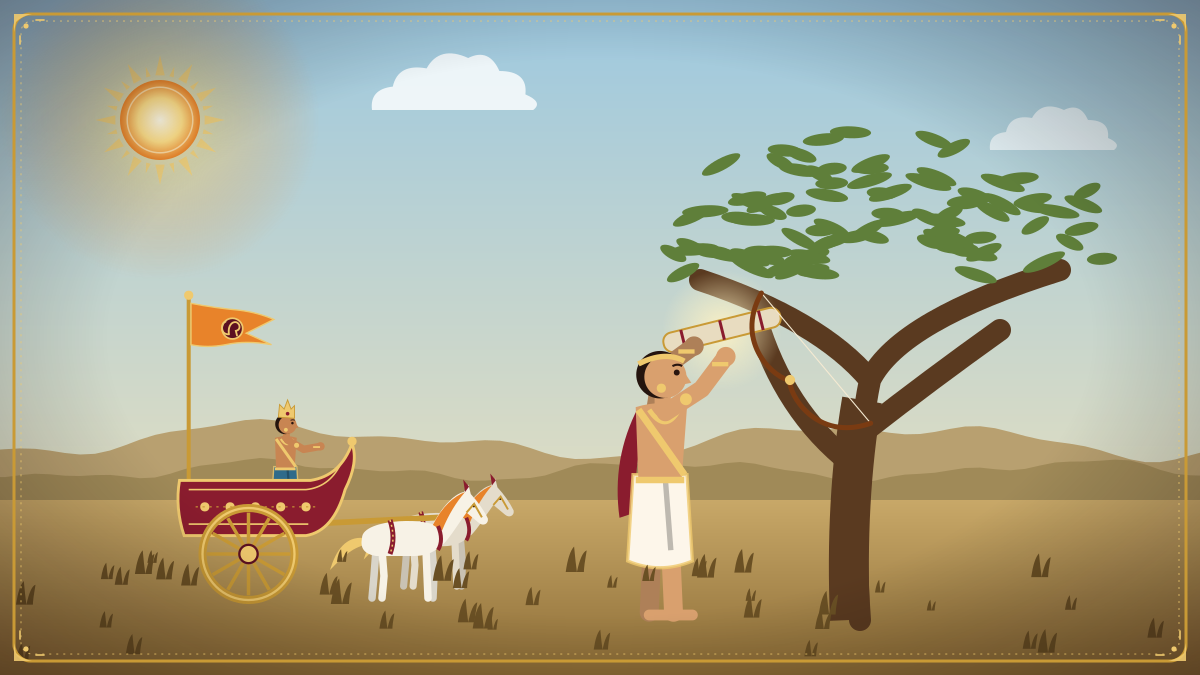
On the battlefield, Prince Uttar lost his courage on seeing the huge army and tried to run away. Brihannala stopped him, took the Pandavas' hidden weapons down from a shami tree and told him the truth: he was Arjuna. Then, with Uttar driving the chariot, Arjuna fought and defeated the Kaurava army. At the end he put the warriors into a deep sleep with a special weapon, and asked Uttar to collect their colourful upper cloths.
Returning to the palace, Arjuna gave those fine clothes to Uttara, and the princess was delighted. It is a sweet, small moment in a great epic: the greatest archer of the age keeping a promise to a group of girls and their dolls.
Bride of Abhimanyu
A few days later, the Pandavas revealed who they really were. King Virata was overjoyed and ashamed at the same time, for he had treated these great heroes as servants. To honour Arjuna, he offered him Uttara's hand in marriage.
Arjuna politely refused. He said, “I have lived in your inner palace and seen your daughter both alone and in company, and she has trusted me as she would trust a father. I was her teacher. If I accept her as my daughter-in-law, everyone will know that our conduct was pure. I accept her as a bride for my son Abhimanyu.”
King Virata gladly agreed. The wedding was held at Upaplavya in the kingdom of Matsya. Krishna came with Balarama, Subhadra, Abhimanyu and many Yadava heroes, and many allied kings came as well. Krishna gave rich gifts, and the wedding was celebrated with great joy.
This marriage tied Matsya closely to the Pandavas. When war came, King Virata and his sons stood on the Pandava side.
Six months, and then the war
The war was terrible for Uttara's family. On the very first day her brothers Uttar and Shveta were killed, Uttar by Shalya and Shveta by Bhishma. Later, Drona killed her father, King Virata.
On the thirteenth day, young Abhimanyu entered the Chakravyuha, the circular battle formation, and fell fighting alone against many great warriors. At that time Uttara was expecting their child.
After the war, Gandhari, looking over the battlefield, described Uttara's grief to Krishna. The young widow sat beside Abhimanyu's body, gently stroking his face, and said, “We were together for only six months, and in the seventh month you have gone.”
In those few words we hear the whole sorrow of the war — not of kings and generals, but of a young wife whose life together with her husband had barely begun.
The weapon aimed at the unborn child
Even after the war, the danger was not over. Ashwatthama released the terrible Brahmashira weapon. When he could not take it back, he turned it toward the wombs of the Pandava women, to end the family line. Krishna declared that Uttara's child would be born dead, but that he himself would bring the child back to life. He also recalled that a brahmin had once told Uttara that her son would be born when the Kuru family had dwindled, and would be named Parikshit.
Months later, Uttara gave birth to a boy who lay still and lifeless. The women of the palace cried out in grief. Kunti and Subhadra begged Krishna to keep his promise.
Uttara, almost out of her mind with sorrow, held the baby and spoke to him: “Child, see, Krishna is here. Wake up and bow to him.” She said she would rather give up her own life than live without her child.
Krishna entered the birth chamber, touched water and withdrew the power of the weapon. Then he made a solemn vow: “I have never spoken a lie. I have never turned back from battle. By that truth, may this child live.” At once the baby began to move and came back to life. Joy filled the palace, and Uttara bowed before Krishna with a full heart.
Did you know?
- Kichaka, the commander of Matsya who troubled Draupadi, was Uttara’s maternal uncle (mama).
- Uttara asked her teacher Brihannala to bring back fine clothes from the Kaurava warriors for her dolls, and Arjuna did exactly that.
- Arjuna refused to marry Uttara because he had been her teacher, and a teacher sees a student like his own child.
- Krishna brought Uttara’s baby back to life by calling on the power of his own truthfulness.
What we learn from Uttara
Uttara's life holds great sorrow — the loss of her father, brothers and young husband in one war. Yet she clung to hope for her child, and through Krishna's grace that hope came true. Her story shows that faith in God can carry us through even the darkest days. From her grief came new life for the whole family.
Uttara in the story
Read the chapters where Uttara plays a part.