How the Ramayana Was Born
Sage Valmiki asks Narada whether a truly perfect man lives on earth, hears the story of Rama, sees a hunter kill one of a pair of krauncha birds, and is asked by Lord Brahma to sing the whole Ramayana.
What is the Ramayana?
Before we walk into Ayodhya and meet its princes, let us sit together the way a family sits around a grandmother in the evening, and ask a simple question: what is the Ramayana? The word means “the journey of Rama”. It is the story of Shri Rama, the eldest son of King Dasharatha of Ayodhya, of his wife Sita, his loyal brother Lakshmana, his great devotee Hanuman, and of the long road that took them from a royal palace into the forest, to Lanka and back home again.
The poet of this story is Sage Valmiki, and our elders lovingly call him the “Adi Kavi”, the first poet. His poem is the oldest long poem in the Sanskrit language. It has about twenty-four thousand verses, called shlokas, arranged in seven books called kandas: the Bala Kanda, Ayodhya Kanda, Aranya Kanda, Kishkindha Kanda, Sundara Kanda, Yuddha Kanda and Uttara Kanda.
Valmiki was not a stranger to the people he wrote about. He lived in his ashram while Rama ruled, and he appears inside the story more than once. Rama visits his hermitage on the way to Chitrakuta, and many years later Sita finds shelter in that same ashram. So the poet sings about a family he knew and loved.
The Ramayana is not only an adventure. It shows how a son keeps his father’s word, how brothers love one another, how a wife stands firm in hardship, how a friend keeps a promise and how a devotee serves without asking anything for himself. That is why, in our homes, the name of Rama is the first name taught to a child and the last name spoken at the end of life.
In these pages we will follow Valmiki’s own text, as printed by the Gita Press of Gorakhpur, from its first verse to its last. Many lovely stories have grown up around the Ramayana over the centuries, but here we will listen only to what Valmiki himself tells us. And the very first thing he tells us is how the poem itself came to be born.
Narada visits the ashram
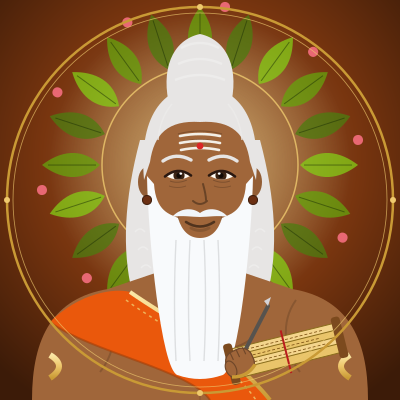
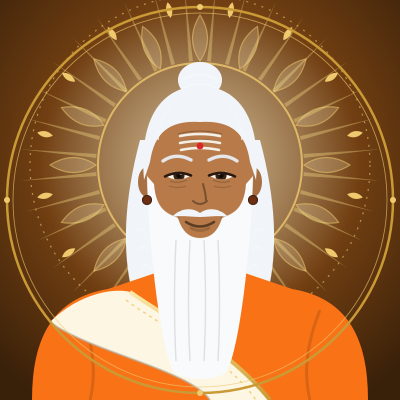
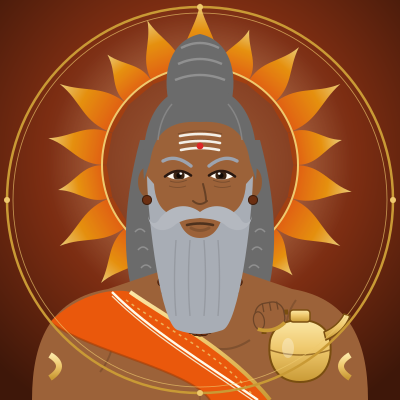
Valmiki’s ashram stood near the river Tamasa, not far from the holy Ganga. He was a sage devoted to tapas and to the study of the Vedas. One day the divine sage Narada, who travels freely through all the worlds singing the name of Narayana, came to visit him. Valmiki welcomed him with respect, and when they were seated, he asked Narada a question that had long been in his heart.
“Tell me, O sage,” said Valmiki, “is there any man in this world today who is full of good qualities and also mighty? Who knows dharma, who is grateful, truthful and firm in his vows? Whose conduct is pure, who wishes well to every living being, who is learned, capable and pleasant to look upon? Who has conquered anger, who is radiant and free from envy, and whose anger, when it is roused in battle, even the gods fear?”
Narada, who knew the past, present and future of all three worlds, listened happily. “The qualities you have named are many and rare,” he said, “and it is hard to find them together in one person. Yet there is such a man. Listen, and I will tell you about him. He was born in the royal family of Ikshvaku, and the people know him by the name of Rama.”
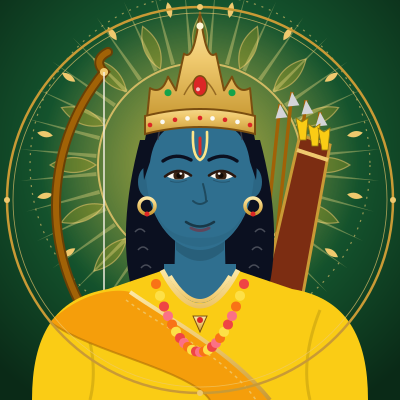
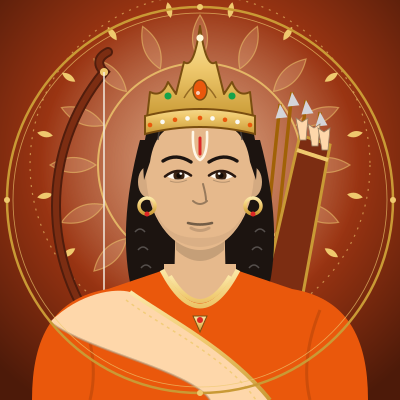
Then Narada described Rama with love. He was self-controlled, very strong, radiant and steady. His shoulders were broad and his arms long, reaching down to his knees. He was a protector of dharma and of all who came to him for shelter. In patience he was like the Earth, in depth like the ocean, in steadiness like the Himalaya, and in generosity like Kubera, the lord of wealth.
The whole story in a few verses
Then, in a short and beautiful song, Narada told the whole story of Rama. He told how King Dasharatha wished to crown Rama as the crown prince, how Queen Kaikeyi asked for two boons, and how Rama went to the forest for fourteen years to keep his father’s word. Sita and Lakshmana went with him. Guha, the chief of the Nishadas, helped them cross the Ganga, and they made their home at Chitrakuta.
He told how Dasharatha died of grief, how Bharata refused the throne and ruled from Nandigram in Rama’s name, keeping Rama’s sandals on the throne. He told how Ravana, king of Lanka, carried Sita away with the help of Maricha, how the vulture Jatayu died trying to save her, and how Rama met Shabari, Hanuman and the vanara king Sugriva.
He told how Rama killed Vali and made Sugriva king, how Hanuman leapt across the ocean, found Sita and burned Lanka, how the vanaras built a bridge across the sea, and how Rama killed Ravana in battle and crowned Vibhishana as king of Lanka. Then Rama flew home in the Pushpaka chariot, met Bharata at Nandigram and was crowned in Ayodhya.
Narada ended by describing the joy of Rama’s rule. In that kingdom, he said, no father would see the death of his son, no woman would become a widow, people would be free from disease, famine and fear, and everyone would live by dharma. Having said all this, the divine sage blessed Valmiki and went on his way to the heavens.
The cry of the krauncha bird
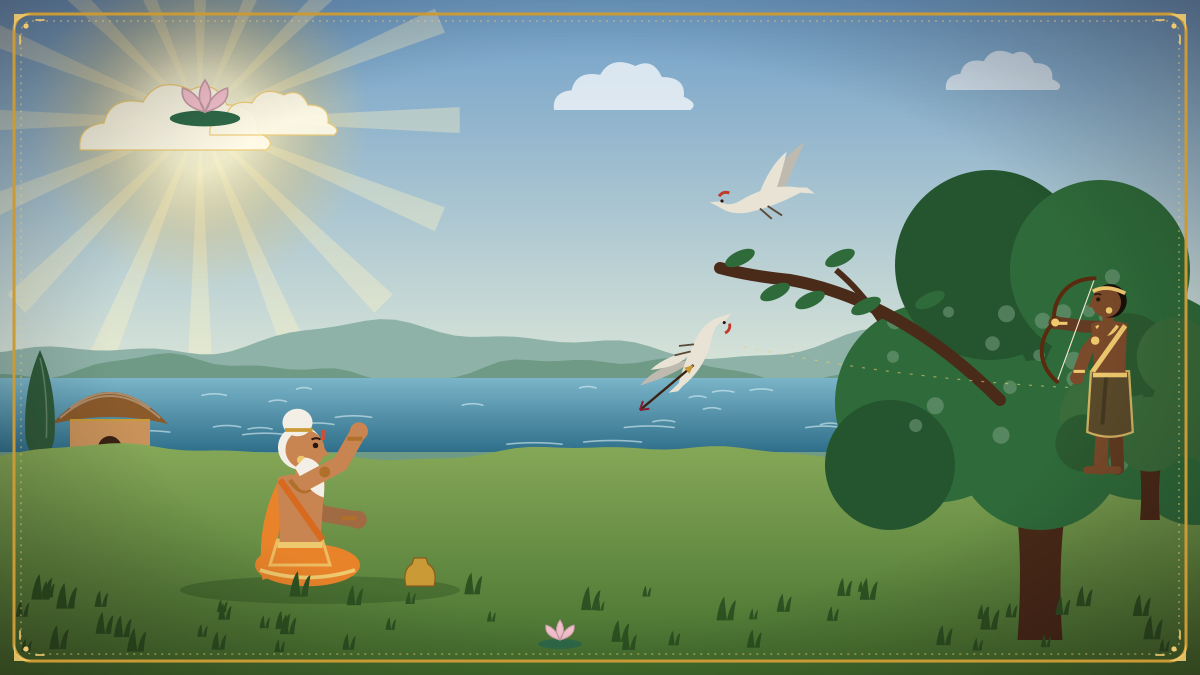
After Narada left, Valmiki went with his disciple Bharadvaja to bathe in the river Tamasa. Looking at the calm water, he said, “See, Bharadvaja, how clear and lovely this water is, like the mind of a good person.” He asked his disciple for his bark garment and walked slowly along the bank, enjoying the beauty of the forest around him.
Not far away, a pair of krauncha birds was singing sweetly, the male and the female happy together. Suddenly a hunter, a nishada with a cruel heart, shot an arrow and struck the male bird. It fell to the ground, its wings trembling, and died. Seeing her companion lying there, the female bird cried out again and again in a voice full of pain.
Valmiki’s heart melted with compassion. Seeing the bird struck down for no fault of its own, and hearing its companion’s cry, he spoke these words to the hunter: “O nishada, may you never find rest for endless years, because you have killed one of this pair of krauncha birds while they were lost in love.”
As soon as the words left his lips, the sage was amazed. His grief had come out in a perfect form: four quarters, each with an equal number of syllables, which could be sung to the music of the vina. “This was born from my grief, my shoka,” he said, “so let it be called a shloka.” Ever since, the verse form of the Ramayana has been called the shloka.
Bharadvaja learned the verse at once and was delighted. The sage bathed, finished his prayers and returned to the ashram, but his mind kept going back to the verse. How had words of sorrow turned into music? It was the first time such a verse had been spoken in this way, and the whole of the Ramayana would be sung in this same metre.
Brahma’s blessing
While Valmiki sat thinking, Lord Brahma, the four-faced creator of the worlds, came to the ashram. Valmiki rose in wonder, bowed with folded hands and offered him water and a seat. Brahma sat down and asked the sage to sit too, but Valmiki’s mind was still with the bird and the hunter, and he found himself reciting the verse once again.
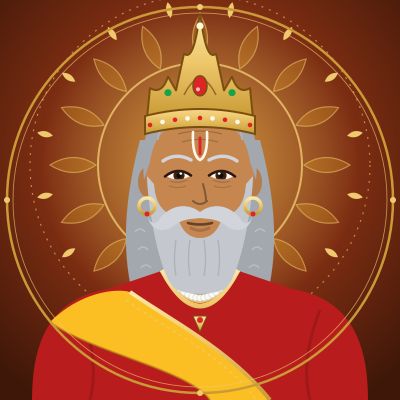
Brahma smiled and said, “Do not be troubled. This shloka came from your lips by my own wish. Now, O best of sages, tell the whole story of Rama, just as you heard it from Narada. Sing of Rama, the most virtuous man in the world, who is wise, steady and devoted to dharma.”
“Everything about Rama, Lakshmana and Sita, and about the rakshasas,” Brahma continued, “both what is known and what is hidden, will be revealed to you. Not a single word of your poem will be false. As long as the mountains stand and the rivers flow on this earth, so long will the story of the Ramayana be told among people.”
Having given this blessing, Brahma disappeared. Valmiki and his disciples were filled with wonder. The disciples sang the verse again and again, and each time it pleased them more. The sage now decided to compose the whole Ramayana in such verses, so that people everywhere could hear the story of Rama in a form that the heart can sing.
The poem and its first singers
Valmiki sat on a seat of kusha grass with its tips pointing east, sipped holy water and folded his hands. Then, by the power of his meditation, he saw the whole story before him. He saw Rama, Lakshmana and Sita, King Dasharatha and his queens, how they spoke, laughed and walked, as clearly as one sees a small fruit resting in one’s palm.
Then he composed the poem: twenty-four thousand verses in five hundred chapters, called sargas, in six books, with the Uttara Kanda after them. He gave it three names: the Ramayana; the great story of Sita; and the fall of the descendant of Pulastya, that is, Ravana. So from the very first chapter, Sita’s story is placed beside Rama’s.
Next the sage wondered who would sing this long poem to the world. Just then two young princes living in his ashram, the twin brothers Lava and Kusha, came and touched his feet. They had sweet voices, knew music well, and looked as if Rama himself had come in two forms. Valmiki taught them the whole Ramayana, and they learned it by heart.
The twins sang it in gatherings of sages, who wept with joy and gave them gifts: one a water pot, another a bark garment, another a deerskin. Later Rama himself saw them, brought them into his palace and listened to the whole song with his brothers. Now let us listen to it too, beginning in Ayodhya, where a great king longed for a son.
The Birth of Four Princes
In the shining city of Ayodhya, the childless King Dasharatha performs great sacrifices; the gods ask Lord Vishnu to be born on earth to end Ravana, and from the sacred fire comes the payasa that brings Rama, Bharata, Lakshmana and Shatrughna into the world.
Ayodhya, the city of Manu
The song that Lava and Kusha sang begins on the banks of the river Sarayu. There lay the rich and happy country of Kosala, and in it the city of Ayodhya, which Manu himself, the first king of human beings, had built. Valmiki tells us the city was twelve yojanas long and three yojanas wide, with broad royal roads that were sprinkled with water every day and scattered with flowers.
Ayodhya had high gates and strong walls, deep moats around it, markets full of goods, and houses rising like the palaces of the gods. Its gardens were full of mango groves, and the sound of drums, vinas and the chanting of the Vedas filled the air. Valmiki compares it to Amaravati, the city of Indra.
The people of Ayodhya were happy and good. Valmiki says that no one there was poor, greedy or cruel, no one was without learning, and no one spoke untruth. Every home had grain and cattle, and every person kept to dharma. Brahmins studied the Vedas, warriors protected the people, and everyone respected one another.
This was the city of the Ikshvaku kings, the family of the Sun. Many great and famous kings had ruled from here before, kings who were known for truth, generosity and courage. Now it was ruled by one of the greatest of them all, King Dasharatha, and it is with him that our story truly begins.
King Dasharatha and his sorrow
King Dasharatha was wise, truthful and devoted to dharma. He was a mighty warrior, loved by the people of the city and the villages alike. He ruled with the help of eight good ministers, among whom Sumantra was his trusted charioteer and adviser. His family priests were the great sages Vashishtha and Vamadeva, whose advice he always followed.
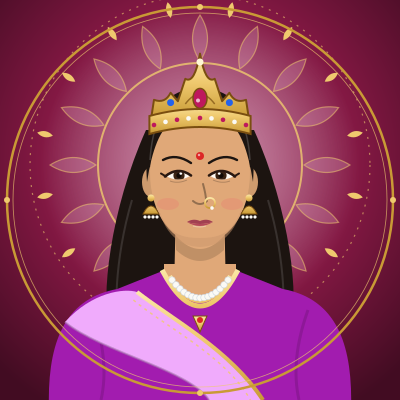
The king had three principal queens. Kaushalya was the eldest queen, gentle and devoted to dharma. Kaikeyi was the daughter of the king of Kekaya and very dear to the king. Sumitra was calm, wise and kind. With them the king lived in wealth and honour, and the whole land was at peace.
Yet there was one sorrow in his heart. Though he had everything a king could wish for, he had no son to carry on the family of the Ikshvakus. Year after year he waited, and as he grew older the longing grew stronger. At last he made a decision: he would perform the Ashvamedha, the great horse sacrifice, so that he might be blessed with sons.
He called his ministers and priests and told them his wish. Vashishtha and the other sages praised his decision and said, “Your wish will be fulfilled; you will have sons who are full of virtue.” The king’s face shone with hope, and he told his queens to prepare for the sacred vows.
Sage Rishyashringa
Then Sumantra came to the king privately and told him an old prophecy he had heard from the sage Sanatkumara. In the kingdom of Anga, he said, there once was a terrible drought. The king of Anga, Romapada, was told that rain would come only if the young sage Rishyashringa came to his land.
Rishyashringa was the son of the sage Vibhandaka. He had grown up deep in the forest with only his father and knew nothing of the world. The ministers of Anga found a gentle way to bring him to the city, and the moment he arrived, the rain poured down. Romapada gave him his daughter Shanta in marriage. Sanatkumara had foretold that this sage would help King Dasharatha to have sons.
Romapada was a dear friend of Dasharatha, so the king himself travelled to Anga with his queens and ministers. He was received with great love, and after some days he brought Rishyashringa and Shanta back with him to Ayodhya. The whole city was decorated, and the people welcomed the sage with joy.
In the spring the sacrificial horse was set free to wander, and after a full year the Ashvamedha was performed on the northern bank of the Sarayu. Kings came from many lands, including King Janaka of Mithila and the old king of Kekaya, Kaikeyi’s father. Food and gifts were given to everyone, and Valmiki says that no one went away hungry or disappointed.
When the horse sacrifice was finished, Rishyashringa told the king, “Now I will perform a special sacrifice for sons, the putrakameshti, with the mantras of the Atharva Veda.” With great care he began the new sacrifice, and the fire blazed bright as the offerings were poured into it.
The gods go to Brahma
At the same time, the gods, the gandharvas and the sages had gathered to receive their share of the offerings. They went to Lord Brahma with a heavy heart. “O Grandfather,” they said, “the rakshasa Ravana is troubling all the worlds. Because of the boon you gave him, we cannot stop him. He torments sages, gods and kings, and even the sun and the wind are afraid of him.”
Brahma thought for a moment and said, “Ravana asked me that he should not be killed by gods, gandharvas, yakshas or rakshasas. In his pride he did not think human beings worth mentioning. So he can be killed only by a human being.” The gods were overjoyed to hear this.
Just then Lord Vishnu arrived, riding on Garuda, wearing yellow garments and holding his conch, discus and mace. The gods bowed to him and prayed, “O Lord, please divide yourself into four and be born as the sons of King Dasharatha by his three queens. Become a man and destroy Ravana, who cannot be killed by the gods.”
Vishnu comforted them. “Do not fear,” he said. “For your good I will kill Ravana with his sons, ministers and relatives, and then I will rule the earth for eleven thousand years.” Then the Lord chose King Dasharatha to be his father on earth.
The payasa from the fire
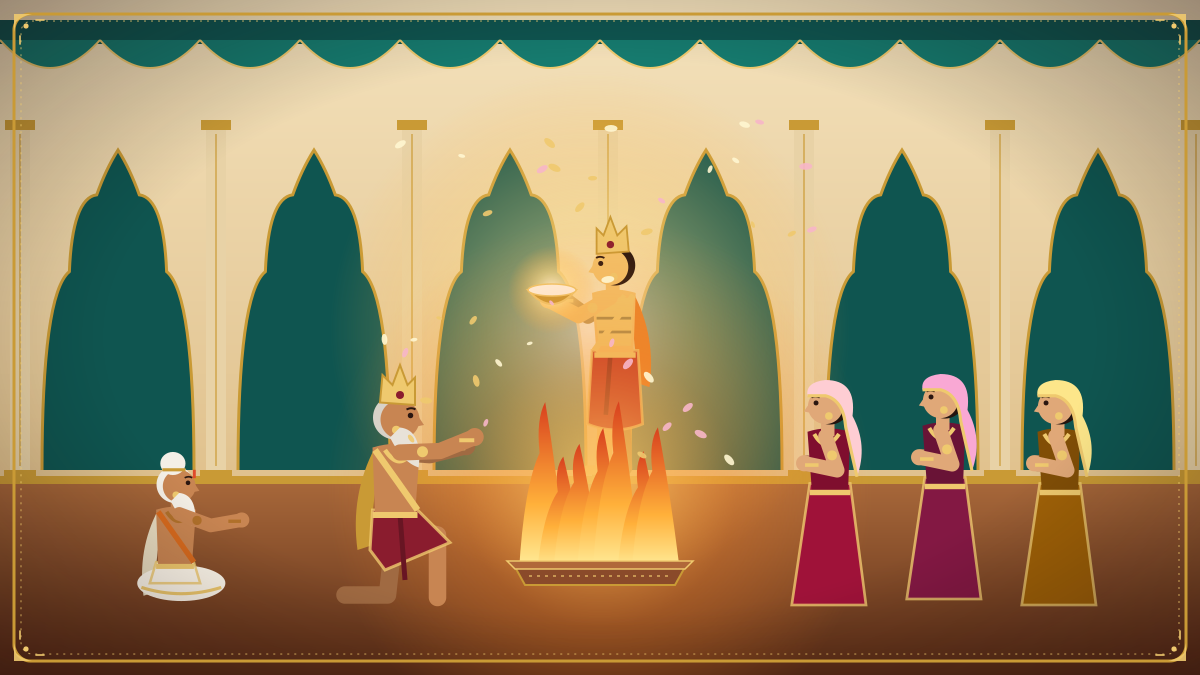
Then, from the fire of King Dasharatha’s sacrifice, a wonderful being rose up. He was tall and shining, dressed in red, with a voice like the beat of a drum. In his hands he held a large golden vessel covered with a silver lid, full of divine payasa, a sweet dish of rice cooked in milk.
“I am a being sent by Prajapati,” he said to the king. “O king, take this payasa, prepared by the gods. It brings children and good health. Give it to your worthy queens to eat, and through them you will have the sons you have prayed for.” The king received the vessel with joy, like a poor man who has suddenly found treasure. The divine being then vanished into the fire.
Dasharatha went into the inner palace and shared the payasa. He gave half to Kaushalya. Of the half that remained, he gave half to Sumitra. Of what was left, he gave half to Kaikeyi, and after thinking for a moment, he gave the last portion again to Sumitra. In time, all three queens shone with the light of the children within them.
Meanwhile Brahma told the gods, “Vishnu is going to earth. You too must create mighty helpers for him.” So the gods created brave vanaras, strong as mountains. From Indra was born Vali, from Surya, the Sun, Sugriva, from Vishvakarma, Nala, and from Vayu, the Wind god, Hanuman. Brahma said that he had already created Jambavan, the king of bears, long before.
Four princes are born
The sacrifice ended, the gods returned to their homes and the season turned. In the twelfth month, in the month of Chaitra, on the ninth day of the bright half, under the star Punarvasu, when five planets were in their highest places, Queen Kaushalya gave birth to Rama. That day is celebrated even now as Rama Navami.
Then Kaikeyi gave birth to Bharata under the star Pushya, and Sumitra gave birth to twin sons, Lakshmana and Shatrughna, under the star Ashlesha. The gandharvas sang, the apsaras danced, drums sounded in the sky and flowers rained down. In Ayodhya there was a great festival, and the king gave gifts to everyone.
On the eleventh day Sage Vashishtha performed the naming ceremony. The eldest he named Rama, Kaikeyi’s son Bharata, and Sumitra’s sons Lakshmana and Shatrughna. All four grew up learned in the Vedas and skilled in archery, riding and the use of elephants and chariots. They served their parents and teachers, and among them Rama shone like a spotless moon.
From childhood Lakshmana loved Rama more than his own life. Valmiki says he was like Rama’s second life breathing outside his body. Rama would not sleep without Lakshmana beside him, nor eat good food without sharing it with him, and when Rama rode out to hunt, Lakshmana followed with his bow to guard him. In the same way Shatrughna was devoted to Bharata.
When the princes came of age, the king began to think of their marriages. Just then the great sage Vishvamitra arrived at the palace gate. Dasharatha hurried out with Vashishtha, welcomed him and said, “Your coming is like rain on a dry land. Tell me what you wish, and I will do it.” He did not yet know what the sage was about to ask.
Rama’s First Journey
Sage Vishvamitra takes the young Rama and Lakshmana from Ayodhya to protect his sacrifice; on the way Rama ends the terror of Tataka, receives divine weapons, defeats Maricha and Subahu, and frees Ahalya from a long curse.
The sage’s request
King Dasharatha had promised Sage Vishvamitra that he would give him whatever he asked. The sage now spoke. “O king, I am performing a sacrifice to gain spiritual power. But each time it is nearly complete, two powerful rakshasas, Maricha and Subahu, pour flesh and blood on the altar and spoil it. During the vow I may not grow angry or curse them. So give me your eldest son Rama for ten days. Under my protection he will destroy them.”
When Dasharatha heard this, he shook with fear and almost fainted. “Rama is not yet sixteen years old,” he said. “He has never fought in battle. Take my whole army instead; I will come myself and fight the rakshasas. But do not take Rama from me. I had him after so many years of longing.” And when he learned that these rakshasas were sent by Ravana, he became even more afraid.
Vishvamitra’s face grew red with anger. “You promised to give me what I asked, and now you are breaking your word,” he said. “This is not worthy of the family of Raghu. If you are happy breaking promises, then stay happy with your sons. I will go back the way I came.” As the great sage’s anger rose, the whole earth seemed to tremble.
Then Sage Vashishtha gently spoke to the king. “You were born in the family of Ikshvaku and you are known as dharma itself. Do not abandon your promise. Rama is safe with Vishvamitra, who knows every divine weapon. He does not need Rama’s help; he asks for Rama for Rama’s own good.” Hearing this wise counsel, the king’s heart became calm.
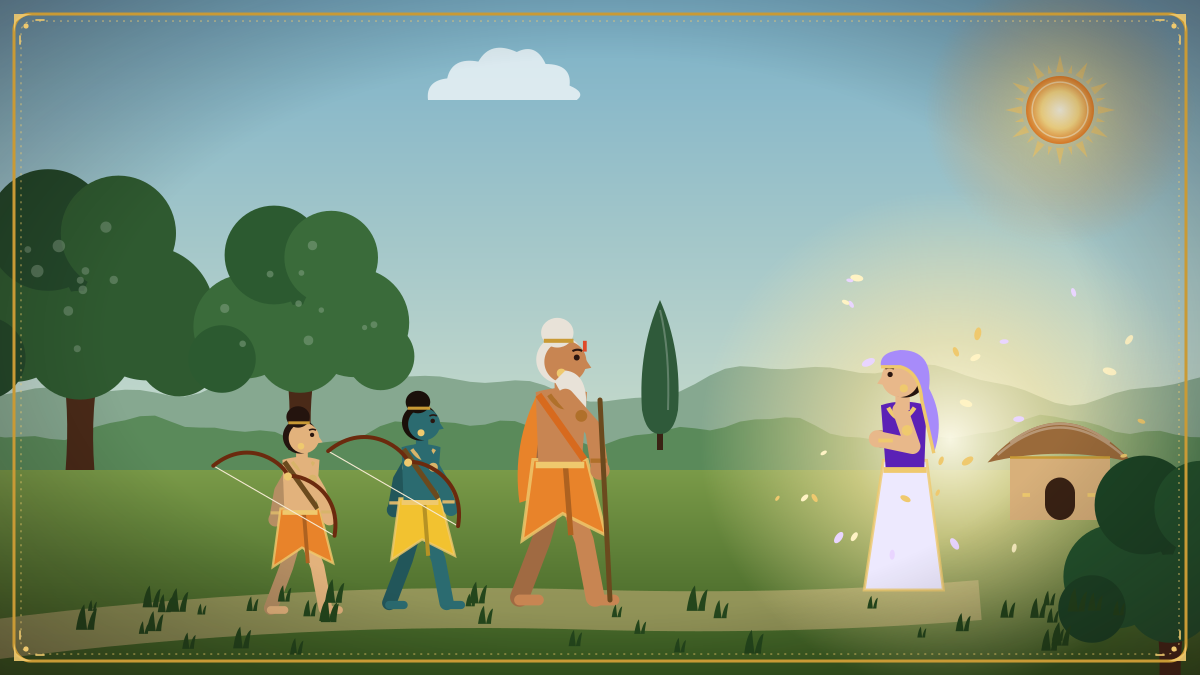
Dasharatha called Rama and Lakshmana. Their mothers and father blessed them, and Vashishtha chanted protective mantras. As the two brothers set out behind the sage, a cool breeze blew, flowers fell from the sky, and drums sounded among the gods. With their bows, quivers and swords, the two young princes followed Vishvamitra the way the two Ashvins follow Brahma.
Bala and Atibala on the road
After walking a yojana and a half along the southern bank of the Sarayu, Vishvamitra stopped and said lovingly, “Rama, sip some water. I will teach you two special mantras called Bala and Atibala. With them you will never feel tired or ill, and no one will equal you in strength. Even when you are asleep or careless, no rakshasa will be able to harm you. You will feel neither hunger nor thirst.”
Rama purified himself and received the two vidyas from the sage with joy. That night the princes slept on a bed of grass on the riverbank, and the great sage spoke to them sweetly. The palace boys, used to soft beds, did not complain; they were happy to serve their guru.
Early next morning, Vishvamitra woke Rama with a verse that our elders still sing at dawn: “Kausalya supraja Rama purva sandhya pravartate…” It means, “Rama, blessed son of Kaushalya, the dawn has come. Rise, O tiger among men, it is time for the morning prayers.” The princes rose, bathed and offered their prayers to the Sun.
Then they came to the place where the Sarayu meets the Ganga. There they saw a holy ashram, and Vishvamitra told them that here Lord Shiva had once burned Kama, the god of love, with the fire of his eye. They spent the night with the sages there. The next morning a boat carried them across the Ganga, and in the middle of the river they heard the great roar of the two rivers meeting.
The forest of Tataka
On the far bank lay a dark and dreadful forest, full of crickets, wild beasts and tangled trees. “This was once the rich land of Malada and Karusha,” Vishvamitra said, “but now it is empty because of a fierce yakshi called Tataka. She has the strength of a thousand elephants. She is the wife of Sunda and the mother of Maricha, who troubles my sacrifice.”
He told them her story. Tataka had been born a yakshi with great strength by Brahma’s blessing. After her husband Sunda died, she and her son Maricha attacked the great sage Agastya. Agastya cursed Maricha to become a rakshasa, and Tataka to lose her beauty and become a fearsome man-eater. Since then she had destroyed this whole land.
“Rama, you must end her terror,” the sage said. “Do not hesitate because she is a woman. A prince must protect his people, even when the duty is hard.” Rama folded his hands and replied, “In Ayodhya my father told me to obey your words without doubt. I will do as you say, for the good of the people, the cows and the sages.”
Rama twanged his bowstring so loudly that the whole forest echoed. Tataka came rushing out in rage, raising great clouds of dust and throwing showers of stones. By her magic she even became invisible. “Evening is coming,” warned Vishvamitra, “and rakshasas grow stronger at dusk. Do not wait.” Rama, guided by sound, held her back with his arrows.
At last, as Tataka rushed at him, Rama shot a single arrow into her chest, and she fell to the ground and died. The gods in the sky praised Rama, and Indra told Vishvamitra, “Now give Rama all your divine weapons; he will do a great work for the gods.” That night they rested peacefully in the forest that Tataka could no longer harm.
Divine weapons and Siddhashrama
The next morning Vishvamitra, very pleased, said, “Rama, I am happy with you. I will give you all the divine weapons.” Facing east, he gave him the great discs of Dharma, Kala and Vishnu, Indra’s thunderbolt, Shiva’s trident, the Brahmashira, the Aishika and the Brahmastra, the maces Modaki and Shikhari, the nooses of Dharma, Kala and Varuna, and many more, including the Manava, Agneya and Vayavya weapons.
Then something wonderful happened. The weapons themselves appeared before Rama in shining forms, with folded hands, and said, “O Raghava, we are your servants. Command us.” Rama touched them with his hands and said, “Come to my mind whenever I remember you.” He also asked how to call them back, and Vishvamitra taught him the mantras for withdrawing them.
As they walked on, Rama saw a beautiful hermitage near a mountain, and asked whose it was. Vishvamitra said, “Long ago Lord Vishnu did tapas here. When the asura king Bali had taken the three worlds from Indra, Vishnu was born as Vamana, the son of Aditi and Kashyapa, asked Bali for three steps of land, and took back the worlds for the gods.”
“This is that ashram of Vamana, and now it is mine,” said the sage. “It is called Siddhashrama, the place where tapas succeeds. Here Maricha and Subahu come to spoil my sacrifice. Today this ashram is as much yours as mine.” The sages of Siddhashrama came running to welcome them with great joy.
Guarding the sacrifice
That very day Vishvamitra took the vow for his sacrifice and fell silent. The princes asked the other sages when the rakshasas would come. “For six nights the sage will remain silent,” they said. “For six nights you must guard the sacrifice.” So Rama and Lakshmana stood guard with their bows day and night, without sleep, watching the sky.
On the sixth day, as the fire blazed on the altar, a terrible roar filled the sky. Maricha and Subahu came with their followers, spreading dark clouds of magic and raining blood on the altar. Rama said calmly, “Lakshmana, look.” Then he fired the Manava weapon at Maricha. It struck him in the chest and threw him a hundred yojanas away into the ocean, stunned but still alive.
With the Agneya weapon, the weapon of fire, Rama struck down Subahu, and with the Vayavya weapon, the weapon of wind, he drove away and destroyed the rest of the rakshasas. The sacrifice was completed in peace. The sages honoured the princes, and Vishvamitra said, “Rama, you have done what I asked. You have made the name Siddhashrama true.”
The next morning the sages said, “King Janaka of Mithila is holding a great sacrifice. He has a wonderful bow that no god or demon has been able to string. Come with us and see it.” So they set out north with a hundred carts of sages. On the way Vishvamitra told the princes many stories of his own family and of how Bhagiratha brought the Ganga down to earth.
Ahalya is freed
Near Mithila they came upon an old, lonely ashram, beautiful but empty. Rama asked whose it was. Vishvamitra said, “This was the ashram of the great sage Gautama, who lived here with his wife Ahalya and did tapas for many years. One day, when Gautama was away, Indra came here disguised as Gautama. Ahalya recognised him, and yet, in a moment of foolishness, she did not refuse him.”
“When Gautama returned and saw Indra in his form leaving the ashram, he understood everything and cursed Indra. Then he said to Ahalya, ‘You will live here for many thousands of years, living only on air, without food, lying on ashes and doing penance, unseen by any living being. When Rama, the son of Dasharatha, comes to this forest, you will be purified. When you welcome him as your guest, you will regain your own form and come back to me.’”
“Then Gautama went to the Himalaya to do tapas,” said Vishvamitra. “Now, Rama, enter the ashram and help Ahalya.” Rama and Lakshmana went in, and there they saw Ahalya, shining with the power of her penance. Until then she had been hidden from gods and men alike, like a flame covered by smoke or the moon behind clouds. Now, at the sight of Rama, she became visible.
The two princes joyfully bowed and touched her feet. Ahalya remembered Gautama’s words and welcomed them with water for their feet, an offering of honour and every courtesy due to guests, and Rama accepted it. At that moment flowers rained down from the sky, the gandharvas sang, and the gods praised Ahalya, purified by her long tapas.
Then Sage Gautama himself returned, and husband and wife were together again. Gautama honoured Rama with joy and went back to his tapas with Ahalya. Rama, having received the sage’s blessing, walked on with Vishvamitra and Lakshmana towards Mithila, where King Janaka, his great bow and his daughter Sita were waiting.
Shiva’s Bow and the Four Weddings
Vishvamitra brings Rama and Lakshmana to King Janaka’s sacrifice in Mithila, where Rama breaks the mighty bow of Shiva and wins Sita. The four princes of Ayodhya are married, and on the way home Rama humbles Parashurama.
Arrival in Mithila
In the last chapter Ahalya was freed from her long penance the moment Rama arrived at Gautama’s hermitage. From there Vishvamitra led the two princes on to Mithila, the city of King Janaka, ruler of the Videhas. Janaka was holding a great sacrifice, and brahmins and sages had come to it from many lands. The camps of the guests, with their carts and cattle, filled the land around the sacrificial ground.
When Janaka heard that Vishvamitra had come, he hurried to meet him with his family priest Shatananda and welcomed him with folded hands and every honour. Then the king looked with wonder at the two young men. “Who are these two princes,” he asked, “brave as gods, walking like lions, carrying swords, quivers and bows?” Vishvamitra told him that they were the sons of King Dasharatha and described how they had protected his sacrifice.
Shatananda was the eldest son of Sage Gautama and Ahalya. When he heard that Rama had visited the hermitage, that his mother had honoured Rama and had been united again with his father, he was overjoyed. He thanked Vishvamitra again and again and then turned to Rama. “You are fortunate, prince,” he said, “to have Vishvamitra as your guide. Listen to how this great sage reached his high position.”
Shatananda told the long story of Vishvamitra. Once he had been a king, the son of Gadhi. He wanted Vasishtha’s wish-fulfilling cow, fought for it, and was defeated by the spiritual power of Vasishtha. Then he understood that the strength of tapas is greater than the strength of arms. Through thousands of years of austerity, after many struggles with anger and desire, he was finally hailed as a brahmarshi, a sage among sages, and Vasishtha himself accepted him.
The bow of Shiva and the birth of Sita
The next morning Janaka sent for his guests and asked how he could serve them. Vishvamitra said, “These two sons of Dasharatha wish to see the great bow that is kept in your house.” Janaka explained how the bow had come to his family. Long ago, at the sacrifice of Daksha, Lord Shiva had raised this very bow in anger against the gods. When they begged for mercy, Shiva was pleased and gave the bow to them, and the gods placed it in the keeping of Devarata, one of Janaka’s ancestors.
Then Janaka told the story of his daughter. “Once, when I was ploughing a field to prepare the ground for a sacrifice, a baby girl rose up out of the earth in the furrow made by my plough. Because she came from the furrow, she was named Sita. She was not born from any mother; the Earth herself gave her to me. She has grown up in my house as my own beloved daughter.”
“I decided,” Janaka continued, “that Sita would be given only to a man who could show his strength by stringing this bow. Her bride-price is valour.” Many kings had come to Mithila hoping to win her. Janaka had the bow shown to them, but not one of them could even lift it. Angry and ashamed, the kings joined together and laid siege to Mithila for a whole year, until Janaka’s treasury was nearly empty.
Janaka performed austerities and prayed to the gods. Pleased with him, they gave him a complete army of chariots, elephants, horses and foot soldiers, and with it he defeated and scattered the proud kings. “Now,” he said to Vishvamitra, “I will show this bow to Rama and Lakshmana. If Rama can string it, I will give my daughter Sita to the son of Dasharatha.”
Rama breaks the bow
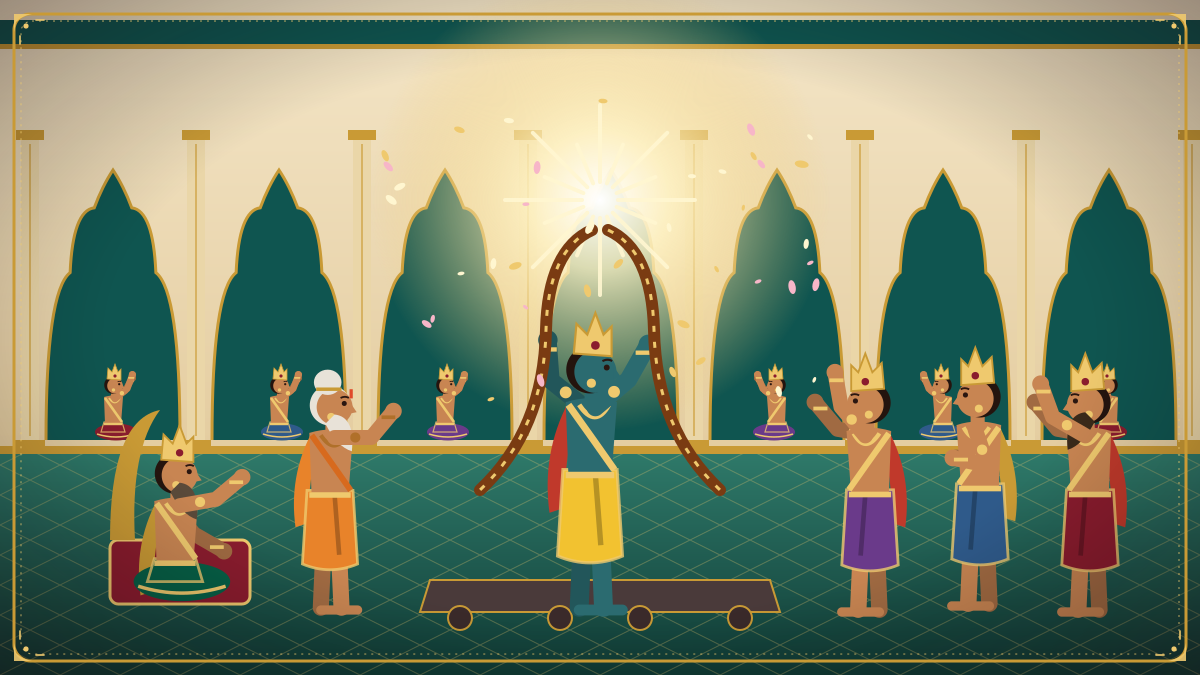
Janaka ordered the bow to be brought. Five thousand tall, strong men pushed an iron chest set on eight wheels into the hall, and inside it lay the bow, honoured with garlands and sandal paste. Janaka said, “This is the excellent bow worshipped by the kings of my line. Gods, asuras, rakshasas, gandharvas and great serpents could not string it. How could a human being lift it, fit the string and draw it?”
Vishvamitra turned to Rama and said gently, “Rama, my child, look at the bow.” Rama opened the chest, looked at the bow and said, “Let me touch this divine bow. I will try to lift it and string it.” The king and the sage said, “Very well.” In front of thousands of people Rama lifted the bow by its middle as easily as if it were a toy. He bent it, fitted the string, and drew it back.
At that moment the great bow broke in the middle. The sound was like a crash of thunder, like a mountain splitting apart, and the earth shook. Everyone in the hall fell down, stunned, except Vishvamitra, King Janaka and the two princes. When the people slowly recovered, they looked at Rama with amazement and joy, and Janaka joined his palms and spoke to the sage.
“Revered sage,” said Janaka, “I have seen the strength of Dasharatha’s son, and it is wonderful beyond imagining. My daughter Sita, by marrying Rama, will bring glory to the family of the Janakas. My vow is fulfilled. Sita, dearer to me than my own life, shall be given to Rama. With your permission, my ministers will go at once to Ayodhya and bring King Dasharatha here.”
Dasharatha comes to Mithila
Janaka’s messengers travelled for three nights, their horses weary, and reached Ayodhya. They told Dasharatha everything: how his sons had protected Vishvamitra’s sacrifice, how Rama had broken Shiva’s bow, and that Janaka wished to give Sita to him. Dasharatha was filled with joy. He asked Vasishtha and his other counsellors, and they all agreed gladly. “We leave tomorrow,” said the king.
The next day Dasharatha set out with the sages Vasishtha, Vamadeva, Jabali, Kashyapa, Markandeya and Katyayana, followed by his army and carts full of wealth. After four days on the road he reached Mithila. Janaka received him with great honour. “Now I am free of worry,” said Janaka. “When my sacrifice is complete, let the wedding take place.” Dasharatha replied humbly, “A gift depends on the giver. We will do as you say.”
Janaka also sent for his younger brother Kushadhvaja, who ruled the city of Sankashya. When the two royal families sat together, Vasishtha proudly recited the long line of the Ikshvaku kings, from Brahma and Manu down through Ikshvaku, Raghu and Aja to Dasharatha. Then Janaka recited his own family line, from King Nimi and his son Mithi, after whom Mithila is named, down to himself and Kushadhvaja.
Then Janaka said, “I give my two daughters as brides: Sita to Rama and Urmila to Lakshmana.” Vishvamitra and Vasishtha then made a further proposal. “Kushadhvaja has two daughters of matchless beauty. Let Bharata marry the elder and Shatrughna the younger.” Janaka gladly agreed, saying, “Let all four sons of Dasharatha be married on the same day.”
The four weddings
Before the wedding Dasharatha performed the godana ceremony for each of his sons and gave hundreds of thousands of cows with gold-covered horns to the brahmins. On that same day Yudhajit, the brother of Queen Kaikeyi, arrived from the kingdom of Kekaya. He said that his father, the king of Kekaya, longed to see his grandson Bharata, and that he would take Bharata home with him after the wedding.
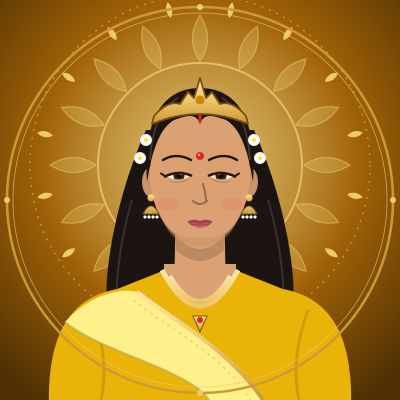
On the auspicious day of the star Uttara Phalguni, the four princes, wearing their ornaments, came to the wedding hall with Vasishtha leading them. Vasishtha prepared the altar, decorated it with flowers, golden vessels and fresh sprouts, and lit the sacred fire. Janaka brought Sita, adorned with every ornament, and seated her before the fire, facing Rama.
Janaka said to Rama, “This is my daughter Sita. She will walk with you in every act of dharma. Accept her, and may good fortune be yours. Take her hand in yours. She is devoted and blessed, and she will always follow you like your own shadow.” Saying this, he poured sacred water into Rama’s hand. In the same way Janaka gave Urmila to Lakshmana, Mandavi to Bharata and Shrutakirti to Shatrughna.
Each prince took his bride’s hand and walked three times around the fire, the altar, the king and the sages. Flowers rained down from the sky, divine drums sounded, the gandharvas sang and the apsaras danced. The next morning Vishvamitra blessed the two kings and left for the northern mountains. Janaka gave his daughters a rich dowry of cows, fine cloth, elephants, horses, chariots, soldiers, maidservants, gold, silver and pearls.
Parashurama on the road home
As Dasharatha’s party travelled back towards Ayodhya, birds began to cry fearfully, yet deer passed by on the right side, which is a good sign. Vasishtha explained, “A danger is coming from the sky, but the deer tell us that it will pass peacefully.” Soon a fierce wind shook the trees, the earth trembled, dust and darkness hid the sun, and everyone was frightened. Out of the darkness appeared Parashurama, the son of Sage Jamadagni.
He blazed like fire, with matted hair, an axe on his shoulder and a bow in his hand. He was the sage who had destroyed many kshatriya kings after his father was killed. The sages offered him water of welcome. Then he spoke to Rama: “I have heard that you broke Shiva’s bow. Here is the bow of Vishnu, which Vishvakarma made together with Shiva’s bow. If you can string it and fit an arrow to it, I will fight a duel with you.”
Dasharatha, pale with fear, begged Parashurama to spare his young sons, but the sage did not even look at him. Rama answered calmly and respectfully. He took the bow and arrow from Parashurama’s hands, strung the bow in a moment and fitted the arrow. “You are a brahmana, and you are dear to my teacher Vishvamitra, so I will not take your life,” he said. “But this arrow of Vishnu never goes in vain. Shall it destroy your power to travel, or the worlds you have won by your tapas?”
Parashurama’s pride melted away. “I gave the whole earth to Sage Kashyapa and promised not to stay on it at night,” he said. “Leave me my power to travel, but destroy the worlds I have won.” He recognised Rama as Lord Vishnu himself, walked around him in reverence and went away to Mount Mahendra. Rama released the arrow, gave the bow into the keeping of Varuna, and the whole party entered Ayodhya amid great celebrations.
Soon afterwards Bharata left for his grandfather’s kingdom with his uncle Yudhajit, taking Shatrughna with him. Rama stayed in Ayodhya, serving his father and the people, and his love for Sita grew day by day. Sita later recalled that they lived together happily in Ayodhya for twelve years. Then King Dasharatha, growing old, began to think of making Rama the crown prince, and that decision would change everything.
Key moments
- Valmiki asks Narada about a man with every good quality
- Narada names Rama of the Ikshvaku family
- Narada tells the whole story in a short song
- A hunter kills one of a pair of krauncha birds
- Valmiki’s grief (shoka) becomes the first shloka
- Brahma asks Valmiki to compose the story of Rama
- 24,000 verses in seven kandas
- Lava and Kusha learn the poem and sing it
- Ayodhya on the Sarayu was built by Manu
- King Dasharatha has three queens but no son
- Sage Rishyashringa comes from Anga with Shanta
- The Ashvamedha and the putrakameshti are performed
- Ravana can be killed only by a human being
- Vishnu agrees to be born as Dasharatha’s four sons
- Divine payasa rises from the sacrificial fire
- Rama is born on the ninth day of Chaitra
- Dasharatha fears to send Rama, who is not yet sixteen
- Vashishtha persuades the king to keep his word
- Vishvamitra teaches Bala and Atibala
- “Kausalya supraja Rama”: the dawn verse
- Rama ends Tataka’s terror
- The divine weapons appear before Rama in person
- Maricha is thrown into the ocean; Subahu falls
- Rama and Lakshmana touch Ahalya’s feet and she is freed
- Shatananda, Ahalya’s son, welcomes the princes to Mithila
- Sita rose out of the earth in a ploughed furrow
- Five thousand men wheel in the iron chest holding Shiva’s bow
- Rama strings the bow and it breaks with a thunderous crash
- Dasharatha comes from Ayodhya with Vasishtha
- Sita, Urmila, Mandavi and Shrutakirti marry the four princes
- Rama strings Vishnu’s bow and humbles Parashurama
- Bharata leaves for Kekaya with Shatrughna
What this kanda teaches us
The Ramayana was born from compassion: a sage’s heart broke for a small bird, and that pain became a song for the whole world. When we feel for the suffering of even the smallest creature, our words and deeds also become pure and beautiful.
Dasharatha had wealth and power, yet he prayed with humility for what money could not buy. The gods too did not fight Ravana by force alone; they sought the Lord’s help. When a task is too great for us, sincere prayer, patience and good company open the way.
Rama obeyed his father and his guru without fear, and kept watch for six nights without sleep. True strength is joined with humility: the prince who had just received divine weapons bowed at the feet of Ahalya. Respect for elders and for those who repent makes a person truly great.
Rama, the strongest man in the hall, lifted the bow only when his teacher asked him to, and even before the angry Parashurama he stayed calm and respectful. True strength does not need to boast. Janaka’s words at the wedding also remind us that marriage is a partnership in dharma, two people walking the same path together.
Did you know?
- Valmiki gave his poem three names: the Ramayana, the great story of Sita, and the fall of Ravana.
- The krauncha verse is famous as the first shloka; the word is linked with “shoka”, meaning grief.
- Valmiki said the water of the Tamasa was as clear as the mind of a good person.
- Brahma blessed the poem that it would be told as long as mountains stand and rivers flow on earth.
- Valmiki says Ayodhya was built by Manu himself and was twelve yojanas long.
- Ravana asked not to be killed by gods and other beings, but did not mention human beings.
- Sumitra received two portions of the payasa and became the mother of twins, Lakshmana and Shatrughna.
- Brahma said he had created Jambavan, the king of bears, long before the other vanaras.