Vibhishana and the Bridge
Rama’s army marches to the sea. In Lanka, Vibhishana advises peace, is insulted by Ravana and comes to Rama for refuge. The Ocean shows the way, Nala builds the bridge, and Angada carries Rama’s last message to Ravana.
The March to the Sea
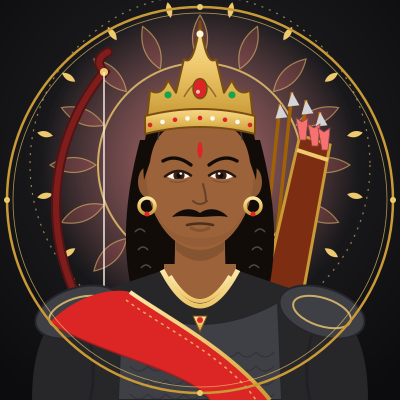
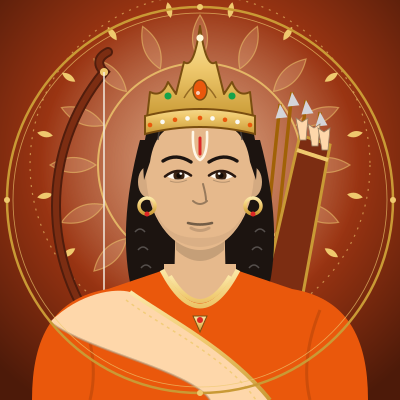
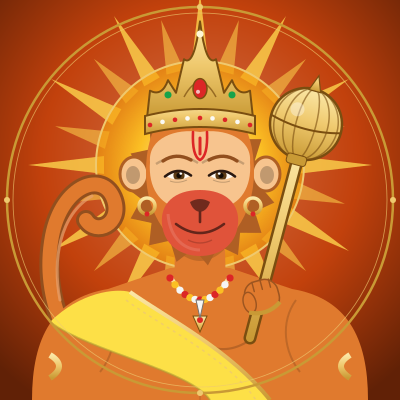
In the last chapter Hanuman brought Sita’s jewel to Rama. Now Rama praised him before everyone: “Hanuman has done what no one else could even dream of. He crossed the ocean, found Sita, comforted her and kept his master’s honour.” But then Rama grew sad. “How will this great army cross the ocean?” he asked. King Sugriva cheered him: “Do not grieve like an ordinary man. We will find a way.”
Hanuman then described Lanka carefully: its four great gates, its high golden walls, its deep moats full of water, the bridges that could be raised, the guards and the weapons on the walls. “But I have already broken many of them,” he said with a smile. “Command us, and the vanaras will take the city.” Rama listened to every detail like a wise general.
Rama decided to set out at once, at the auspicious time of midday. The great army moved south like a flood, with Nila leading the way to find food, water and safe roads. Rama rode on Hanuman’s shoulders and Lakshmana on Angada’s, and they shone like the sun and the moon. The vanaras leapt, roared and played as they marched, eager for the battle.
Crossing forests and mountains, they reached the shore of the great southern ocean. There they made their camp. Rama looked at the endless waves, rising and falling under the sky, and thought of Sita on the other side. The night came, and the army rested by the sea, while Rama lay awake, longing for the day when he would see her again.
The Council in Lanka
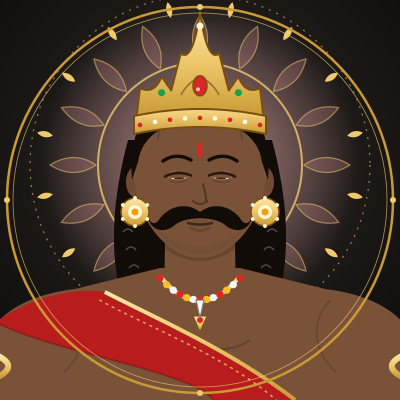
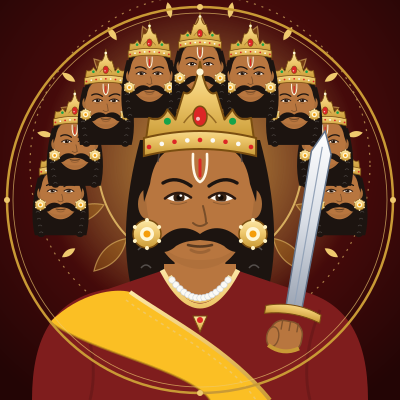
Meanwhile in Lanka, Ravana was troubled. A single vanara had burned his city and killed his son. He called his ministers to council. Most of them flattered him: “You defeated Kubera, Yama and even the gods. Why worry about a human and some vanaras? Indrajit alone can destroy them.” Kumbhakarna, his giant brother, scolded Ravana for acting without thinking, but promised to fight for him.
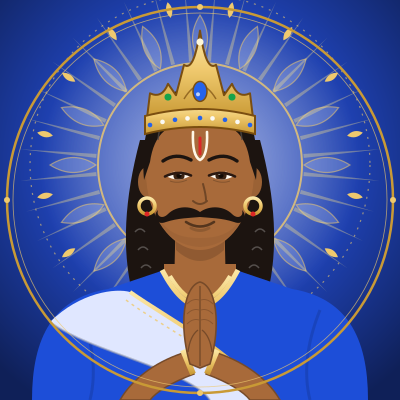
Then Vibhishana, Ravana’s youngest brother, spoke with courage and respect. “Brother, since Sita came to Lanka, we have seen many bad omens. Rama is righteous and powerful; no one can defeat him. Return Sita to him with honour before his arrows fall on Lanka. I am saying this for your good and for the good of our people.”
Indrajit laughed at his uncle and called him a coward. Vibhishana answered calmly that a child cannot understand the danger, and repeated his advice. But Ravana flew into a rage. “An enemy can be faced,” he shouted, “but a relative who is jealous of my fortune is worse than any enemy. If anyone else had said this, he would not live. Shame on you, disgrace of our family!”
Vibhishana rose into the sky with four loyal companions. “You are my elder brother and I respect you,” he said. “I spoke only for your good, but a man close to death does not accept good advice. Protect yourself and Lanka as you can. I am going. Be happy without me.” And he flew across the sea to the place where Rama was camped.
Rama Gives Refuge
Hovering in the sky above the vanara army, Vibhishana called out: “I am Vibhishana, the younger brother of Ravana. I advised him to return Sita and he insulted me. I have left my wife, my children and my home, and I come to Rama, the refuge of all beings. Please tell him that I have come.” The vanaras grew alert and reached for trees and rocks.
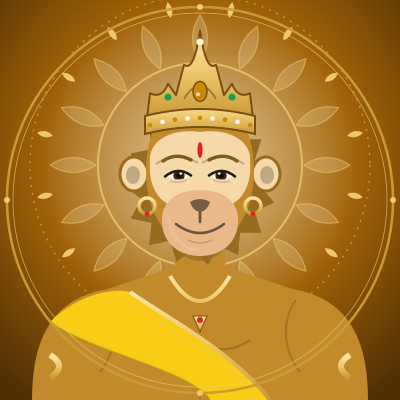
Sugriva was suspicious. “He is a rakshasa and Ravana’s brother,” he said. “He may be a spy. He should be captured.” Rama asked the others for their opinions. Some said he should be tested; others said he should be watched. Then Hanuman spoke: “I see no deceit in his face or his words. He has seen Ravana’s wrong and your goodness. He hopes for the kingdom of Lanka. I think he should be accepted.”
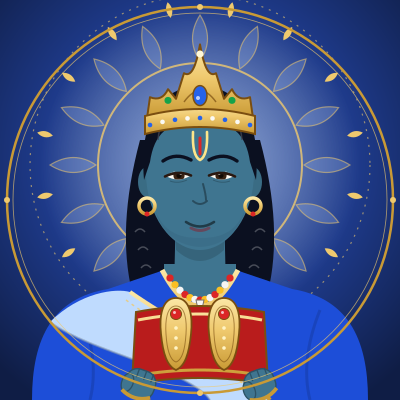
Rama listened to everyone and then spoke the words that have comforted devotees ever since: “Whoever comes to me even once, saying ‘I am yours’, I give him freedom from fear of all beings. This is my vow. Bring him here, Sugriva. Even if it were Ravana himself who came, I would accept him.” Sugriva was moved, and gladly welcomed Vibhishana.
Vibhishana came down and fell at Rama’s feet. He told Rama all about the strength of Lanka and its warriors. Rama promised, swearing by his three brothers, that he would kill Ravana and make Vibhishana king of Lanka. Then, at Rama’s word, Lakshmana brought water from the sea and anointed Vibhishana as king right there on the shore, before a single arrow had been shot.
The Ocean and the Bridge
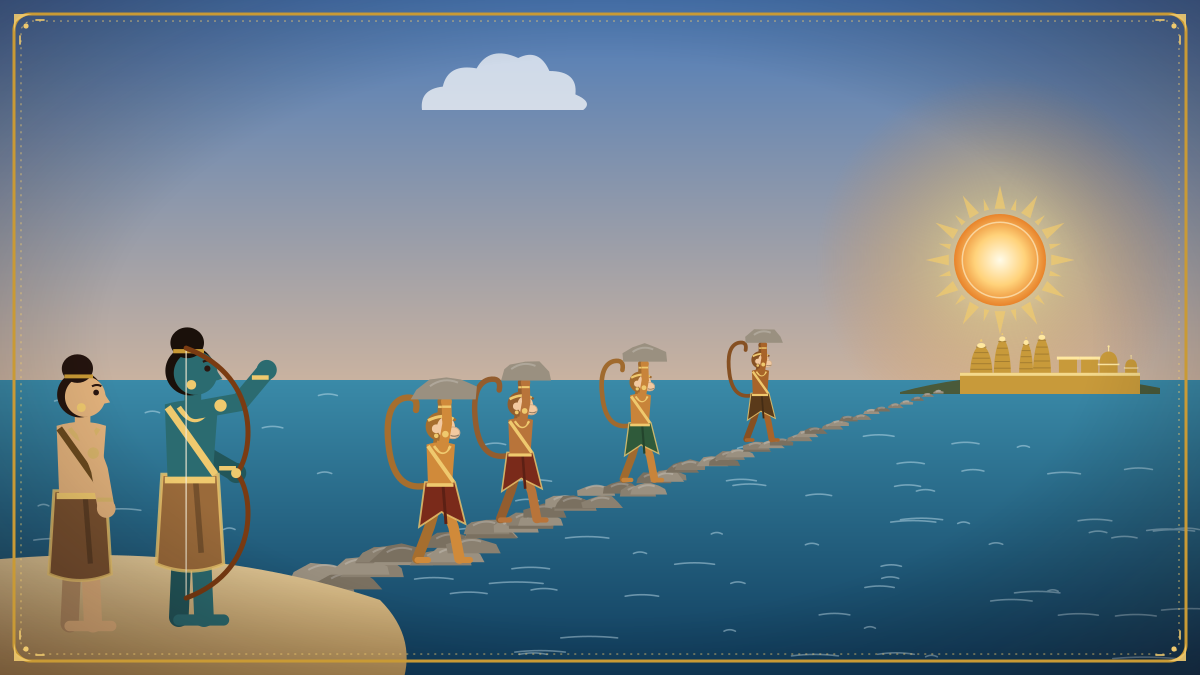
Now they had to cross the sea. Vibhishana advised, “Rama, ask the Ocean for help. The Ocean is an old friend of your family, for his waters were dug by your ancestors, the sons of King Sagara.” So Rama spread kusha grass on the shore, lay down facing the sea with folded hands, and prayed. For three days and nights he waited, fasting and calm, but the Ocean did not appear.
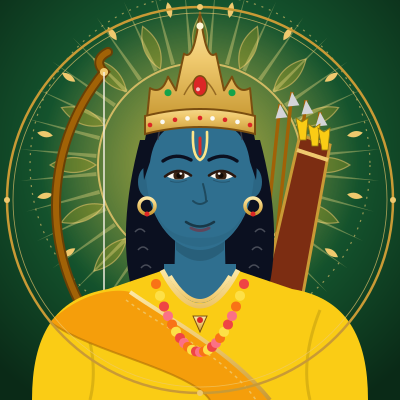
Then Rama’s eyes turned red with anger. “Gentleness is taken for weakness by the proud,” he said to Lakshmana. “Bring my bow. I will dry up this ocean with my arrows.” His arrows struck the water and the sea began to boil and shake. When Rama fitted the Brahmastra to his bow, the earth and the sky trembled, and the Ocean himself rose out of the waves with folded hands.
“Rama,” said the Ocean, “by nature my waters cannot be made shallow or still. But here is Nala, the son of Vishvakarma, the architect of the gods. Let him build a bridge across me, and I will hold it up.” Rama’s arrow could not be taken back, so, at the Ocean’s request, he sent it to the north, to a place called Drumakulya, which became a desert, and Rama blessed that land so that herbs and fruits would grow there.
Nala began at once. The vanaras uprooted trees and carried huge rocks, and threw them into the sea, while Nala set them in place with skill. On the first day they built fourteen yojanas, then twenty, then twenty-one, then twenty-two, and on the fifth day twenty-three, until the bridge, a hundred yojanas long and ten wide, reached Lanka. The gods watched in wonder, and the army crossed the sea.
On the Shore of Lanka
The army camped on the shore of Lanka. Ravana sent two spies, Shuka and Sarana, disguised as vanaras, to count the soldiers. Vibhishana recognised them and brought them to Rama. Rama only smiled. “If you have seen everything, go back,” he told them. “If not, Vibhishana will show you more. Then tell Ravana to be ready.” The spies returned and praised Rama’s strength and kindness before Ravana.
In Lanka, Malyavan, a wise old elder of the family of Ravana’s mother, also advised him to make peace and return Sita. But Ravana would not listen to anyone. He set his warriors to guard the gates and the walls. Inside the Ashoka grove, a kind rakshasi named Sarama, who was a friend to Sita, comforted her and brought her news that Rama had arrived.
Rama climbed Mount Suvela with his companions to look at Lanka. The city stood on the top of Trikuta, shining like a city of the gods. On a high gateway they saw Ravana himself, with his royal umbrella. Seeing him, Sugriva could not hold back. He leapt across, knocked off Ravana’s crown, and the two wrestled fiercely on the tower, until Sugriva sprang free and returned.
Rama embraced him but scolded him lovingly: “A king must not take such risks without consulting his friends. If something had happened to you, what would we have done?” Sugriva humbly accepted the advice. Then the army was arranged around the city: Nila at the eastern gate, Angada at the southern gate, Hanuman at the western gate, and Rama and Lakshmana at the northern gate, where Ravana himself stood guard.
Angada’s Mission
Even now, before the battle, Rama wished to give Ravana one more chance, as the rules of righteous kings require. With Vibhishana’s agreement he called Angada, the son of Vali. “Go to Ravana,” he said. “Tell him: give back Sita and ask for forgiveness, or come out and fight. If you do not, I will destroy you and give Lanka to Vibhishana.”
Angada leapt over the walls and landed in Ravana’s hall, shining like a flame. He gave Rama’s message word for word, loudly and clearly, before all the ministers: “Rama says: you have done wrong to the sages and to the gods, and you have carried away Sita by trickery. Come out and face me, or return her. Otherwise the kingdom of Lanka will belong to Vibhishana.”
Ravana shook with fury. “Seize him and kill him!” he ordered. Four strong rakshasas grabbed Angada by the arms. Angada let them hold him, then sprang up into the air with all four hanging from his arms, shook them off so that they fell to the ground before Ravana, and leapt onto the top of the palace. With one stamp of his foot, he broke its high pinnacle.
Then, roaring his own name, Angada flew back to Rama and told him everything. Rama understood that Ravana would never choose peace. He gave the order, and the vanaras rushed towards the walls of Lanka with trees and rocks, shouting, “Victory to Rama! Victory to Lakshmana! Victory to Sugriva!” The great war of Lanka had begun, and its story we will see in the next chapter.
The War for Lanka
The great battle begins at the gates of Lanka. Rama and Lakshmana survive the serpent arrows and Ravana’s spear, Kumbhakarna is woken and falls, Hanuman carries a mountain of healing herbs, and Lakshmana defeats the mighty Indrajit.
The Army at the Gates
Angada had come back from Ravana’s court with only proud words, and now nothing stood between the two armies except the golden walls of Lanka. Rama’s army of vanaras and bears covered the land around the city like a second ocean. Rama climbed Mount Suvela with his friends and looked down on Lanka, shining on the top of Mount Trikuta, with its towers, gardens and gateways.
Rama divided his army with care. Lanka had four great gates, and he set a strong leader against each one. Nila went to the eastern gate, Angada to the southern gate and Hanuman to the western gate. Rama and Lakshmana took the northern gate, where Ravana himself stood guard. Sugriva, Jambavan and Vibhishana stayed in the middle to help wherever help was needed.
Even then Rama did not forget dharma. Before the fighting, he had sent Angada to give Ravana one last chance to return Sita and save his people. Ravana refused, and the war could no longer be avoided. The vanaras rushed at the walls with trees and rocks in their hands, shouting “Victory to Rama, victory to Lakshmana, victory to King Sugriva!”
The rakshasas came out to meet them with swords, spears, maces and bows. Elephants trumpeted, chariots thundered and the earth grew dark with dust. The fighting went on until night fell, and even in the darkness it did not stop. The vanaras fought with great courage, for they knew that Sita was waiting somewhere inside that city.
The Serpent Arrows and Garuda
Ravana’s eldest son Indrajit, also called Meghanada, was the most dangerous warrior in Lanka. By the power of his worship he could make himself invisible. Hiding in the sky, he shot arrows that turned into serpents and bound Rama and Lakshmana from head to foot. The two brothers fell to the ground, covered in arrows, and the whole vanara army wept around them.
Ravana thought the war was already won. He sent Sita in the Pushpaka chariot to see the princes lying on the battlefield. Sita cried bitterly, but the kind rakshasi Trijata, who sat beside her, comforted her. “Look, their faces still shine,” she said. “Those who have died do not look like this. Your husband and his brother are alive.”
Vibhishana and Sugriva guarded the fallen brothers through that frightening time. Then a mighty wind began to blow, and Garuda, king of the birds and enemy of serpents, came flying from the sky. The moment the snakes felt him near, they slipped away. Garuda gently touched the faces of Rama and Lakshmana, and their wounds healed. They stood up stronger and brighter than before.
Garuda told Rama that he was his friend and had come to help him, and he promised that Rama would win. Then he flew away. The vanaras roared with joy, and the sound reached Ravana inside his palace. When he heard that the princes were free, his face fell. For the first time, a shadow of worry crossed the heart of the king of Lanka.
Ravana Enters the Battle
One after another, Ravana sent out his great commanders. Hanuman defeated Dhumraksha and then Akampana, Angada defeated Vajradamshtra, and Nila defeated Prahasta, the chief of Ravana’s army. When Ravana heard that Prahasta had fallen, he was filled with grief and anger, and he decided to go out and fight himself.
Ravana was a terrible warrior. He struck down many vanaras and fought Hanuman, Nila and Sugriva. Then Lakshmana stood before him. Ravana threw at him a spear that Brahma had given him, and it struck Lakshmana in the chest. Lakshmana fell, and Ravana rushed to lift him up and carry him away, but he could not move him at all.
Hanuman ran forward and struck Ravana so hard with his fist that the rakshasa king fell senseless in his chariot. Then Hanuman lifted Lakshmana in his arms. Ravana could not move him, but for Hanuman, full of love and devotion, he was light. Hanuman carried him to Rama, and soon Lakshmana recovered, for he remembered his own divine nature.
Rama now climbed onto Hanuman’s shoulders and fought Ravana face to face. His arrows broke Ravana’s chariot, killed his horses and knocked the crown from his head. Ravana stood before him tired and without a weapon. Rama could have killed him, but he said: “You have fought hard today and you are weary. Go back to Lanka and rest. Come again tomorrow, and you will see my strength.”
Kumbhakarna Wakes
Ashamed and worried, Ravana remembered his giant brother Kumbhakarna. Because of Brahma’s word, Kumbhakarna slept for six months at a time and woke for only one day. The rakshasas beat drums, blew conches and shouted into his ears. They brought him mountains of food. At last the huge warrior opened his eyes and went to see his brother.
Kumbhakarna listened to Ravana and then spoke honestly. “You did not listen to the advice of good people and wise ministers,” he said. “What you did was wrong, and now trouble has come.” Yet he loved his brother. “Still, I will fight for you and remove your worry,” he said, and he marched out to the battlefield with a great spear.
When the vanaras saw him, tall as a mountain, many ran away in fear. Vibhishana told Rama who this giant was. Kumbhakarna crushed many warriors, wounded Hanuman with his spear and even caught Sugriva and carried him off towards Lanka. But Sugriva came to his senses, broke free and leapt back to his own side.
Then Rama faced Kumbhakarna himself. With his arrows he took away the giant’s strength little by little, and at last, using a weapon of Indra, Rama brought his life to an end. Kumbhakarna’s great body fell into the ocean. In Lanka, Ravana wept for his brother. After that, his sons Trishira, Devantaka, Narantaka and Atikaya also went to battle and were killed; Lakshmana defeated Atikaya with the Brahmastra.
Hanuman Brings the Mountain of Herbs
Now Indrajit went out again, invisible in the sky. With the Brahmastra he struck down Rama, Lakshmana and sixty-seven crore vanaras. Rama and Lakshmana lay still, out of respect for Brahma’s weapon. The battlefield became silent as evening fell, and Indrajit went back to Lanka to tell his father, sure that he had won the war.
That night Vibhishana and Hanuman walked across the field with torches, searching for anyone still alive. They found the old bear king Jambavan, badly hurt, who could not even open his eyes. His first question was: “Is Hanuman alive?” Vibhishana was surprised that he did not ask about Rama first. Jambavan explained: “If Hanuman lives, the whole army lives, even if it seems dead.”
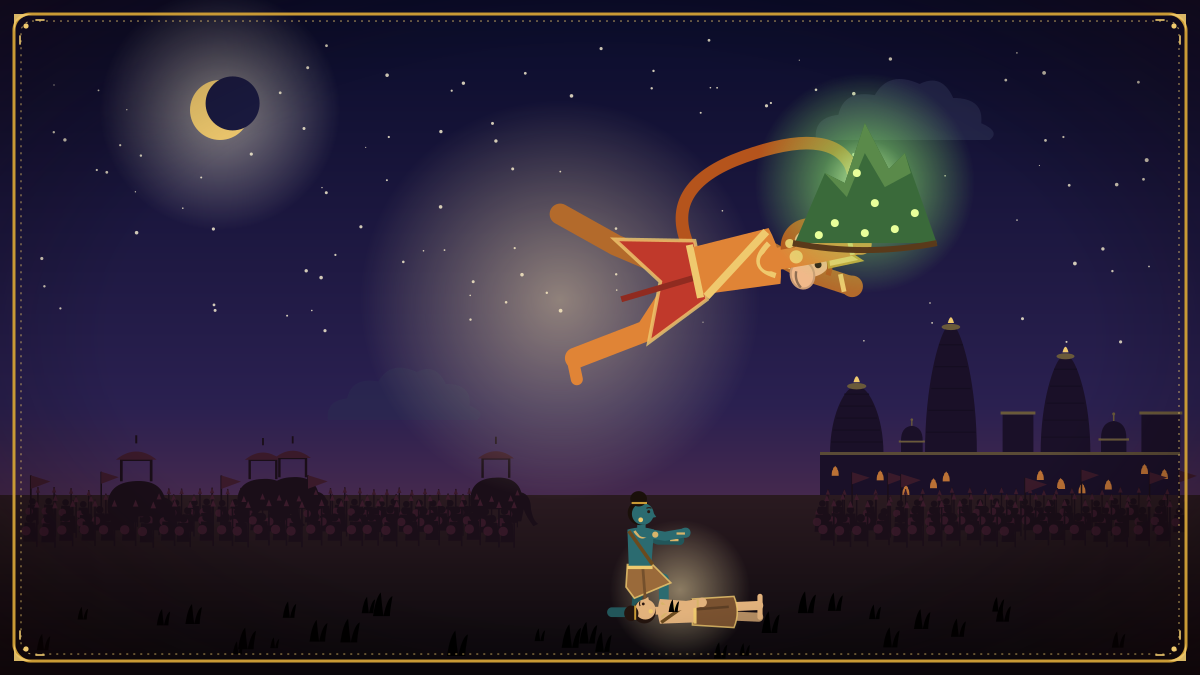
Jambavan told Hanuman to fly to the Himalayas. Between the Rishabha and Kailasa peaks stood a mountain covered with four shining healing herbs: one that brings back life, one that removes arrows, one that restores the body’s colour, and one that joins broken bones. Hanuman leapt into the sky and flew north at great speed.
When he reached the mountain, the herbs hid themselves. Hanuman did not waste time searching. He tore off the whole peak and carried it back to Lanka in his hands. As soon as the breeze carried the fragrance of the herbs over the battlefield, Rama, Lakshmana and all the fallen vanaras rose up healthy again. Then Hanuman took the mountain back to its place.
Indrajit’s Last Battle
Indrajit tried another trick. In front of Hanuman, he created an illusion of Sita and pretended to strike her down. Hanuman and the vanaras were heartbroken, and when Rama heard the news, he fainted with grief. But Vibhishana said: “This is only Indrajit’s magic. Ravana will never harm Sita. Indrajit wants to confuse us while he goes to Nikumbhila to perform a fire ritual.”
Vibhishana explained the danger. If Indrajit finished that ritual, no one could defeat him. But Brahma had also said that whoever attacked him before the ritual was complete would bring about his death. Rama sent Lakshmana with Vibhishana, Hanuman and a strong army. They reached the sacred grove and stopped the ritual before it could be finished.
Indrajit came out in fury. He spoke harshly to Vibhishana, calling him a traitor to his own family. Vibhishana replied that he had left Ravana because of Ravana’s wrong deeds, not because he did not love his family. Then Lakshmana and Indrajit fought a long and fierce battle, shooting thousands of arrows, cutting each other’s weapons and armour.
At last Lakshmana placed Indra’s weapon on his bow and said: “If Rama, son of Dasharatha, is devoted to dharma, true to his word and unmatched in courage, then let this arrow slay the son of Ravana.” The arrow flew, and Indrajit fell. The gods rejoiced. Sushena healed Lakshmana’s wounds with herbs, and Rama embraced his brother. In Lanka, Ravana now had to face the war himself.
The Fall of Ravana
Ravana comes out for his last battle. Lakshmana is struck down again and saved by Hanuman’s herbs, Sage Agastya teaches Rama the Aditya Hridayam, Ravana falls to the Brahmastra, and Vibhishana is crowned king of Lanka.
Ravana’s Grief and Anger
With Indrajit gone, Ravana had lost his brother, his sons and most of his commanders. When the news reached him, he fainted with sorrow. When he woke, his grief turned into rage. He picked up his sword and rushed towards the Ashoka grove, saying that he would kill Sita, the cause of all his loss.
Sita saw him coming and trembled, thinking her end had come. But a wise minister named Suparshva stopped Ravana. “You are a learned king who has studied the Vedas,” he said. “How can you think of killing a woman? Turn your anger towards Rama. Go and fight him tomorrow, and win Sita by victory.” Ravana listened and went back to his palace.
In the city, the women of Lanka were weeping for their husbands, sons and brothers. They said to one another that all this sorrow had come because Ravana had carried away Sita and would not listen to Vibhishana. Ravana heard their cries, but his pride would not let him give up. He called the remaining warriors and prepared his own chariot.
Ravana went out with his last army. His commanders Virupaksha, Mahodara and Mahaparshva fought bravely, but Sugriva and Angada defeated them. Then Ravana himself attacked the vanaras, and many of them fell before his arrows. At last Rama stepped forward, and the two great warriors stood face to face.
Lakshmana Falls Again
During the battle, Ravana saw his brother Vibhishana and was filled with fury. He hurled a heavy spear at him. Lakshmana quickly stepped in front of Vibhishana and broke its force with his arrows. Then Ravana took up a terrible spear made by the demon architect Maya, and threw it at Lakshmana with all his strength.
The spear struck Lakshmana in the chest, and he fell to the ground. Rama pulled the spear out and asked the vanaras to guard his brother while he fought Ravana. Then, overcome with sorrow, he sat by Lakshmana and wept. “I can find another wife and other friends,” he cried, “but where in the world will I find a brother like Lakshmana?”
The vanara physician Sushena checked Lakshmana carefully. “He is not dead,” he said. “His face is still bright and his hands are still soft.” He asked Hanuman to go once more to the Mahodaya mountain and bring the healing herbs. Once again Hanuman flew there, and once again, not knowing which herb was which, he brought back the whole peak.
Sushena crushed a herb and held it near Lakshmana’s nose. As soon as Lakshmana breathed it in, the spear’s wound disappeared and he stood up. Rama hugged him with tears in his eyes. Lakshmana said lovingly: “Brother, do not waste your strength in sorrow. Keep your promise, and finish Ravana before the sun sets today.”
Indra’s Chariot and the Aditya Hridayam
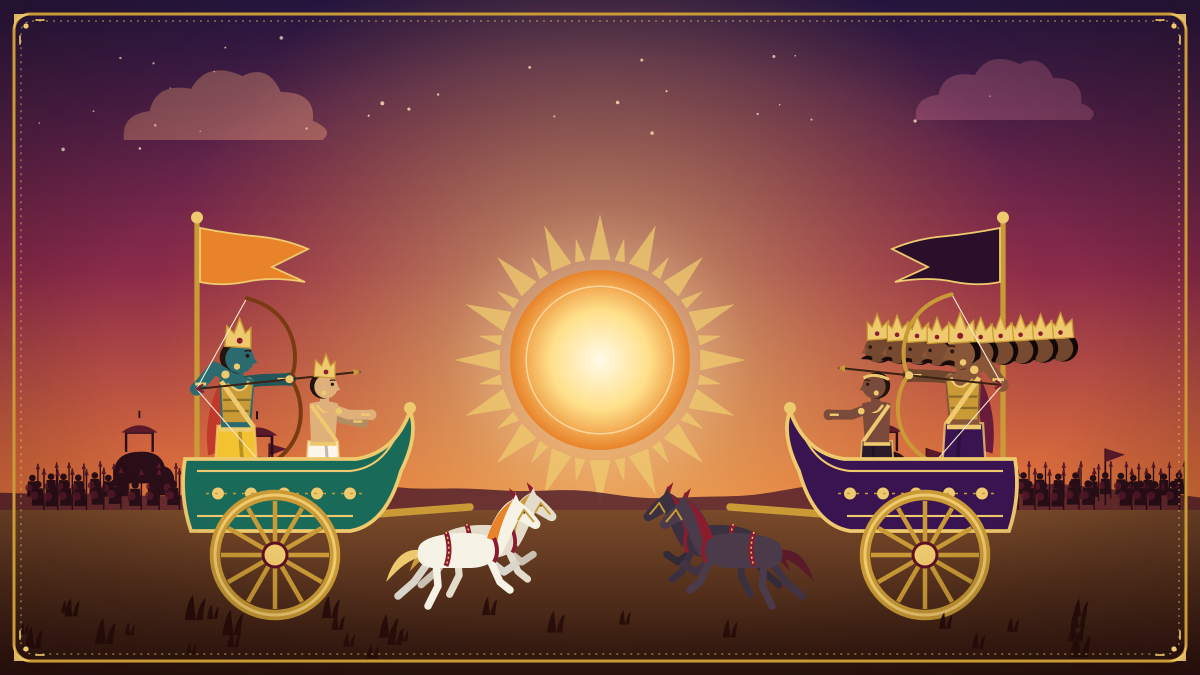
Ravana fought from a powerful chariot, while Rama stood on the ground. The gods saw this and felt it was not a fair fight. Indra, king of the gods, sent his own chariot down from heaven, with its driver Matali, its horses, its flag and its armour. Matali bowed to Rama and invited him to climb in.
Rama honoured the chariot and climbed in, and a long and fierce battle began. Arrows filled the sky and hid the sun. At one point Rama grew tired and thoughtful, and Ravana seemed to be gaining strength. The gods, the sages and the celestial beings watched from the sky with great worry, wondering how the battle would end.
Then the great sage Agastya, who had come with the gods to watch the battle, came near Rama. He said: “Rama, listen to this ancient secret hymn, the Aditya Hridayam, the praise of the Sun God. It destroys all enemies, brings victory and removes all sorrow and worry.” He taught Rama the hymn and then went back to his place.
Rama looked at the Sun, sipped water three times to purify himself and recited the hymn three times with a happy heart. His tiredness disappeared and fresh strength filled him. The text says that the Sun God himself looked down at him with joy and said, “Hurry, Rama.” Rama then took up his bow again and turned towards Ravana with new energy.
The Last Arrow
Ravana’s charioteer had once driven his chariot away from the battle when Ravana was dazed, and Ravana had angrily scolded him for it. Now Ravana came back and the final fight began. People who watched said that the sky can only be compared to the sky and the ocean to the ocean, and in the same way, the battle of Rama and Ravana could only be compared to itself.
Rama cut off one of Ravana’s heads with a sharp arrow, but at once another head rose in its place. Again and again Rama cut, and again and again a new head appeared. More than a hundred times this happened, and Rama began to wonder how such an enemy could be defeated.
Then Matali reminded him: “Rama, why are you fighting as if you do not know? Use the Brahmastra; the time of Ravana’s end has come.” Rama took out the arrow that Agastya had given him. Brahma had made it for Indra. Wind lived in its feathers, the Sun and Fire in its tip, and it was as heavy as the great mountains Meru and Mandara.
Rama chanted the sacred words and drew the bow to his ear. The arrow flew like lightning and pierced Ravana’s chest. Ravana’s bow slipped from his hands, and the king of Lanka fell from his chariot to the earth. The arrow returned to Rama’s quiver. Flowers rained from the sky, the gods sang, and the sun shone clearly again.
Vibhishana’s Tears and Mandodari’s Lament
Vibhishana saw his elder brother lying on the battlefield and broke down in tears. He remembered Ravana’s strength, his learning and his generosity, and he grieved that his brother had not listened to good advice. He even hesitated to perform the last rites for someone who had done so much wrong.
Rama spoke with great kindness. “Enmity ends with death,” he said. “Our purpose is fulfilled. Ravana was a brave warrior who never ran away from battle. Perform his last rites with full honour, for he is now as much mine as he is yours.” Vibhishana was comforted by these noble words.
The queens of Lanka came out weeping, and among them was Mandodari, Ravana’s chief queen. She sat beside her husband and spoke of his greatness and his mistakes. She said that she had always known Rama was no ordinary man, and that Ravana had been destroyed by his own desire for Sita, a woman devoted completely to her husband.
Then Vibhishana, as his brother, performed Ravana’s funeral with fire and sacred verses, as the scriptures teach. The queens returned to the city. Matali took Indra’s chariot back to heaven, and Rama took off his armour. The great war was over, and the vanaras rested at last.
Vibhishana Crowned and Good News for Sita
Rama had promised to make Vibhishana king of Lanka, and he kept his word. Because he was still living the life of a forest exile, Rama himself did not enter the city. He asked Lakshmana to go into Lanka, and there, with water from the ocean brought by the vanaras, Lakshmana anointed Vibhishana as the new king.
Then Rama turned to Hanuman. “Go to Sita with King Vibhishana’s permission,” he said. “Tell her that Ravana has fallen and that Lakshmana and I are well. Bring back her message.” Hanuman bowed and went to the Ashoka grove, where Sita sat, thin and pale, surrounded by the rakshasis.
Hanuman told her the whole story of the victory. Sita was so happy that for a moment she could not speak. Then she said: “I have nothing in all the three worlds that could repay you for this news.” Hanuman wanted to punish the rakshasis who had frightened and troubled her for so long, but Sita stopped him.
“They only obeyed their master’s orders,” she said. “Who in this world has never made a mistake? A noble person shows kindness even to those who do wrong.” Hanuman bowed before such goodness. Sita asked him only one thing: “I want to see my husband.” Hanuman hurried back to Rama with her words, and now the meeting everyone had waited for was near.
Return to Ayodhya and the Coronation
Sita’s Test of Fire
Hanuman had brought Sita’s wish to see her husband, and Rama asked Vibhishana to bring her. Sita came bathed and dressed in fine clothes. Vibhishana’s guards began to push the crowd aside, but Rama stopped them. He told Sita to come on foot so that the vanaras could see her. She came before him and looked at his face with love.
But Rama, thinking of his family’s honour and what people would say, spoke hard words to her. He said that he had fought this war to remove the insult to his family, and that since she had lived so long in another’s house, she was free to go wherever she wished. Sita wept, deeply hurt, as if she had been struck.
Then she wiped her tears and answered with dignity. “My heart, which is in my control, has always been yours,” she said. “What happened to my body when I was helpless was not my doing.” She turned to Lakshmana: “Make a fire for me. That is the only remedy now.” Lakshmana looked at Rama, and when Rama gave no sign against it, he built the fire.
Sita walked around Rama with folded hands and stood before the flames. “If my heart has never moved away from Rama,” she prayed, “then may Agni, the witness of the whole world, protect me on every side.” Then she entered the fire. Everyone watching, vanaras and rakshasas alike, cried out in grief.
The Gods Bear Witness
At that moment the gods appeared in the sky: Kubera, Yama, Indra, Varuna, Shiva and Brahma himself. Brahma said to Rama: “You are Lord Narayana himself, the eternal Lord, and Sita is Lakshmi.” Then Agni, the god of fire, rose out of the flames holding Sita in his arms. She was dressed in red, wearing her ornaments, and even her garlands had not wilted.
Agni gave her back to Rama and said: “Here is your Sita. She is without any fault. In word, thought and look she has never turned away from you.” Rama’s eyes filled with tears. “I always knew she was pure,” he said. “But if I had taken her back without this test, people would say that Rama acted out of desire. Sita is as much a part of me as light is part of the sun.”
Then Shiva showed Rama another wonder: his father, King Dasharatha, shining in a heavenly chariot. Rama and Lakshmana bowed to him, and Dasharatha embraced them lovingly. Rama asked his father to take back the angry words he had once spoken against Kaikeyi and Bharata, and Dasharatha agreed. He blessed Sita too and returned to heaven.
Indra then offered Rama a boon. Rama asked that all the vanaras and bears who had died for him should live again and find fruit and fresh water wherever they went, even out of season. Indra granted it, and the fallen warriors rose as if waking from sleep.
Home in the Pushpaka
Vibhishana offered Rama the Pushpaka, the flying chariot that Ravana had once taken from Kubera. Rama was eager to reach Ayodhya, for the fourteen years of exile were complete and Bharata would be waiting. He climbed in with Sita and Lakshmana, and at their request, Sugriva, Vibhishana and the vanara leaders came along too.
As they flew, Rama showed Sita the places of their story: the battlefield of Lanka, the bridge Nala had built across the ocean, Kishkindha, Lake Pampa, Panchavati and Chitrakuta. At Sita’s wish they stopped at Kishkindha so that Tara and the other vanara women could come with them to see Ayodhya.
Rama landed at Sage Bharadvaja’s ashram near Prayag. From there he sent Hanuman ahead to tell Guha, and then Bharata, that he was coming home. Hanuman found Bharata at Nandigram, living like a hermit in bark clothes, ruling the kingdom in Rama’s name with Rama’s sandals on the throne.
Bharata was so overjoyed that he fainted. Then he arranged a great welcome. With Shatrughna, the three queen mothers, the ministers and the people, he went out to meet Rama. He carried Rama’s sandals himself and placed them on his brother’s feet, saying: “The kingdom you left with me as a trust, I now return to you.” Everyone wept with happiness.
The Coronation and Ramarajya
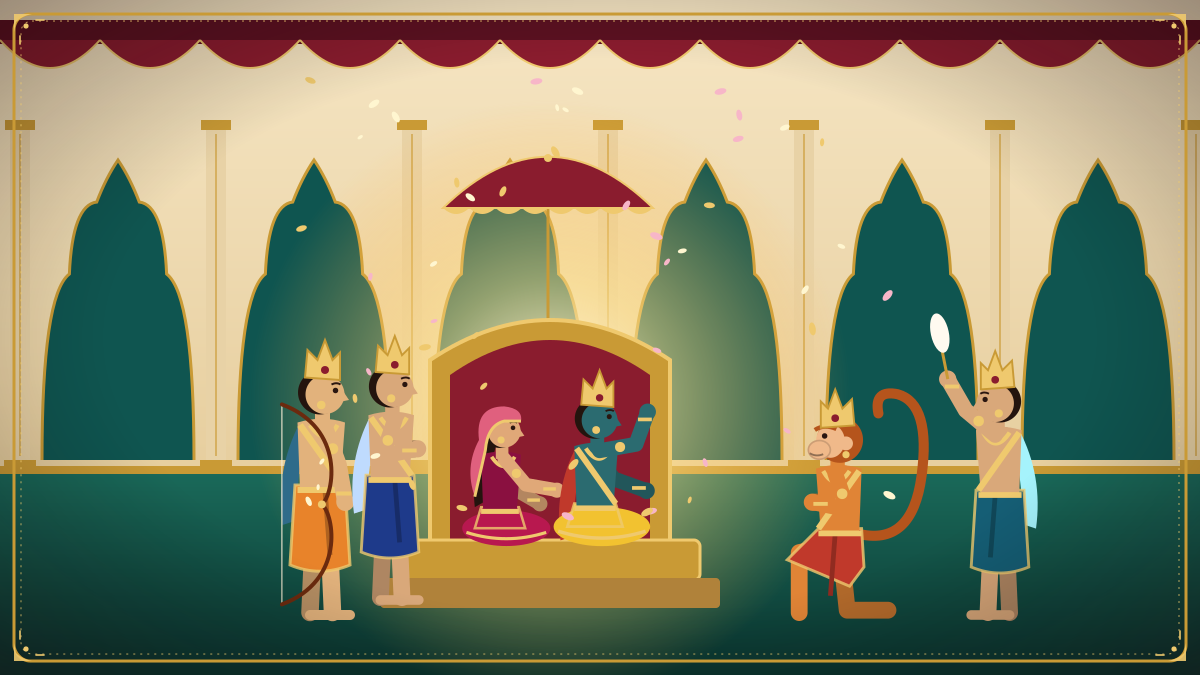
Ayodhya was decorated like a bride. Sage Vashishtha and the other sages consecrated Rama as king with water from the sacred rivers and the four oceans. Shatrughna held the royal white umbrella over him, and Sugriva and Vibhishana waved the fans. The gods sent a golden garland of lotuses through Vayu, the wind god.
Rama gave gifts to everyone who had helped him. He gave Sita a beautiful pearl necklace. Sita held it and looked at the vanaras, and then at her husband. Rama understood and said: “Give it to the one who pleases you most.” Sita placed the necklace around Hanuman’s neck, and he shone like a mountain lit by the moon.
Rama wished to make Lakshmana the crown prince, but Lakshmana lovingly refused, so Bharata was made crown prince instead. Sugriva, Vibhishana and the vanaras returned to their homes with gifts and blessings. When Hanuman’s turn came, he asked for nothing but this: that his love for Rama should never grow less.
Valmiki describes Rama’s rule, Ramarajya, as a golden age. No widow wept, no child died before its parents, there was no fear of disease, wild animals or thieves. The rain came on time, trees bore fruit and every person followed dharma. The text says Rama ruled for eleven thousand years, and the people felt that the whole world was Rama.
Key moments
- Rama’s army marches to the southern ocean
- Vibhishana advises Ravana to return Sita
- Rama’s vow: refuge to all who surrender
- Vibhishana crowned king of Lanka on the shore
- The Ocean rises and names Nala to build the bridge
- The bridge is finished in five days
- Sugriva wrestles Ravana on the gate tower
- Angada gives Rama’s final message
- Rama surrounds all four gates of Lanka
- Indrajit’s serpent arrows bind the two princes
- Garuda arrives and the serpents flee
- Rama spares a tired Ravana: “Go and rest, come back tomorrow”
- Kumbhakarna warns Ravana but fights for him
- Jambavan asks first: “Is Hanuman alive?”
- Hanuman carries the herb mountain from the Himalayas
- Lakshmana defeats Indrajit after the Nikumbhila ritual is stopped
- Suparshva stops Ravana from harming Sita
- Lakshmana shields Vibhishana and is struck by Maya’s spear
- Hanuman brings the herb mountain a second time
- Indra sends his chariot and charioteer Matali
- Agastya teaches Rama the Aditya Hridayam
- Ravana’s heads grow back again and again
- Ravana falls to the Brahmastra
- Lakshmana crowns Vibhishana king of Lanka
What this kanda teaches us
Rama opened his arms to Vibhishana though he came from the enemy’s house, because a sincere heart matters more than birth. He first prayed patiently to the Ocean and offered Ravana peace even at the last moment. True strength begins with patience and kindness, and uses force only when all else fails.
Rama did not strike a tired and unarmed enemy, even in the middle of a war. Kumbhakarna told his brother the truth, and Hanuman showed that a devoted heart can carry any load. Courage becomes great only when it walks together with dharma.
Rama fought Ravana to the end, but once Ravana had fallen he honoured him and asked for a proper funeral. Sita forgave the rakshasis who had troubled her for months. A truly great heart does not hate forever: enmity ends with death, and kindness is greater than revenge.
Did you know?
- Vibhishana was anointed king of Lanka by Lakshmana with sea water before the war had even begun.
- The bridge built by Nala was a hundred yojanas long and ten yojanas wide, and was finished in only five days.
- Rama prayed to the Ocean for three days and nights, lying on kusha grass, before he lifted his bow.
- Sugriva once leapt onto the gate tower of Lanka and wrestled with Ravana himself before the war began.
- When Ravana threw his spear at Lakshmana and tried to lift him, he could not move him, yet Hanuman carried Lakshmana easily.
- The healing herbs did not revive the fallen rakshasas, because Ravana had ordered their bodies to be thrown into the sea from the very first day.
- Jambavan was so badly wounded by the Brahmastra that he recognised Vibhishana only by his voice.
- Garuda, who freed Rama and Lakshmana from the serpent arrows, told them he was their friend but did not stay to explain more.