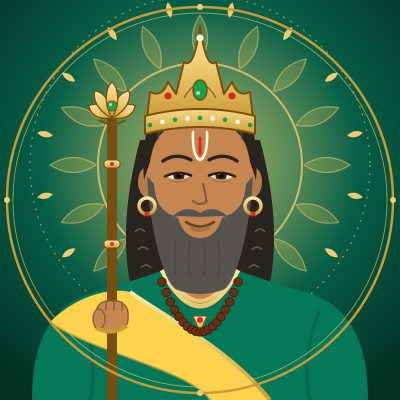
Janaka was the king of Mithila, the capital of the land of Videha, and one of the most respected kings of his time. Valmiki calls him a royal sage who knew dharma deeply. He is best known as the father of Sita, whom he found in the earth while ploughing a field for a sacrifice. In his palace he kept the great bow of Lord Shiva, and the test of that bow brought Rama to Mithila and made Rama and Sita husband and wife.
The family of Nimi
When Dasharatha arrived in Mithila for the weddings, Janaka proudly told the story of his family. It began with Nimi, a famous and righteous king. Nimi’s son was Mithi, after whom the city of Mithila is named, and Mithi’s son was the first king to be called Janaka. After him many kings of that line ruled Videha, and they too were known by the family name Janaka.
This Janaka was the elder son of King Hrasvaroma, and his younger brother was Kushadhvaja. When their father went to the forest, Janaka became king and lovingly cared for his brother. Later King Sudhanva of Sankashya attacked Mithila, demanding Shiva’s bow and Sita for himself. Janaka defeated him in battle and made Kushadhvaja the king of Sankashya.
Sita, the daughter of the earth
Once Janaka was ploughing a field to prepare the ground for a sacrifice. As the plough cut a furrow, a baby girl rose up out of the earth. Janaka took her as his own daughter. Because she came from the furrow, called sita, she was named Sita. She was not born from a mother’s womb, and so she is called ayonija, “not born from a womb”.
Janaka also had a daughter named Urmila, and he loved both girls dearly. As Sita grew, kings came from many lands to ask for her hand. But Janaka had made a firm promise: Sita would be given only to the man who could show his strength by stringing the great bow kept in his palace. That is why Valmiki calls her viryashulka, “a bride to be won by valour”.
The bow of Shiva
The bow had a long history. At the sacrifice of Daksha, Lord Shiva had raised this bow in anger against the gods, who had not given him his share. When he became calm again, he gave the bow to the gods, and they placed it in the care of Devarata, an ancestor of Janaka. Since then it had been honoured and worshipped in the royal house of Mithila.
Many kings came to try it, but none could even lift it. Angry and ashamed, they joined together and surrounded Mithila for a whole year. Janaka’s wealth and strength began to fail, so he did penance and prayed to the gods, and they gave him a great army. With it he drove the kings away.
When Vishvamitra arrived at his sacrifice with Rama and Lakshmana, Janaka came out to welcome him with his priest Shatananda and treated him with great honour. Seeing the two young princes, he asked, “Who are these two boys, who walk like lions and are as handsome as the gods? Whose sons are they, and why have they come on foot?” Vishvamitra told him who they were, how they had protected his sacrifice and how they had come to see the famous bow.
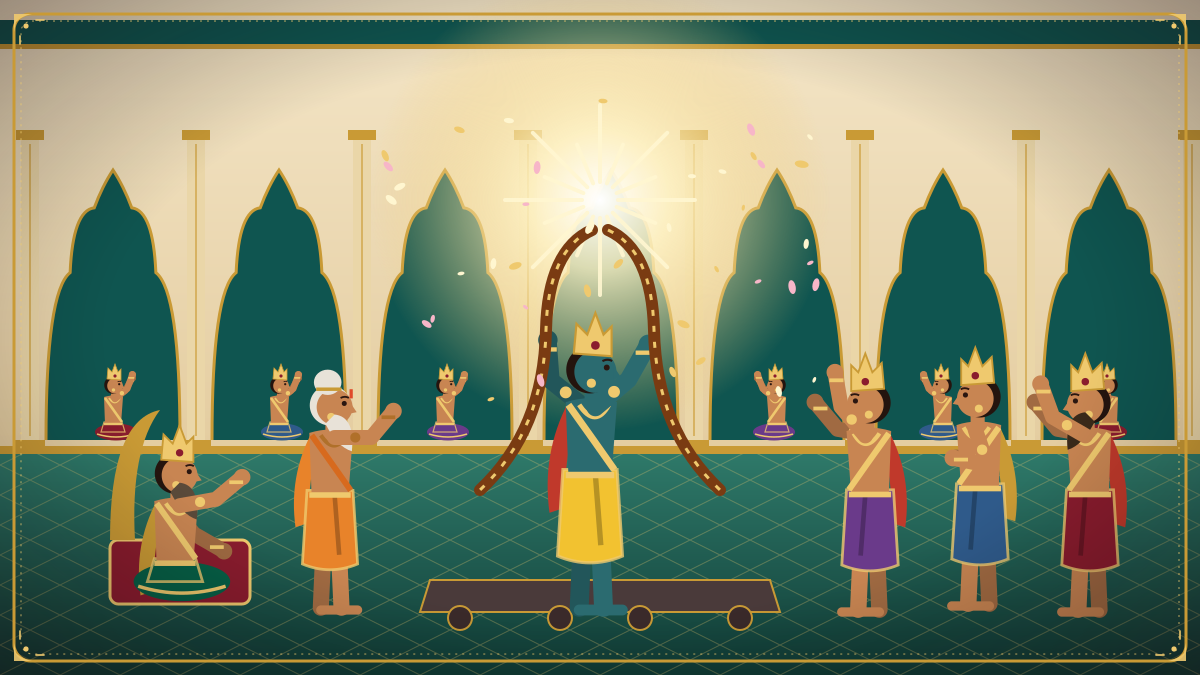
The next day, at the sage’s request, the bow was brought out in an iron chest on an eight-wheeled cart, pulled by five thousand strong men. Rama opened the chest, lifted the bow with ease and strung it. As he drew the string, the bow broke in the middle with a sound like thunder. The earth shook, and everyone fell down except Vishvamitra, Janaka and the two princes. Janaka joyfully declared, “By marrying Rama, Sita will bring glory to my family.”
Four weddings in Mithila
Janaka at once sent messengers to Ayodhya, and King Dasharatha came with his family, his priests and his army. The two kings met with great love. Vashishtha recited the family line of the Ikshvakus, and Janaka recited his own. Then Janaka offered both his daughters: Sita to Rama and Urmila to Lakshmana.
Vishvamitra and Vashishtha then suggested that the two daughters of Kushadhvaja, Mandavi and Shrutakirti, should marry Bharata and Shatrughna. Janaka gladly agreed and said that it was a great honour for his family. He fixed the weddings for the day of the Uttara Phalguni star, an auspicious day for marriage.
At the sacred fire Janaka placed Sita’s hand in Rama’s and said, “This is Sita, my daughter. She will walk with you in dharma. Take her hand in yours. She is devoted and blessed, and she will follow you always like your own shadow.” Then he gave his daughters rich gifts of cows, cloth, elephants, horses, chariots, attendants and much gold, and sent them to Ayodhya with his blessings.
Later years
Janaka does not appear again in the main story of the exile. When Dasharatha later planned Rama’s coronation in a great hurry, he did not even send for Janaka or the king of Kekaya. In the forest Sita spoke of her father with love, and when she met Anasuya, the wife of the sage Atri, she told her how Janaka had found her in the earth and how Rama had won her.
After Rama returned from Lanka and was crowned, many kings came to Ayodhya to honour him. In the Uttara Kanda, before Janaka went home, Rama honoured him with respectful words and rich gifts. Then Janaka returned to Mithila with joy, happy that his daughter was at last a queen beside Rama.
Character and qualities
Janaka was a king who loved dharma more than power. He kept his promise about the bow even when kings attacked his city, and he received sages with deep respect. He treated Sita, who came to him from the earth, as his very own child, and gave her to Rama with a full heart. Even when proud kings surrounded his city, he did not break his word or give up his daughter to force.
He was also humble. Though he was a powerful king, he listened to Vishvamitra and Vashishtha, honoured Dasharatha as an equal and gladly joined both families through four marriages. Valmiki shows him as a calm, generous and truthful father whose daughter became the heart of the whole Ramayana.
Did you know?
- The city of Mithila is named after King Mithi, the son of Nimi and an ancestor of Janaka.
- Shiva’s bow was so heavy that it came to the court on an eight-wheeled cart pulled by five thousand men.
- Janaka’s family priest, Shatananda, was the son of the sage Gautama and Ahalya.
- Kings once surrounded Mithila for a whole year because they could not string the bow, and Janaka drove them away with an army given by the gods.
What we learn from Janaka
Janaka teaches that a parent’s love does not depend on birth; a child who comes into our care is truly our own. He also shows that a ruler should keep his word firmly and treat guests, teachers and family with honour.
Janaka in the story
Read the kandas where Janaka plays a part.