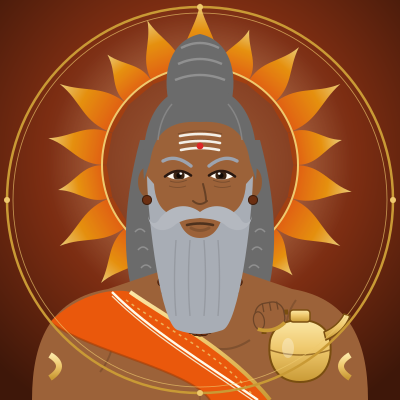
Vishvamitra is one of the most powerful sages in Valmiki’s Ramayana. He was born a king, the son of King Gadhi, and was first known as Kaushika. A meeting with the sage Vashishtha changed his life, and through thousands of years of hard penance he rose to become a brahmarishi, the highest kind of sage. He took the young Rama and his brother Lakshmana to protect his sacrifice, taught them divine weapons and led them to Mithila, where Rama won Sita.
King Kaushika, son of Gadhi
Vishvamitra came from a royal family that began with Kusha, a son of Lord Brahma. Kusha’s son was Kushanabha, and Kushanabha’s son was the righteous King Gadhi. Vishvamitra was Gadhi’s son, so he is also called Gadhi-nandana, “the son of Gadhi”, and Kaushika, “one of Kusha’s family”. His elder sister Satyavati was so devoted that after her life she became the holy river Kaushiki, and Vishvamitra lived happily on its banks for a time.
This whole story is told in the Bala Kanda by Shatananda, the family priest of King Janaka, when Vishvamitra arrives in Mithila with Rama and Lakshmana. As a king, Kaushika ruled the earth for many thousands of years. He was strong, wise and good to his people, and he travelled across the land at the head of a great army, visiting forests, rivers, mountains and holy hermitages.
The cow Shabala and the power of Vashishtha
One day King Kaushika came with his army to the ashram of the sage Vashishtha. Vashishtha welcomed him warmly and offered to feed the whole army. He called his wish-fulfilling cow, Shabala, and she produced every kind of food and drink in plenty. The king and all his soldiers were fed like guests at a royal feast.
Amazed, the king asked Vashishtha to give him Shabala, offering a hundred thousand cows, elephants, horses and gold in exchange. “A jewel like this belongs to a king,” he said. Vashishtha refused, for the cow was needed for his offerings and sacred duties. Then the king took her by force. Shabala broke free, ran back to the sage in tears, and with his permission she created armies of warriors, Pahlavas, Shakas, Yavanas and others, who drove back the king’s soldiers.
A hundred of Kaushika’s sons rushed at Vashishtha, and the sage burnt them to ashes with a single sound. The king then did penance, received divine weapons from Lord Shiva and came back to attack. But Vashishtha simply held up his holy staff, the brahma-danda, and it swallowed every weapon, even the Brahmastra. Humbled, Kaushika said, “Shame on the strength of a warrior; the spiritual power of a brahmin is the true power.” From that moment he resolved to become a brahmin sage himself.
From royal sage to brahmarishi
Kaushika went south with his queen and did fierce penance for a thousand years, and Brahma came and called him a rajarshi, a royal sage. Not satisfied, he went on. At this time King Trishanku of the Ikshvaku family wished to go to heaven in his own body. Vashishtha refused to help him, and Vashishtha’s sons cursed him. Out of pity, Vishvamitra performed a sacrifice for Trishanku. When the gods would not let him in, Vishvamitra began to create new stars and new sages in the southern sky, until the gods agreed that Trishanku could shine there among the stars.
His store of penance was used up, so he went west to Pushkara. There he saved a boy named Shunahshepa, who was to be offered in King Ambarisha’s sacrifice, by teaching him two sacred hymns; the boy sang them, and Indra blessed him with long life. After another thousand years Brahma called Vishvamitra a rishi. Then the apsara Menaka came to Pushkara, and he lived with her for ten years before he realised that his penance had been broken. He let her go gently, without a curse, and went north to the Himalaya.
There he controlled his senses so completely that Brahma named him a maharshi, a great sage. Still he did not stop. When Indra sent the apsara Rambha to tempt him, he cursed her in anger to stand as a stone for a thousand years, and then grieved that anger had spoiled his penance once again. He gave up anger and speech and held his breath for a thousand years. At last Brahma and the gods declared him a brahmarishi, and Vashishtha himself greeted him as one. The two great sages became friends.
Teacher of Rama and Lakshmana
Years later Vishvamitra was performing a sacrifice at his ashram, Siddhashrama, but two rakshasas, Maricha and Subahu, kept spoiling it by throwing impure things on the altar. Bound by the rules of his vow, he could not curse them. So he went to Ayodhya and asked King Dasharatha for his eldest son. Dasharatha was frightened. “My lotus-eyed Rama is not yet sixteen,” he said, and offered to go himself with his army instead. Vishvamitra grew angry that the king was going back on his promise, until Vashishtha gently persuaded Dasharatha that Rama would be safe with such a teacher.
Rama and Lakshmana followed the sage. On the bank of the Sarayu, Vishvamitra taught Rama two mantras called Bala and Atibala, which would keep him free from tiredness, hunger and thirst. In the forest he told Rama to kill Tataka, a fierce yakshi who had become a rakshasi through the curse of the sage Agastya and was destroying the whole region. Rama did not wish to kill a woman, but Vishvamitra explained that protecting the people is a prince’s duty, and Rama obeyed.
Pleased, Vishvamitra gave Rama a great collection of divine weapons, among them shining discs, the trident and the Brahmashira, and taught him how to call each one back. At Siddhashrama, where Lord Vishnu had once lived in penance before he came as Vamana, the brothers guarded the sacrifice for six days and nights. When the rakshasas came, Rama’s Manava weapon threw Maricha a hundred yojanas away into the sea, and the Agneya weapon killed Subahu. The sacrifice was completed in peace.
To Mithila: Ahalya and the bow
Vishvamitra then led the princes towards Mithila, where King Janaka was holding a great sacrifice and kept a wonderful bow. On the way he told them many old stories, such as the descent of the Ganga brought down by King Bhagiratha, one of Rama’s own ancestors. Near Mithila he brought Rama to the empty ashram of the sage Gautama, where Ahalya had been doing penance, unseen by all, and Rama’s arrival set her free.
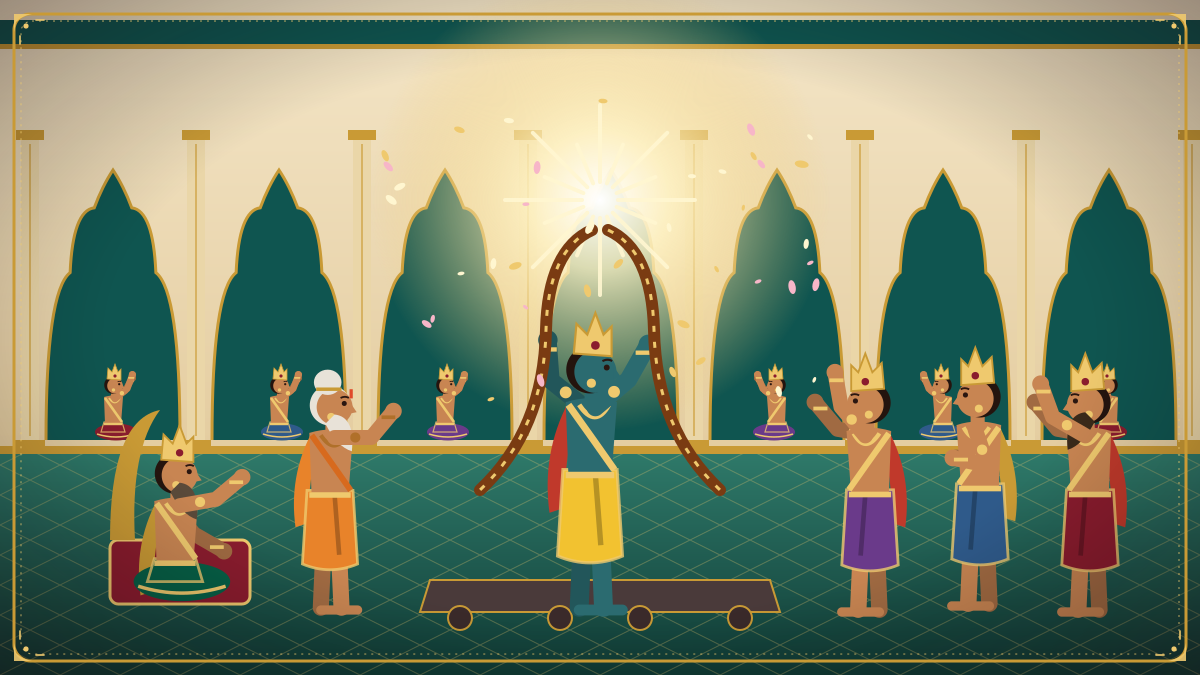
In Mithila Vishvamitra asked Janaka to show the princes Shiva’s bow. Rama lifted it, strung it and broke it, and Janaka joyfully gave him Sita. Vishvamitra, together with Vashishtha, also proposed that Bharata and Shatrughna should marry the daughters of Janaka’s brother Kushadhvaja. After the four weddings he took leave of both kings and went away to the northern mountains.
Character and qualities
Vishvamitra’s life shows the power of effort. He was born a warrior and a king, yet by penance, patience and self-control he reached the highest place a sage can reach. He fell many times, through pride, desire and anger, but each time he saw his mistake and began again. Valmiki shows him as a person who grew step by step, not one who was perfect from the start.
He was also a generous teacher. He chose Rama, trusted a young boy with a great task and gave him the best weapons he had. Through Vishvamitra, Rama first saw the forest, fought rakshasas, heard the sacred stories of his land and reached the bow that led him to Sita. In many ways the great journey of the Ramayana begins with Vishvamitra’s visit to Ayodhya.
Did you know?
- Vishvamitra’s elder sister Satyavati became the holy river Kaushiki after her life, and he lived on its banks for a time.
- The mantras Bala and Atibala, taught by Vishvamitra on the bank of the Sarayu, kept Rama free from hunger, thirst and tiredness.
- Vishvamitra’s life story is told to Rama in Mithila by Shatananda, the son of the sage Gautama and Ahalya.
- Siddhashrama, where Vishvamitra held his sacrifice, was the place where Lord Vishnu had lived in penance before coming as Vamana.
What we learn from Vishvamitra
Vishvamitra teaches that it is never too late to change. Anger and pride can undo years of good work, but honest effort, started again and again, can lift a person to the highest goal. A good teacher shares his best gifts with a worthy student.
Vishvamitra in the story
Read the kandas where Vishvamitra plays a part.