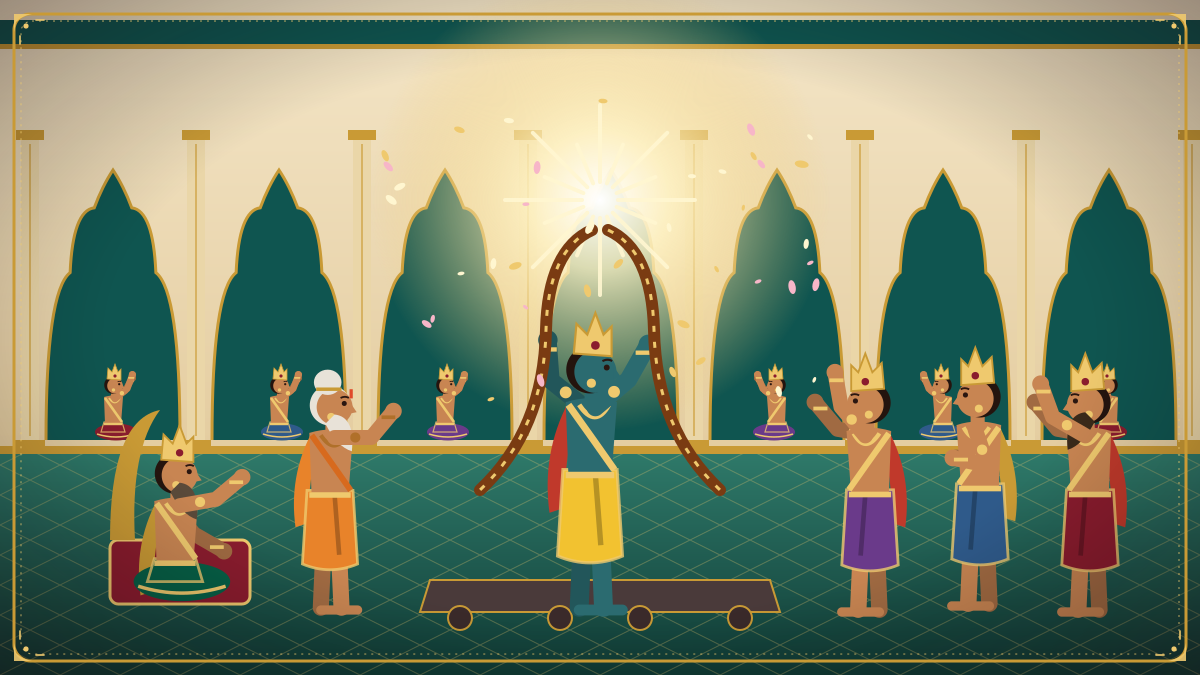
Ahalya was the wife of the great sage Gautama, and their ashram stood in a forest near Mithila. After a grave mistake involving Indra, the king of the gods, her husband cursed her to live for thousands of years in penance, unseen by any living being. When young Rama entered the ashram on his way to Mithila, she was set free and united again with Gautama. Valmiki tells her story with compassion, as a story of fault, repentance and purification.
Created by Brahma
In the Uttara Kanda the sage Agastya tells Rama how Ahalya came to be. Lord Brahma created her with great care, taking the finest part of the beauty of every creature and placing it in her. Because there was nothing in her that was ugly or faulty, which in Sanskrit is called halya, she became famous as Ahalya, “the one without any blemish”.
Indra, the king of the gods, hoped that she would become his wife. But Brahma placed her in the care of the sage Gautama. Gautama looked after her with complete purity for many years and then returned her to Brahma. Pleased with his self-control and his penance, Brahma gave Ahalya to Gautama as his wife.
Agastya told this part of the story long after the war, while describing to Rama the history of Ravana and his son Indrajit. In this way Ahalya’s story, which began long before Rama was born, is linked with the events of Lanka.
Wife of the sage Gautama
Gautama and Ahalya lived in a beautiful ashram in a forest near Mithila. The place was full of flowering trees, and the couple spent many years there in prayer and penance, honoured by gods and sages. Their son Shatananda grew up to be a learned sage and became the family priest of King Janaka of Mithila. Gautama was known everywhere for his learning and his strict penance.
Many ages later, when Vishvamitra brought Rama and Lakshmana to that place, it looked old and empty, as if no one had lived there for a very long time, yet it was still lovely and peaceful. Rama asked whose ashram it was, and Vishvamitra told the princes what had happened there long ago. Then he asked Rama to enter.
The fault and the curse
One day, while Gautama was away from the ashram, Indra came there disguised as the sage and asked Ahalya to be with him. In the Bala Kanda Valmiki says that Ahalya recognised Indra, yet in a moment of foolish curiosity she agreed. In the Uttara Kanda the story is told a little differently: there Ahalya says she was deceived by Indra, who had taken her husband’s form. Both tellings agree that a great wrong was done. Valmiki does not hide her fault, yet he never speaks of her with scorn.
As Indra was leaving, Gautama returned, shining with the power of his penance and carrying holy grass and wood for the sacred fire. Seeing Indra in his own form, he understood everything. In anger he cursed Indra, who soon suffered for his wrong. The Uttara Kanda adds that because of this curse Indra was later defeated and taken captive by Ravana’s son Indrajit.
Then Gautama said to Ahalya, “You will live here for many thousands of years, eating nothing, living only on air, lying on ashes and burning in penance, unseen by all beings. When Rama, the son of Dasharatha, comes to this forest, you will be purified. By welcoming him as your guest, free from greed and confusion, you will regain your own form and live with me again in joy.” Then Gautama left and went to the Himalaya to do penance.
Freed when Rama came
So Ahalya lived on in the empty ashram, doing penance through long ages. No god, demon or human being could see her. But when Rama stepped into the ashram, she became visible. Valmiki says that Brahma had made her with great care, like a divine vision, and he describes her shining with the power of her penance, like a flame hidden by smoke, like the full moon seen through mist, and like sunlight reflected in water.
Rama and Lakshmana respectfully touched her feet. Ahalya remembered Gautama’s words and received the two princes as honoured guests, offering them water for their feet and the welcome given to respected guests. Rama, a prince of a great royal house, did not hesitate to honour a woman whom the world had not seen for ages, and he accepted her hospitality according to the sacred rules. At once flowers rained from the sky, heavenly drums sounded, and gandharvas and apsaras celebrated. The gods praised Ahalya, made pure by her penance.
Gautama then returned to the ashram, joyful to see his wife free. He honoured Rama with great love and went on with his penance, with Ahalya at his side. Later, in Mithila, their son Shatananda eagerly asked Vishvamitra whether his mother had been seen by Rama, whether she had welcomed him, and whether she was now united with his father. Vishvamitra assured him that all had been done.
The meaning of her story
Ahalya’s story does not hide her mistake, but it does not end there either. She accepted her punishment without complaint and spent long ages in silent penance, alone and unseen. In that time her heart was made pure, so that when Rama arrived she shone with light. Even Gautama, in the very words of his curse, had shown her the way to freedom.
Her story also shows Rama’s gentleness. He did not come to judge her. He touched her feet in respect and accepted her welcome as a guest. For Valmiki, Ahalya’s freedom is one of the first signs that Rama’s presence brings purity and peace wherever he goes. Her penance and Rama’s kindness worked together to set her free.
Shatananda’s joy in Mithila shows how a family suffers when one of its members is lost, and how it rejoices when that person is restored. When he heard that his mother was again with Gautama, he welcomed Rama with deep gratitude and then told him the long story of Vishvamitra’s life.
Did you know?
- Valmiki explains her name: there was no ‘halya’, nothing ugly or faulty, in her, so she was called Ahalya.
- During her long penance no god, demon or human being could see Ahalya; she became visible only when Rama entered the ashram.
- Rama and Lakshmana touched Ahalya’s feet in respect when she appeared before them.
- Ahalya’s son Shatananda was the family priest of King Janaka and was overjoyed to hear that his mother was free.
What we learn from Ahalya
Ahalya’s story teaches that a person who sincerely repents and patiently accepts the result of a mistake can become pure again. It also teaches us to treat others with respect and kindness, never with contempt, even when they have done wrong.
Ahalya in the story
Read the kandas where Ahalya plays a part.