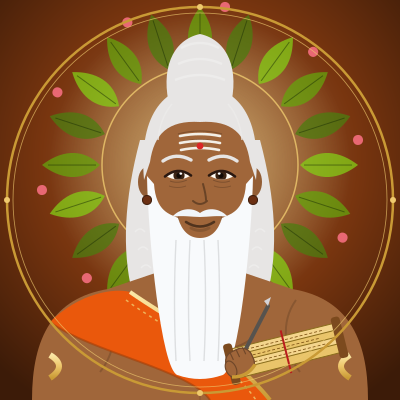
Valmiki is the sage who composed the Ramayana. He is honoured as the Adi Kavi, the first poet, and his Ramayana as the Adi Kavya, the first poem. He is not only its author but also a person in the story: Rama visited his ashram, Sita found shelter there, and her twin sons Lava and Kusha were born and grew up under his care. Through his disciples, the story of Rama reached the world.
Narada’s answer
The Ramayana begins with a question. Valmiki, a sage devoted to penance and the study of the Vedas, asked the divine sage Narada: “Who in this world today is truly virtuous and mighty, grateful, truthful and firm in his vows? Who has good conduct, is kind to all beings, is learned and capable, and whose anger even the gods fear?” He wanted to know whether one person could have every noble quality.
Narada answered that there was such a man: Rama, born in the line of Ikshvaku, self-controlled, wise and devoted to dharma. Then he told Valmiki the whole story of Rama in short, from his birth to his rule over Ayodhya. Valmiki listened with great joy and honoured Narada, who then returned to the heavens.
Narada’s short account, given in the very first canto, is like the seed of the whole poem. In about a hundred verses it names the main events of Rama’s life: his exile, the taking of Sita, the friendship with Sugriva, the bridge to Lanka, the fall of Ravana and Rama’s return. Valmiki later grew this seed into the great epic.
The krauncha birds and the first verse
Soon afterwards, Valmiki went to bathe in the river Tamasa, not far from the Ganga, with his disciple Bharadvaja. The water was so clear and calm that he compared it to the mind of a good person. Nearby, a pair of krauncha birds was singing happily together. Suddenly a hunter shot the male bird with an arrow. It fell to the ground, and the female cried out in grief.
Seeing this, Valmiki’s heart filled with compassion. Words burst from his lips: “O hunter, may you find no rest for endless years, for you have killed one of this pair of krauncha birds while they were lost in love.” Then he was amazed, for his words had come out as a perfect verse of four equal lines, fit to be sung with music.
He called this new kind of verse a shloka, because it was born from shoka, his sorrow. It is remembered as the first verse of poetry in the world, and its meter, the anushtubh, became the main meter of the whole Ramayana.
Brahma’s blessing
When Valmiki returned to his ashram, still thinking about the verse, Lord Brahma himself came to see him. Brahma told him that the verse had come to him by Brahma’s own will, and that he should now use this new kind of verse to tell the full story of Rama, just as Narada had told it to him.
Brahma also gave him a blessing: everything about Rama, Sita, Lakshmana and the rakshasas, whether known to the world or hidden, would be revealed to him, and not a single word of his poem would be untrue. “As long as the mountains stand and the rivers flow on the earth,” Brahma said, “the story of the Ramayana will be told among people.”
Valmiki sat in deep meditation and saw the whole life of Rama clearly, as clearly as a fruit held in the palm of the hand. Then he composed the Ramayana: about twenty-four thousand verses in five hundred cantos, divided into six kandas and the Uttara Kanda, the final book.
Rama, Sita and the ashram
Valmiki also meets Rama inside the story. When Rama, Sita and Lakshmana went to Chitrakuta at the start of their exile, they visited Valmiki’s ashram and bowed to the sage, who welcomed them warmly. Then they built their hut on the beautiful hill nearby.
Years later, when Rama sent Sita away from Ayodhya, Lakshmana left her near Valmiki’s ashram by the Ganga. The young sons of the sages saw her weeping and ran to tell Valmiki. Through the power of his penance he already knew who she was and why she had come. He went to her, comforted her, and told her that he knew she was the daughter-in-law of King Dasharatha and Rama’s beloved queen, and that she was without blame.
He brought her to the women ascetics of the ashram and asked them to care for her with love, as their own. There Sita gave birth to her twin sons. Valmiki protected the newborn babies with sacred kusha grass and mantras, and from that grass they were named Kusha and Lava.
The song at the Ashvamedha
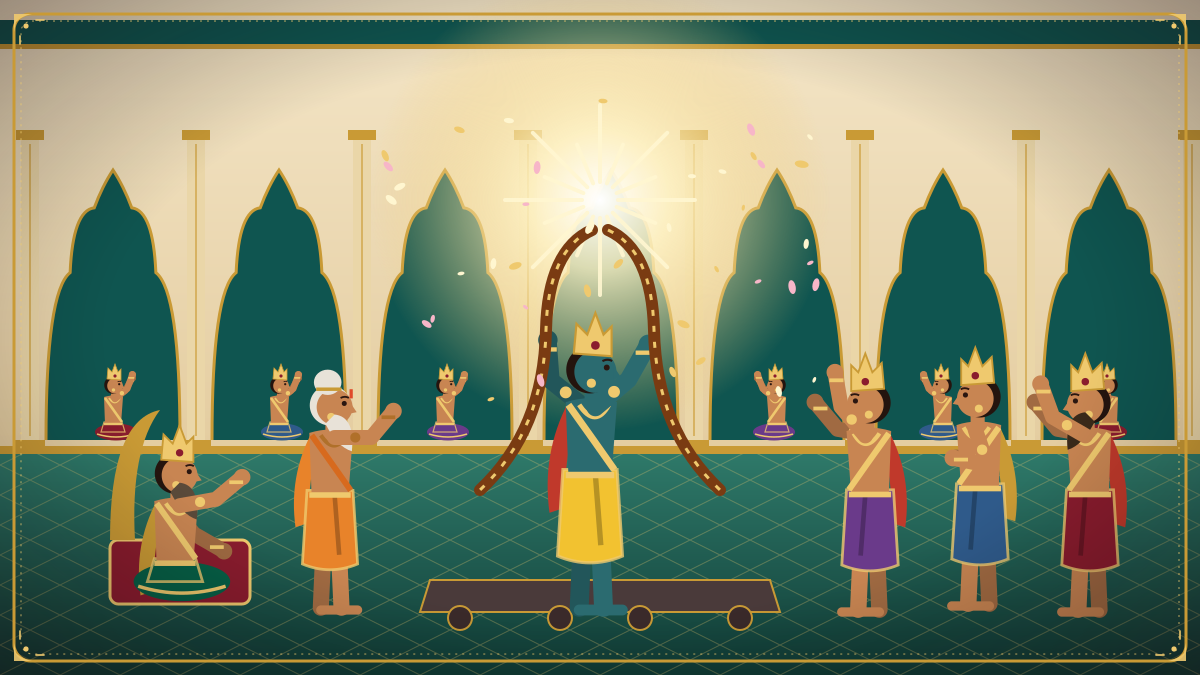
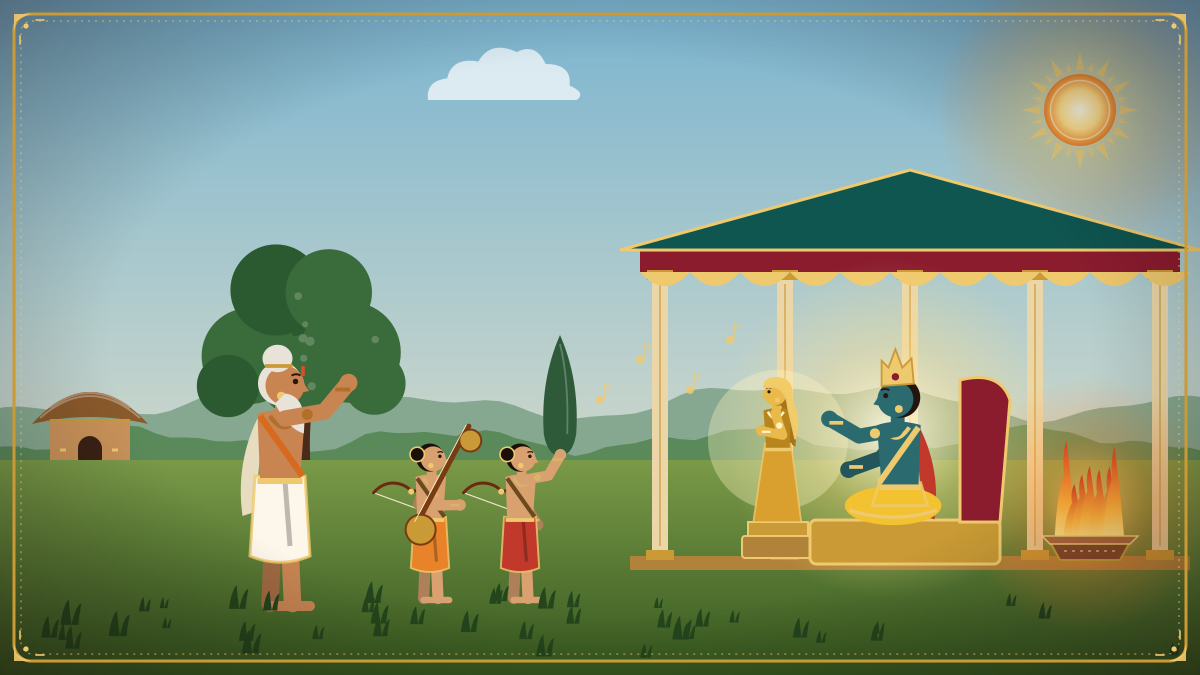
Valmiki taught his whole poem to Lava and Kusha, who sang it with sweet voices. When Rama held an Ashvamedha sacrifice in the Naimisha forest, Valmiki brought the boys and told them to sing the Ramayana everywhere, even before the king. Rama listened, deeply moved, and slowly understood that the young singers were his own sons.
Rama asked Valmiki to bring Sita so that she could declare her purity before everyone. Valmiki led Sita into the gathering and spoke firmly: “I am the tenth son of Pracheta. I do not remember ever telling a lie. These twins are your sons. If Sita has any fault, may I lose the fruit of all my penance.” Then Sita called on the Earth, and the Earth took her back into herself.
Valmiki’s ashram thus joins the two halves of the story of Rama’s family. The poet who wrote about Sita’s sorrows also sheltered her in them, and the boys who sang her story were her own sons. In this way Valmiki is both the teller of the Ramayana and one of its kindest characters.
Character and legacy
Valmiki is a picture of the ideal sage: calm, compassionate and fearless in speaking the truth. His poetry was born not from pride but from pity for a small grieving bird, and that tenderness runs through the whole Ramayana. He protected Sita when she had no one, and he stood up for her before the king and the whole assembly.
Valmiki’s gift to India is beyond measure. Every later telling of Rama’s story, in every language, looks back to his poem. As Brahma promised, wherever mountains stand and rivers flow, the story he composed is still being sung.
Did you know?
- Valmiki linked the word shloka, a verse, with shoka, grief, because the first verse was born from his sorrow.
- The Bala Kanda says the Ramayana has twenty-four thousand verses in five hundred cantos.
- In the Uttara Kanda, Valmiki introduces himself to Rama as the tenth son of Pracheta.
- Rama, Sita and Lakshmana visited Valmiki’s ashram near Chitrakuta at the very start of their exile.
What we learn from Valmiki
Valmiki teaches that compassion is the root of great creation: the first verse of poetry came from his pity for a grieving bird. He also shows that a true teacher protects the helpless and speaks the truth without fear, even before a king.
Valmiki in the story
Read the kandas where Valmiki plays a part.