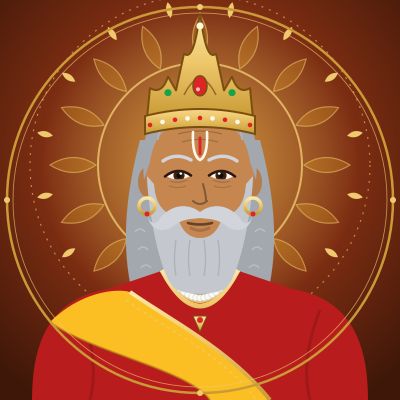
Dasharatha was the king of Ayodhya, a ruler of the great Ikshvaku dynasty and the father of Shri Rama. He was brave, generous and devoted to truth, and his kingdom was rich and peaceful. Yet his life was marked by two great sorrows: for many years he had no son, and when at last he did, he had to send his beloved eldest son into the forest to keep a promise. Dasharatha’s story is the story of a loving father caught between his word and his heart.
A great king without a son
Dasharatha was the son of King Aja and ruled from Ayodhya, the beautiful capital of the Kosala country on the bank of the river Sarayu. He belonged to the Ikshvaku dynasty, the famous family of kings descended from the Sun. Valmiki describes Ayodhya in his time as rich, safe and happy, with wide streets, full granaries and people who were honest, learned and content.
Dasharatha himself was wise, generous and devoted to truth. He was guided by eight trusted ministers, among them the loyal Sumantra, and by the family priests Vashishtha and Vamadeva. Kings far and wide respected him, and he had even fought beside the gods in their battles. Valmiki compares him to Indra ruling in heaven.
Yet in the middle of all this glory, the king carried a deep sorrow. He had three chief queens, Kaushalya, Kaikeyi and Sumitra, but no son to carry on the family line. After thinking long about it, he decided to perform the great horse sacrifice, the Ashvamedha, in the hope of being blessed with sons.
The yajna and the four princes
Sumantra reminded the king of an old prophecy. The sage Sanatkumara had once said that the young sage Rishyashringa would come to Ayodhya and help Dasharatha to have sons. So the king brought Rishyashringa home with great honour, and with Vashishtha’s guidance the Ashvamedha was performed on the bank of the Sarayu. Then Rishyashringa began a special yajna for sons, the putrakameshti.
From the sacred fire rose a radiant being holding a golden vessel with a silver lid. Inside was payasa, a sweet rice pudding prepared by the gods. “Give this to your queens,” he said, “and they will bear sons.” Overjoyed, Dasharatha gave half to Kaushalya and a quarter to Sumitra. Of what remained, he gave half to Kaikeyi, and after a moment’s thought, the last portion to Sumitra again.
In time the four princes were born. Kaushalya gave birth to Rama, Kaikeyi to Bharata, and Sumitra to the twins Lakshmana and Shatrughna. The whole city celebrated. Dasharatha loved all four, but Rama, his eldest, was the light of his eyes. The boys grew up learned in the Vedas and skilled in archery, riding and every royal art.
Sending Rama with Vishvamitra
When Rama was not yet sixteen, the great sage Vishvamitra came to the court. Dasharatha welcomed him warmly and promised to give him whatever he asked. Vishvamitra asked for Rama, to protect his sacrifice from two rakshasas, Maricha and Subahu, who kept spoiling it.
The king turned pale. “My Rama is not yet sixteen,” he cried. “He has never seen a battle. Take me and my whole army instead.” Vishvamitra grew angry that the king was going back on his word. Then Vashishtha calmly reminded Dasharatha that a king of the Ikshvaku line must never break a promise, and that Rama would be perfectly safe with Vishvamitra. So Dasharatha sent Rama, and Lakshmana went with him.
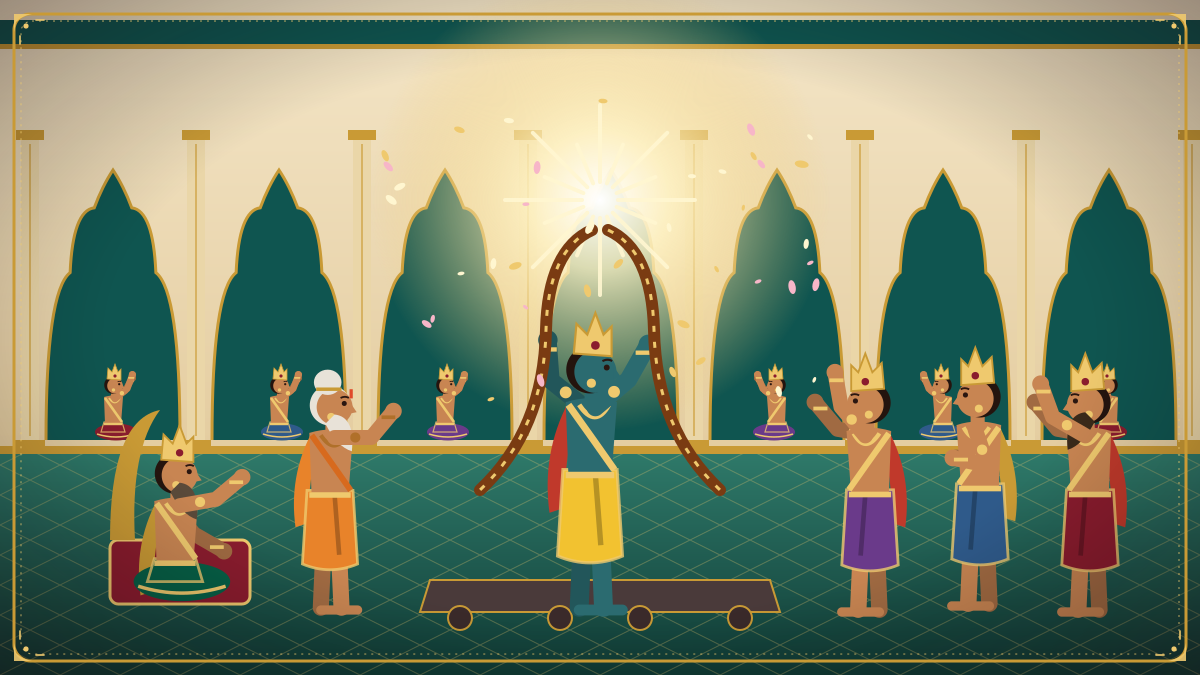
Later, news came from Mithila that Rama had broken the great bow of Shiva and won the hand of Princess Sita. Dasharatha travelled to Mithila with Vashishtha and the royal family. There all four of his sons were married: Rama to Sita, Lakshmana to Urmila, Bharata to Mandavi and Shatrughna to Shrutakirti. On the way home the king trembled when the fierce sage Parashurama blocked their path, but Rama calmly met his challenge.
Two boons and a broken heart
Years passed and Dasharatha grew old. He decided to make Rama the yuvaraja, the crown prince, and the assembly of kings, elders and citizens joyfully agreed. Preparations began at once, and the ceremony was fixed for the next morning. At that time Bharata and Shatrughna were far away, staying with Bharata’s mother’s family in the Kekaya kingdom.
That evening the king went to the palace of Kaikeyi, his youngest and dearest queen, to share the good news. He found her lying on the floor of the “chamber of anger”, her ornaments thrown aside. Her maid Manthara had turned her mind. Long ago, in a battle between the gods and the asuras, Kaikeyi had saved the wounded king, and he had granted her two boons. Now she asked for them: Bharata must be crowned, and Rama must live in the Dandaka forest for fourteen years.
Dasharatha fell to the ground in shock. All night he begged, argued and wept, even bowing at her feet, but Kaikeyi would not change her mind. Bound by his word, the king could not refuse. In the morning he could barely speak. Rama himself, hearing of the promise, cheerfully agreed to go, so that his father would never be called untruthful.
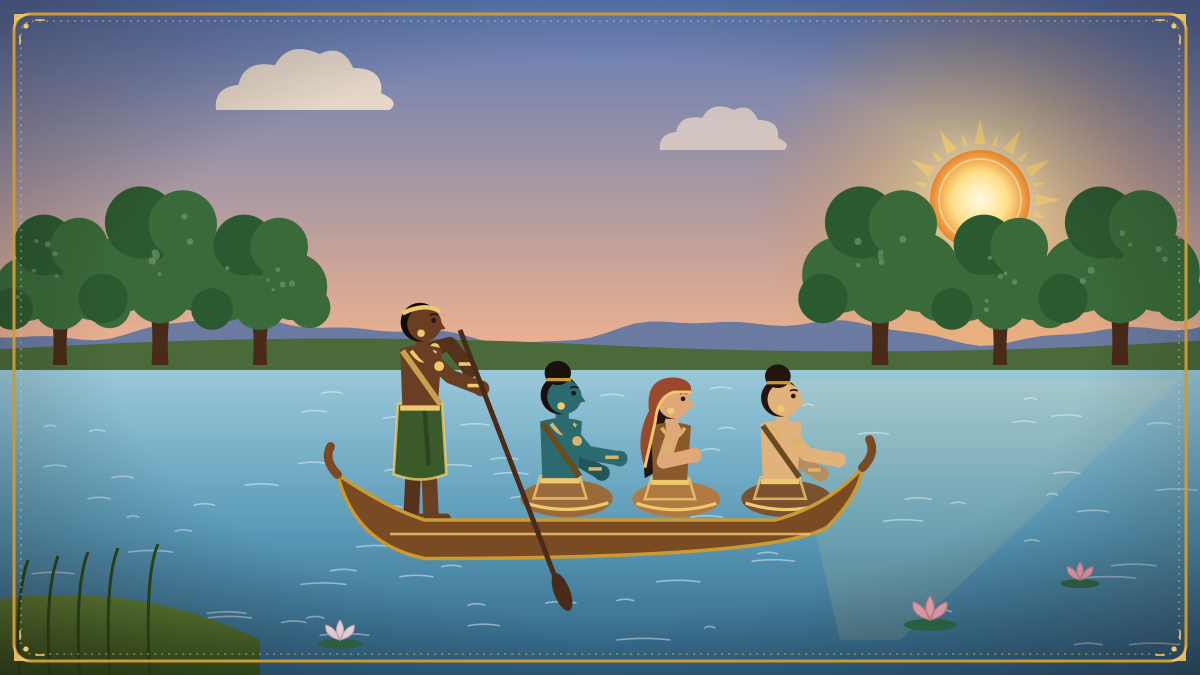
Dasharatha even begged Rama to take him prisoner and seize the throne, but Rama refused. When Rama, Sita and Lakshmana left in Sumantra’s chariot, the old king ran after it until he fell in the dust. He told Kaikeyi not to touch him and said that he rejected her. Then he asked to be taken to Kaushalya’s palace, where he lay in the dark, calling Rama’s name.
An old curse and the king’s death
On the sixth night after Rama left, Dasharatha told Kaushalya a secret from his youth. As a young prince he had been proud of his skill at shooting an arrow at a target he could only hear. One rainy night by the Sarayu, he heard a sound like an elephant drinking and shot towards it. But the sound came from a young ascetic filling a water pot for his old, blind parents.
The dying young man asked the prince to draw out the arrow and to take water to his parents. Shaking with sorrow, Dasharatha went to them and confessed what he had done. The grieving father said, “Just as I am dying of grief for my son, you too will one day die grieving for a son.” Then the old couple gave up their lives on their son’s funeral fire.
“Now that curse has come true,” Dasharatha whispered. “If Rama would only touch me once, I would live.” Calling out the names of Rama, Kaushalya and Sumitra, he died at midnight. His body was kept safely in a vessel of oil until Bharata could be called home from Kekaya to perform his last rites.
A blessing from heaven
Dasharatha’s story does not end with his death. In the Yuddha Kanda, after Ravana had fallen and Sita had come through the test of fire, Dasharatha appeared before Rama in a shining heavenly chariot. He embraced Rama and said that the words of Kaikeyi had stayed in his heart like a thorn, but now, seeing Rama safe, he was at peace. He blessed Lakshmana and spoke lovingly to Sita, his daughter-in-law.
Rama, ever gentle, asked one favour: “Father, please take back the words with which you rejected Kaikeyi and Bharata.” Dasharatha gladly agreed. He told Rama to return to Ayodhya and rule well, and then rose back to heaven. So the father who had died in grief finally met his sons again in peace.
Did you know?
- When Vishvamitra asked for Rama, Dasharatha said that he himself was sixty thousand years old and had been blessed with sons only in his old age.
- Dasharatha gave Sumitra two separate portions of the divine payasa, and she became the mother of twins, Lakshmana and Shatrughna.
- Dasharatha died on the sixth night after Rama left Ayodhya, and his body was kept in oil until Bharata returned from Kekaya.
- After Ravana’s fall, Dasharatha came down from heaven and, at Rama’s request, took back his rejection of Kaikeyi and Bharata.
What we learn from Dasharatha
Dasharatha’s life shows the great value of keeping one’s word, even when it costs everything. It also teaches that promises must be given with care, and that a parent’s love, however deep, must stand together with truth and dharma.
Dasharatha in the story
Read the kandas where Dasharatha plays a part.