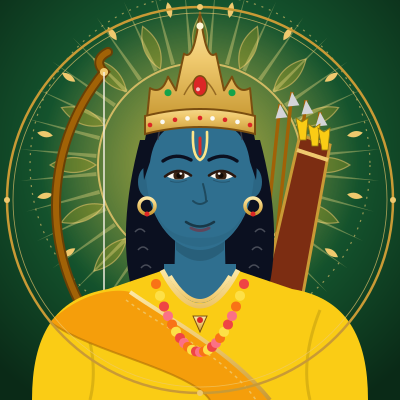
Rama is the hero of Valmiki’s Ramayana, the first great poem of India. The epic begins when Valmiki asks the sage Narada whether there is anyone in the world who is truthful, brave, grateful, firm in his vows and kind to every living being, and Narada answers with the name of Rama of the Ikshvaku family. Rama was the eldest son of King Dasharatha of Ayodhya. He gave up his kingdom without a word of complaint, lived fourteen years in the forest, defeated Ravana to free Sita, and ruled so justly that his reign is still the measure of a good kingdom.
Birth and boyhood
King Dasharatha of Ayodhya had three queens, Kaushalya, Kaikeyi and Sumitra, but for many years no son. With the sage Rishyashringa as priest he performed the putrakameshti yajna, a sacrifice for the blessing of sons. From the fire rose a shining being carrying a golden vessel of payasa, a sweet rice pudding made by the gods. Dasharatha shared it among his queens, and Kaushalya received the first half.
In time Kaushalya gave birth to Rama, on the ninth day of the bright half of the month of Chaitra. Then Kaikeyi gave birth to Bharata, and Sumitra to the twins Lakshmana and Shatrughna. Valmiki says that Lord Vishnu himself was born on earth as these four brothers, with Rama as his greatest part, because the gods had prayed for an end to Ravana’s cruelty.
When Rama was not yet sixteen, the sage Vishvamitra came to Ayodhya and asked for him, to protect a sacrifice from the rakshasas Maricha and Subahu. Dasharatha was afraid for his son, but Vashishtha persuaded him. On the way Vishvamitra taught Rama and Lakshmana the mantras Bala and Atibala. Rama killed the fierce rakshasi Tataka, received many divine weapons from the sage, guarded the sacrifice for six days, killed Subahu and hurled Maricha far away into the ocean.
Later the sage led them to the ashram of Gautama. There Ahalya, under her husband’s curse, had spent long years in penance, unseen by any creature. When Rama arrived she was freed and shone once more, and the two princes touched her feet with respect.
Shiva’s bow and the wedding
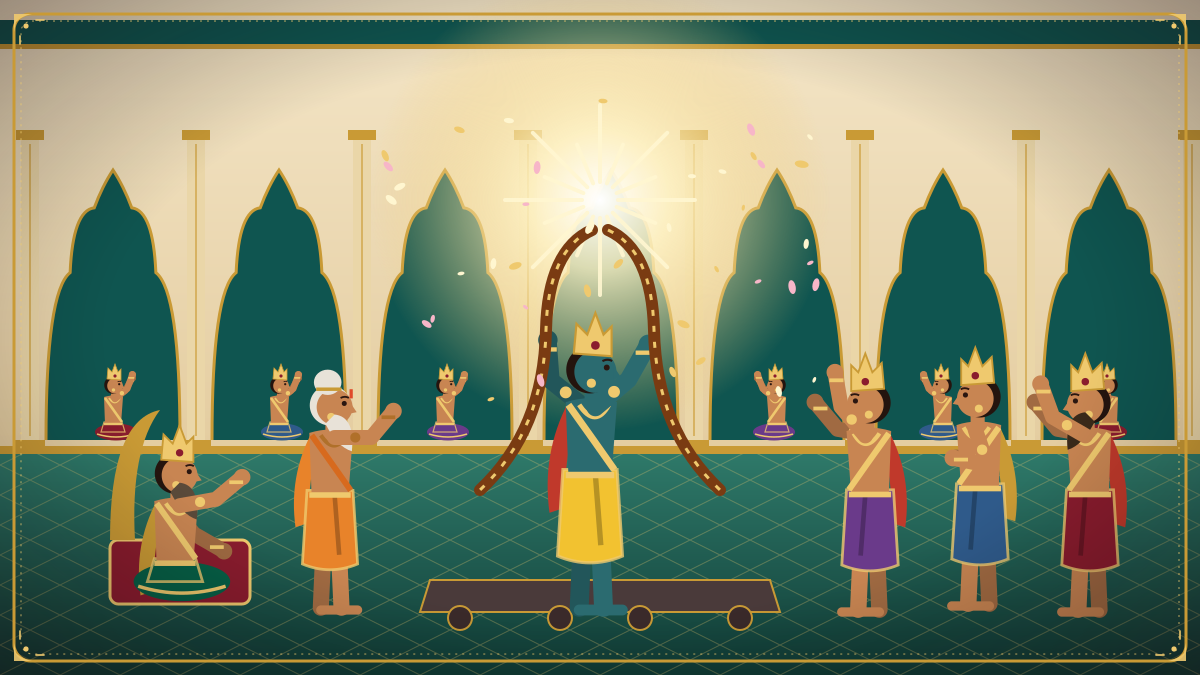
From there Vishvamitra brought the princes to Mithila, the kingdom of King Janaka. Janaka kept a mighty bow that had once belonged to Lord Shiva. He had found a baby girl, Sita, in the earth while ploughing a field, and he had declared that she would marry only the man who could string that bow. Many kings had come for her and failed even to lift it.
At Vishvamitra’s request the bow was brought out in an eight-wheeled iron chest, pulled by five thousand strong men. Rama opened the chest, lifted the bow with ease and strung it. As he drew the string back, the bow broke in the middle with a sound like thunder. Everyone except Vishvamitra, Janaka and the two princes fell to the ground in shock.
Janaka joyfully gave Sita to Rama. Messengers fetched Dasharatha, and four weddings took place together: Rama with Sita, Lakshmana with Janaka’s younger daughter Urmila, and Bharata and Shatrughna with Mandavi and Shrutakirti, daughters of Janaka’s brother Kushadhvaja. On the way home the sage Parashurama stopped them and challenged Rama with the bow of Vishnu. Rama strung that bow too, and Parashurama, humbled, went back to the mountains.
The coronation that became an exile
For twelve years Rama and Sita lived happily in Ayodhya. Dasharatha, growing old, decided to make Rama crown prince, and the whole city rejoiced. Bharata was away at his mother’s family home. But Kaikeyi’s maid Manthara filled her mind with fear, and Kaikeyi asked the king for two boons he had once promised her: that Bharata be crowned, and that Rama live in the forest for fourteen years.
Dasharatha was heartbroken, but he had given his word. When Rama heard Kaikeyi’s demand, his face did not change. He said he would gladly give the kingdom to Bharata, and that obeying his father was the highest dharma. He calmed his angry brother Lakshmana, comforted his weeping mother Kaushalya, and prepared to leave that very day.
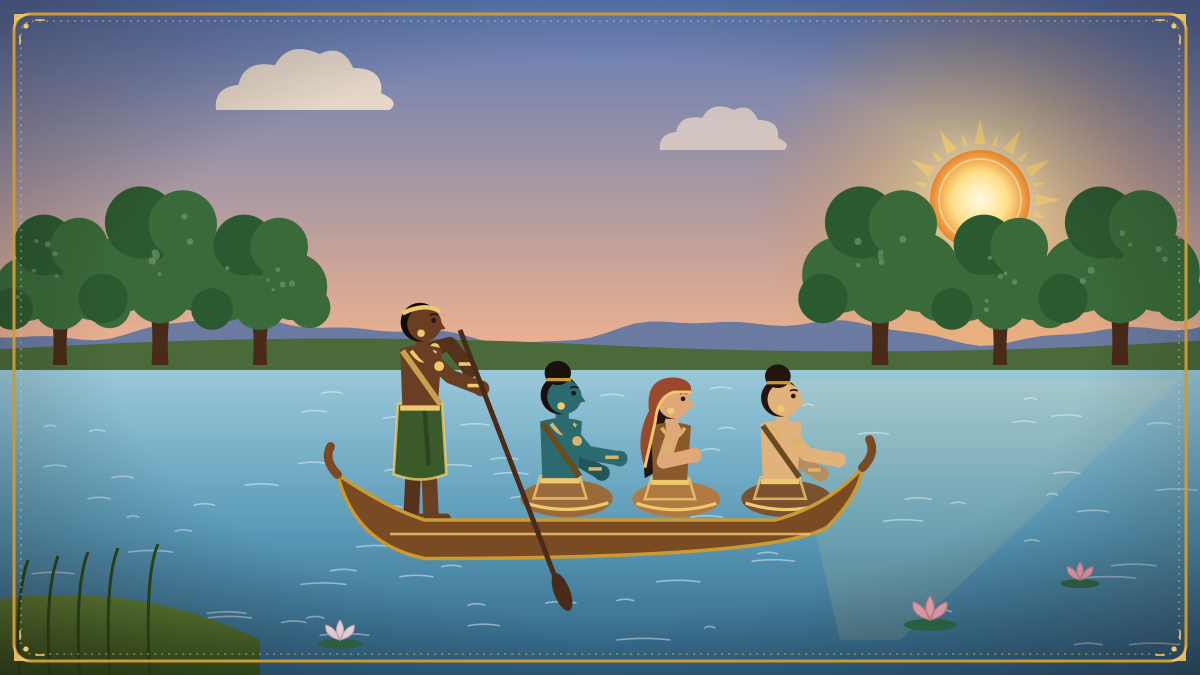
Sita refused to stay behind, and Lakshmana begged to come and serve them. The three put on garments of bark and left Ayodhya in a chariot, while the people followed in tears. At Shringaverapura the forest chief Guha welcomed them, and they crossed the Ganga. Soon afterwards, in Ayodhya, Dasharatha died of grief, calling out Rama’s name.
Life in the forest
Rama, Sita and Lakshmana visited the sage Bharadvaja at Prayaga and built a hut of leaves on the beautiful hill of Chitrakuta. There Bharata came with the people of Ayodhya to beg Rama to return. Rama gently refused: their father’s word had to be kept. Bharata then asked for Rama’s sandals, the padukas, placed them on the throne and ruled from Nandigram in Rama’s name.
Rama went south into the great Dandaka forest. He met the sage Atri and his wife Anasuya, and promised the sages of the forest to protect them from the rakshasas who troubled them. For about ten years the three lived among the ashrams. The sage Agastya gave Rama the bow of Vishnu, an arrow made by Brahma and two quivers that never emptied, and advised him to live at Panchavati by the Godavari river.
At Panchavati, Ravana’s sister Shurpanakha saw Rama and wanted to marry him. When she was refused and rushed at Sita, Lakshmana, at Rama’s command, cut off her nose and ears. Her brothers Khara and Dushana attacked with fourteen thousand rakshasas. Rama, standing alone, defeated them all, while Lakshmana kept Sita safe in a cave.
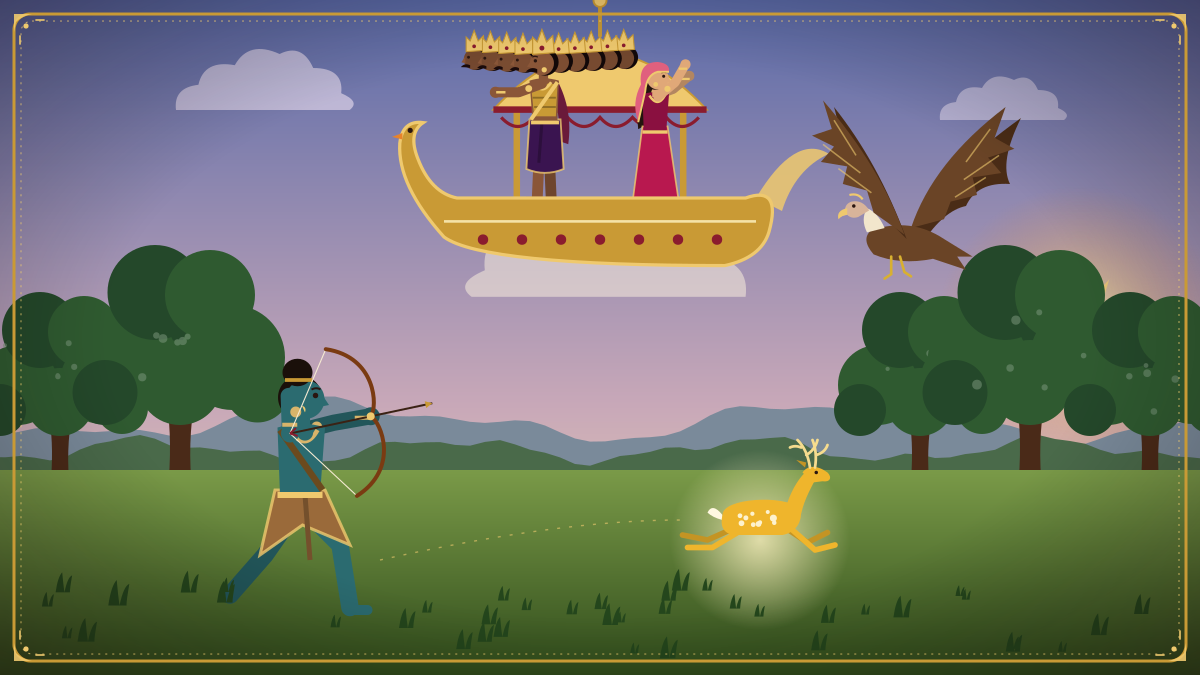
Then Ravana made a plan. The rakshasa Maricha took the form of a golden deer, and Sita longed for it. Rama chased it far away and shot it, and as it died Maricha cried out in Rama’s voice. Sita sent Lakshmana to help, and in that moment Ravana carried her away. The old vulture Jatayu, a friend of Dasharatha, fought him and fell. Rama found Jatayu dying, heard the news, and performed his last rites as a son would.
The search and the friendship with Sugriva
Lakshmana calmed Rama’s terrible grief and anger. Searching southwards, the brothers freed Kabandha from a curse, and he told them to seek the friendship of the vanara Sugriva. At Lake Pampa they visited the aged ascetic woman Shabari, who had waited many years to see Rama. She welcomed him with forest fruits and then rose to heaven in a blaze of light.
On Mount Rishyamuka they met Hanuman, Sugriva’s minister, who came to them disguised as a wandering ascetic. Rama was so impressed by his speech that he told Lakshmana no one could speak so well without mastering the Vedas. Hanuman brought them to Sugriva, and Rama and Sugriva swore friendship by walking around a sacred fire. Sugriva showed Rama the ornaments Sita had dropped from the sky.
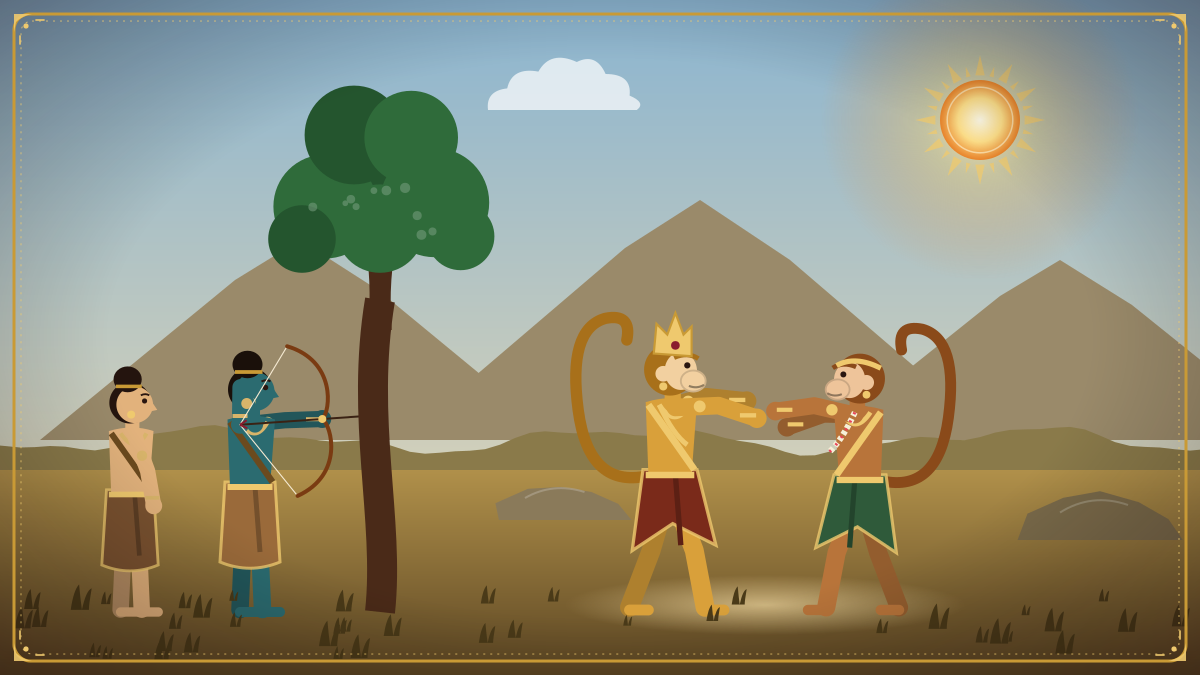
Sugriva had been driven out by his elder brother Vali, who had also taken his wife. Rama shot Vali while the two brothers were fighting, and Sugriva became king of Kishkindha. After the rainy season, vanara search parties went out in every direction. Rama gave his ring, marked with his own name, to Hanuman, trusting that he would be the one to find Sita.
The war of Lanka
Hanuman leapt across the ocean, found Sita in Ravana’s Ashoka grove and brought back her jewel, the chudamani. Rama embraced Hanuman, saying this embrace was all he had to give. The army marched to the seashore. There Ravana’s brother Vibhishana came asking for shelter, and Rama accepted him, declaring that he would protect anyone who comes to him for refuge, even Ravana himself.
Rama prayed to the Ocean for three days, and when it did not appear he raised his bow in anger. Then the Ocean rose before him and said that the vanara Nala, son of Vishvakarma, could build a bridge. In five days the vanaras built it across the sea, and the army reached Lanka. Rama sent Angada to give Ravana one last chance to return Sita, but Ravana refused.
In the long war Rama killed Kumbhakarna and many great warriors. In his first fight with Ravana he broke the king’s crown and bow, and then let him go, saying, “Go and rest, and come back to fight when you are ready.” He would not strike a tired, unarmed enemy.
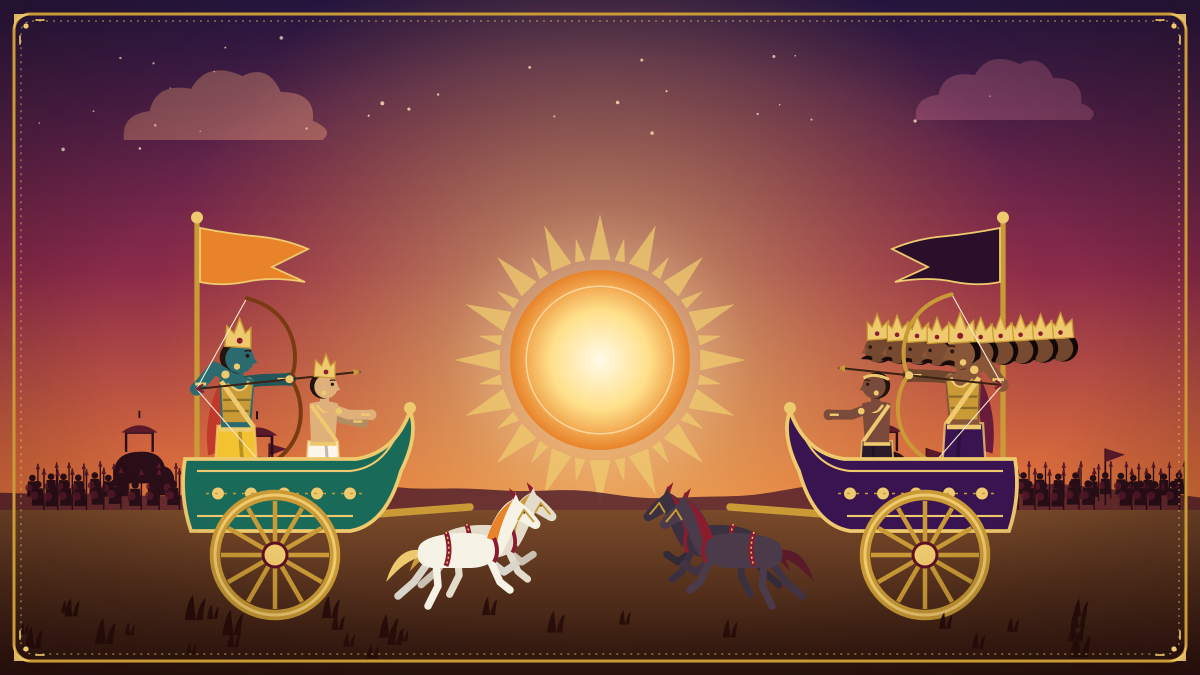
Before the final battle, the sage Agastya came and taught Rama the hymn to the Sun, the Aditya Hridayam. Indra sent his own chariot with his charioteer Matali. Ravana’s heads grew back each time Rama cut them, so, at Matali’s reminder, Rama used the arrow of Brahma given by Agastya, and Ravana fell. Rama told Vibhishana to perform Ravana’s funeral with honour, saying that enmity ends with death.
King of Ayodhya and the last years
Rama had Vibhishana crowned king of Lanka. When Sita was brought before him, he spoke hard words in front of everyone, and Sita entered a fire to prove her purity. Agni, the god of fire, rose carrying her unharmed and gave her back to Rama. Rama said he had never doubted her, but the world needed to see her purity. Dasharatha appeared from heaven to bless his son.
In the Pushpaka chariot they flew back to Ayodhya just as the fourteen years ended. Bharata returned the kingdom, and Vashishtha crowned Rama. Valmiki describes Rama’s rule as a time when no one died young, no widow wept, the rains came on time, and people lived without fear of thieves or disease.
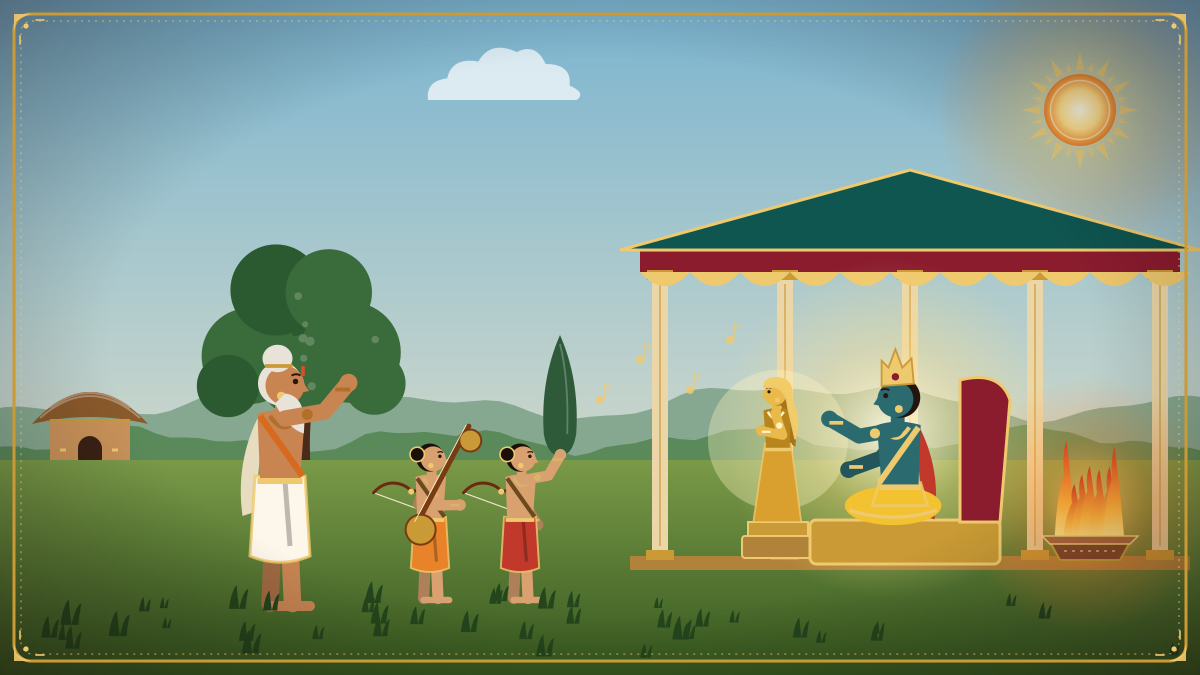
The Uttara Kanda tells of his later years. When Rama learned that people were whispering about Sita’s stay in Ravana’s house, he sent her, though she was expecting a child, to live near Valmiki’s ashram. There she gave birth to Lava and Kusha. Rama never married again; at his great horse sacrifice a golden image of Sita sat beside him as his wife.
At that sacrifice the twins sang the Ramayana, and Rama recognised his sons. When Sita was called, she prayed to Mother Earth and returned into the Earth. Rama ruled for many thousands of years more. At the end, after making Kusha and Lava kings, he walked into the Sarayu river with his brothers and the people of Ayodhya, and returned to his divine form as Vishnu.
Did you know?
- Valmiki’s Ramayana opens with a question: Valmiki asks Narada whether any man alive has every noble quality, and Narada’s answer is the story of Rama.
- Valmiki says Rama was born on the ninth day of the bright half of Chaitra, the day now celebrated as Rama Navami.
- The ring that Hanuman carried to Sita in Lanka was marked with Rama’s own name.
- When Vibhishana came to him, Rama said he would give shelter even to Ravana himself, if Ravana came asking for it.
What we learn from Rama
Rama teaches that keeping one’s word and doing one’s duty matter more than comfort or power. He honoured friends of every kind, from a forest chief to an old vulture and an aged ascetic woman, and he treated even his enemy with fairness.
Rama in the story
Read the kandas where Rama plays a part.