The Great Leap
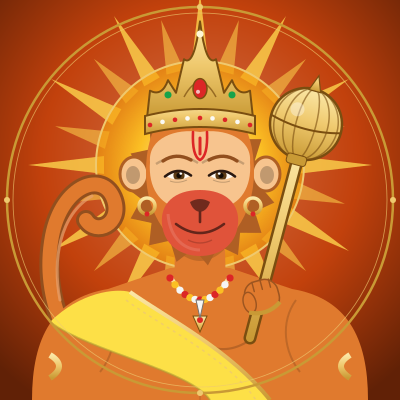
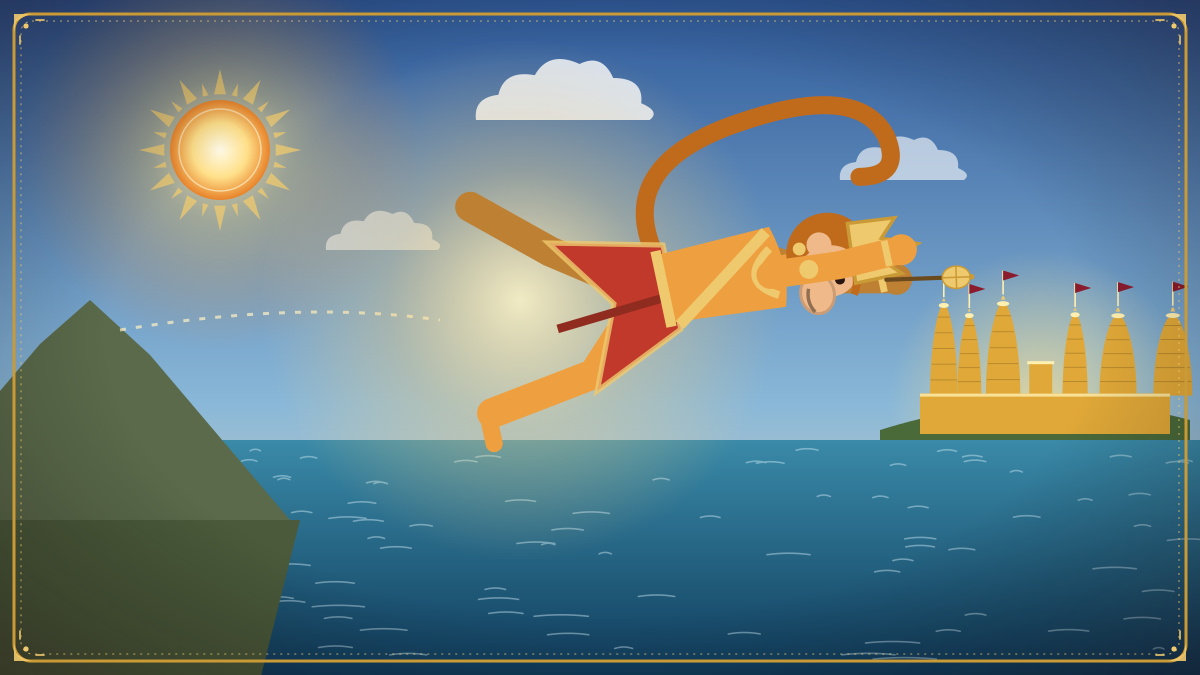
Here the Sundara Kanda, the fifth book, begins. Hanuman bowed to the Sun, to Indra, to Brahma and to his father the Wind god. Then he pressed down with his hands and feet and sprang into the sky. Trees were pulled up by the force of his leap and flew after him for a while. His shadow moved across the ocean like a great ship. “Like an arrow shot by Rama,” he said, “I will reach Lanka.”
The Ocean, grateful to Rama’s family because King Sagara’s sons had once dug the ocean’s bed, asked Mount Mainaka to rise from the water so that Hanuman could rest. Mainaka rose up, golden and shining, and offered him rest. Hanuman touched him gently with his hand and said, “I have promised not to stop until my work is done.” He flew on, and Indra, pleased, blessed Mainaka.
Then the gods sent Surasa, the mother of the nagas, to test Hanuman. She took a huge form and said, “No one may pass without entering my mouth.” Hanuman grew larger, and she opened her mouth wider. Suddenly Hanuman became as small as a thumb, entered her mouth and came out at once. “I have entered your mouth, so your boon is kept,” he said. Surasa blessed him with a smile.
Next, a rakshasi named Simhika, who lived in the ocean, caught hold of Hanuman’s shadow and pulled him down. Hanuman saw her huge open mouth. He made himself small, went inside her and struck her from within. Then he came out swiftly, and she sank lifeless into the sea. The beings of the sky praised his courage and wisdom.
At last Hanuman landed on a peak of the Trikuta mountain on the far shore. He had crossed a hundred yojanas, yet he was not tired at all. Before him rose Lanka, shining with golden walls and tall palaces, guarded by fierce rakshasas. Hanuman decided to wait for night and enter the city in a tiny form. The search for Sita inside Lanka was about to begin.
Hanuman Finds Sita
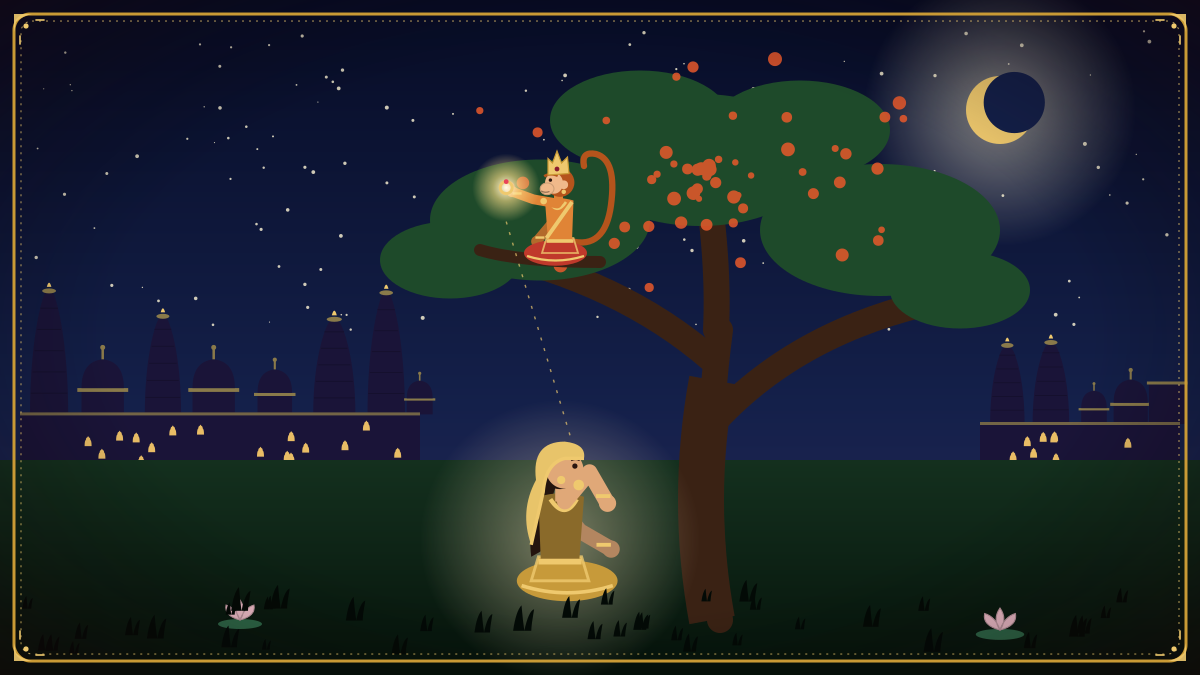
Hanuman enters Lanka by night, searches its palaces, and at last finds Sita in the Ashoka grove. He watches Ravana threaten her, then gently wins her trust and gives her Rama’s ring.
Arriving at Lanka
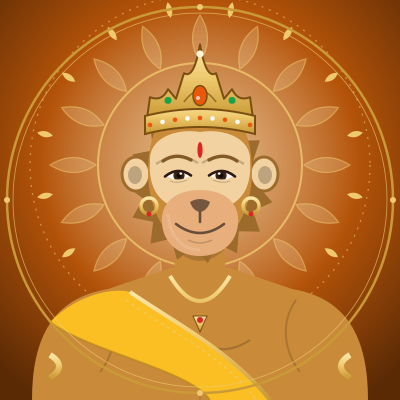
In the last chapter Hanuman crossed the great ocean in one mighty leap. Now he landed softly on Mount Lamba, a hill on the shore of the island, and he was not even out of breath. In front of him, on the top of Mount Trikuta, stood Lanka, the golden city of Ravana. It shone with tall white mansions, golden gateways, gardens and wide roads, and it was guarded all around by deep moats and strong walls.
Hanuman looked at the guards with their bows, swords and spears, and he thought carefully. “Even the gods would find it hard to take this city by force,” he said to himself. “If I enter in my true form by daylight, I will be seen at once, and the whole task may fail. I must enter quietly, find Sita, and not let anyone know why I have come.”
So he waited until the sun had set. When the moon rose and filled the sky with silver light, Hanuman made his body very small, about the size of a cat, and moved towards the city gate. He was wise as well as strong: he knew that a messenger who acts without thinking can spoil the work of his master, however brave he may be.
At the gate he was stopped by the guardian spirit of Lanka, who appeared as a fierce woman and shouted at him. When she struck him, Hanuman struck back with his left fist, holding back his strength because she was a woman. She fell, and then spoke humbly: “Long ago Lord Brahma told me that when a vanara defeats me, the end of the rakshasas would be near. Go in, and find what you seek.”
Searching the City by Moonlight
Hanuman leapt over the wall and moved from roof to roof. He saw beautiful houses where people sang, recited the Vedas, and talked of war. He saw soldiers, spies and guards, and markets full of riches. He searched every great mansion, the houses of Prahasta, Kumbhakarna, Vibhishana, Indrajit and the other leaders, but nowhere did he find the princess of Mithila.
At the centre stood Ravana’s own palace, larger and grander than any other. Near it Hanuman saw the Pushpaka, the wonderful flying chariot that Ravana had taken from his brother Kubera. It was decorated with jewels and looked like a little piece of heaven. Inside the palace Hanuman saw Ravana asleep on a splendid bed, breathing heavily like a great serpent, with many queens sleeping around him.
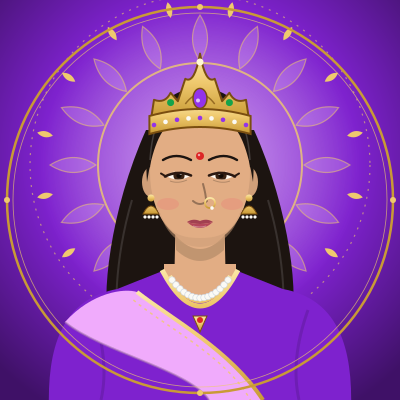
Apart from the others, on a beautiful couch, lay a queen of great beauty and grace. This was Mandodari, Ravana’s chief queen. For a moment Hanuman’s heart leapt and he thought, “Surely this is Sita!” He clapped his arms and jumped about with joy. But then he became calm and thought again: “No. Sita, parted from Rama, would never sleep, eat, wear ornaments or rest in another man’s home. This cannot be her.”
Hanuman searched the whole palace again, the drinking halls, the gardens and the hidden rooms. A worry also came to him: “I have looked upon the sleeping wives of another man. Have I done wrong?” Then he answered himself honestly: “My mind did not change at all. Where else could I look for a lost woman, except among women?” With a clear conscience he went on searching, though he still had not found her.
Sita in the Ashoka Grove
When every house had been searched, Hanuman sat down sadly on a wall. “Perhaps Sita is no longer alive,” he thought. “If I return without news, Rama will not live, and then Lakshmana, Bharata, Shatrughna and the mothers will not live either. Sugriva and the vanaras will grieve too. It is better that I keep searching than give up.” He bowed to Rama, Sita, Lakshmana and the gods, and gathered fresh courage.
Then he noticed a garden he had not yet entered: the Ashoka grove of Ravana. It was full of flowering trees, ponds with lotuses, singing birds and golden steps. Hanuman leapt over its wall and climbed a tall shimshapa tree with thick leaves. “Sita loved the forest,” he thought. “If she is anywhere, she will come to a quiet place like this, perhaps to the stream for her morning prayer.”
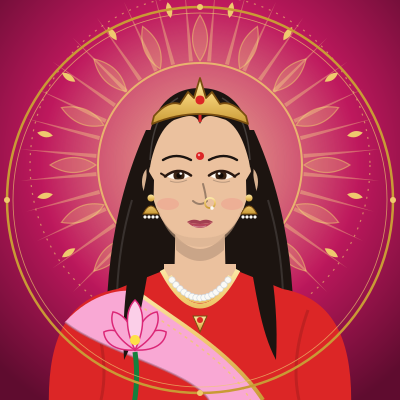
From the branches he saw, not far away, a temple-like building, and near it a lady sitting on the ground. She was thin from fasting, and she wore a single soiled yellow garment. Her hair hung in one long braid. Her face was pale and wet with tears, like the moon covered by clouds. Around her sat rakshasis with frightening faces, keeping guard over her day and night.
Hanuman looked at her closely and remembered the ornaments the vanaras had found on the mountain, and Rama’s description of his wife. “This is Sita,” he said to himself, and tears of joy and sorrow filled his eyes. “For her sake Rama has killed Vali and so many rakshasas. Even in this sorrow she thinks only of Rama.” Hidden among the leaves, he waited and watched.
Ravana’s Threats
As the night was ending, Hanuman heard the sound of anklets and music. Ravana was coming into the grove, surrounded by his queens, who carried golden lamps. When Sita saw him, she trembled and drew her knees close, covering herself with her arms. Ravana spoke sweet words to her, praising her beauty, and promised to make her the chief of all his queens if she would accept him.
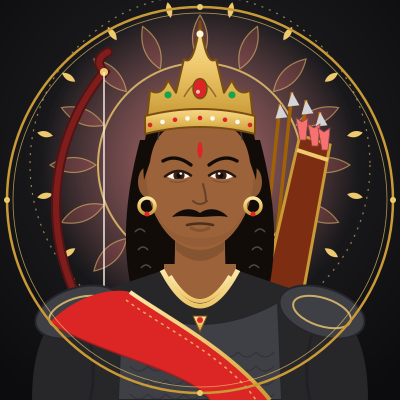
Sita did not even look at him. She picked up a blade of grass and placed it between herself and Ravana, and spoke to him only through it. “Turn your mind back to your own wives,” she said. “I belong to Rama, as sunlight belongs to the sun. If you want to save yourself and your city, return me to him and seek his friendship. No one can escape his arrows.”
Ravana grew angry. “I give you two more months,” he said. “If at the end of that time you do not agree to be mine, you will pay with your life.” The women of his palace looked at Sita with pity. One of his wives, Dhanyamalini, came forward, put her arms around Ravana and gently led him away, saying, “Why trouble yourself over a woman who does not want you?”
As soon as he left, the rakshasis surrounded Sita and frightened her with harsh words. Then an elderly rakshasi named Trijata woke up and said, “Stop! I have seen a dream. I saw Rama and Lakshmana dressed in shining white, and Sita in white too, rising high. I saw Ravana, his head shaven and his body smeared with oil, riding on a donkey towards the south. Lanka will fall. Ask Sita’s forgiveness.” The rakshasis fell silent.
Rama’s Messenger and the Ring
Sita, however, was in such grief that she felt she could not bear to live any longer. Just then good signs appeared: her left eye, her left arm and her left thigh began to throb, which is a sign of good news for a woman. Hanuman saw her sorrow and thought, “I must speak to her now. But if I speak in the polished Sanskrit of a learned brahmin, she may think I am Ravana in disguise. I will speak gently, in the simple language of ordinary people.”
So, from the tree, he began softly to tell the story of Rama: how King Dasharatha ruled Ayodhya, how Rama went to the forest to keep his father’s word, how Sita was carried away, how Rama made friends with Sugriva, and how the vanaras were searching for her. Sita lifted her face in wonder and looked up into the branches, where she saw a small, gentle vanara with bright, kind eyes.
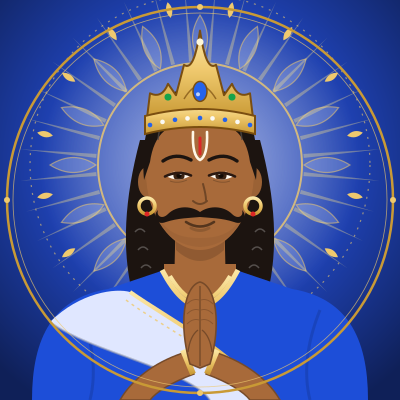
Hanuman came down, folded his hands and asked her who she was. Sita told him her story. When he said that Rama had sent him, she grew afraid that this was another trick of Ravana. So Hanuman described Rama lovingly: his broad shoulders, his long arms, his lotus eyes, his deep voice, his kindness and truthfulness, and Lakshmana too. He told her how he had met the two brothers and how the friendship with Sugriva was made.
Then he gave her Rama’s ring, engraved with Rama’s name. Sita took it in her hands and pressed it close. Her face shone with joy, as if she had met her husband himself, and she praised Hanuman again and again. A whole new hope filled her heart. But with that hope came a question: “Why has Rama not yet come for me?” What she said, and what Hanuman did next, we will see in the next chapter.
Lanka Burns
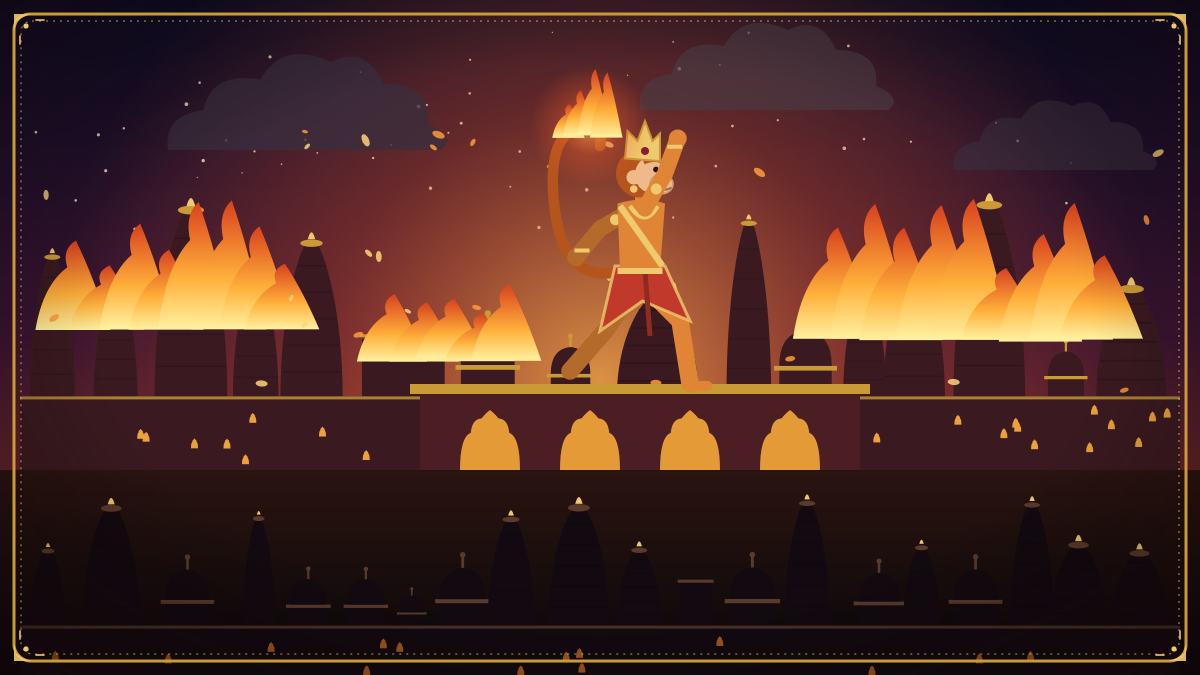
Sita gives Hanuman her jewel and a message for Rama. Hanuman tests Ravana’s strength, is bound by Indrajit, speaks boldly in Ravana’s court, sets Lanka on fire with his burning tail and returns with the good news.
Sita’s Message and the Jewel
In the last chapter Hanuman gave Sita the ring of Rama. Now he told her, “Rama does not know where you are. As soon as he hears it from me, he will come with a great army of vanaras and bears.” Then, full of love, he said, “Mother, sit on my back. I will carry you across the ocean to Rama this very day.” To show he could do it, he grew as large as a mountain.
Sita blessed him, but refused. “If you carry me across the sea, I might fall from fear, and the rakshasas would chase us and fight you,” she said. “Also, I will not willingly touch any man except my husband. Ravana touched me only by force, when I was helpless. And it is Rama who must defeat Ravana and take me home. That alone will bring him the glory that he deserves.”
To make Rama believe that Hanuman had truly met her, Sita told him a secret story. Once at Chitrakuta a crow, who was the son of Indra, hurt her. Rama took a blade of grass, made it into a divine weapon with a mantra, and sent it after the crow. The crow flew through all the worlds, but no one could protect him, and at last he fell at Rama’s feet. Rama spared his life, and the weapon took only one of his eyes.
Then Sita untied a precious jewel from the end of her garment, the chudamani that she wore in her hair, and gave it to Hanuman. “Give this to Rama,” she said. “Tell him I will keep my life for one more month. After that I cannot live. And tell Lakshmana, who served Rama as if he were his own father, to remember me.” Hanuman bowed, took the jewel, and promised her that help would come soon.
The Ashoka Grove Destroyed
Hanuman thought, “I have found Sita, but a good messenger does more than the least he is asked. Let me see how strong Ravana’s army is, and let Ravana see the power of Rama’s servant.” So he began to break the trees of the beautiful Ashoka grove, to crush its bowers, and to scatter its ponds and pleasure hills, until the lovely garden looked as if a great storm had passed through it.
The frightened rakshasis ran to Ravana. Ravana sent eighty thousand fierce warriors called kinkaras against the vanara. Hanuman stood on the gateway of the grove, roared, “Victory to Rama, victory to Lakshmana, victory to King Sugriva! I am Hanuman, servant of Rama!” and struck them down with an iron bar that he found at the gate. Then he destroyed a tall temple-like building of the rakshasas and its guards.
Ravana now sent mighty Jambumali, the son of his commander Prahasta, then the seven sons of his ministers, and then five of his great army chiefs. One after another they came with chariots, bows and arrows, and one after another they fell before Hanuman, who fought with trees, rocks and his own great strength. All Lanka began to shake with fear and wonder.
Then Ravana sent his own young son, Prince Aksha, a brave and skilful warrior. Aksha fought so well that even Hanuman admired him. “This boy fights like a hero,” he thought. “But if I let him grow stronger, he will be a danger.” At last Hanuman caught him and struck him down, and the young prince of Lanka lost his life. Ravana was shaken with grief and anger.
Bound by Indrajit
Ravana now called his eldest son, Indrajit, who had once defeated Indra himself. “Go carefully,” Ravana told him. “This is no ordinary vanara.” Indrajit rode out in his chariot, and a long and fierce fight began. His arrows could not harm Hanuman, and Hanuman could not reach him. At last Indrajit understood that ordinary weapons were useless, and he released the Brahmastra, the weapon of Lord Brahma, and bound Hanuman with it.
Hanuman knew the power of that weapon, and he also knew that, by a blessing of Brahma, it could hold him only for a short time. Out of respect for Brahma, he did not resist. He also thought, “This is good. I will get to see Ravana face to face and speak with him.” So he fell to the ground and lay still, as if he were helpless.
The rakshasas rushed forward and tied him tightly with ropes and strips of bark. Indrajit saw this and was troubled, because the Brahmastra does not stay where any other bond is used, and so its hold on Hanuman fell away at once. But Hanuman pretended to be still bound, and let himself be dragged through the streets of Lanka to the royal hall, while the crowd shouted and jeered.
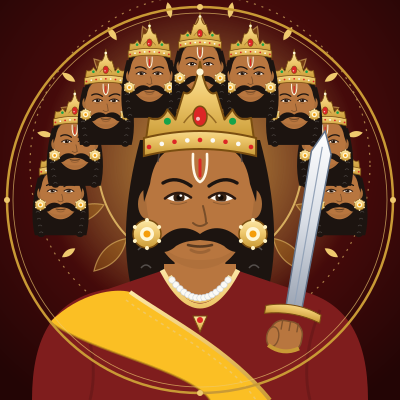
In the hall Hanuman saw Ravana seated on a crystal throne, wearing a golden crown and shining ornaments, surrounded by his ministers. Even in that moment Hanuman was struck by his splendour. “What beauty, what strength, what glory!” he thought. “If only this king of the rakshasas did not walk the path of adharma, he could have protected even the world of the gods.”
In Ravana’s Court
Ravana ordered his minister Prahasta to ask the vanara who he was. Hanuman answered fearlessly: “I am Hanuman, the messenger of Sugriva, king of the vanaras, and the servant of Rama. I came to see you, and I broke your grove only so that I would be brought before you. Your warriors attacked me, and I fought only to defend myself. I let myself be bound so that I could meet you.”
Then he gave Ravana good advice. “You know dharma and you have done great penance. Do not destroy it all for the sake of another man’s wife. Return Sita to Rama, and you and your people will be safe. No one in the three worlds can protect a person who has wronged Rama. Your boons protect you from gods and demons, but not from humans and vanaras.”
Ravana burned with rage and ordered that the vanara be killed. But his younger brother Vibhishana rose and spoke calmly. “O king, a messenger must never be killed, whatever he says. This is the rule of kings everywhere. Punish him some other way if you wish, but if he dies, who will carry your answer back to those who sent him?”
Ravana accepted this advice. “The tail is a vanara’s dearest ornament,” he said. “Set his tail on fire and lead him through the city, so that everyone sees his shame.” The rakshasas wrapped Hanuman’s tail in old cloth, soaked it in oil and lit it. Hanuman allowed them to do this, thinking, “Let me see Lanka by daylight. It will help Rama later.”
Lanka in Flames
The rakshasas led him through the streets, beating drums and announcing his crime. When the rakshasis told Sita that the vanara who had spoken with her was being punished with fire, she was deeply grieved. She turned to Agni, the god of fire, and prayed: “If I have served my husband faithfully, if I have any merit of penance, be cool to Hanuman.” At once the flame on his tail burned brightly but felt cool.
Hanuman understood that this was by the grace of Sita, Rama and his own father, the wind god, who was friendly with fire. He made himself small, slipped out of the ropes, grew huge again, and leapt onto the city gate. Then, with his blazing tail, he jumped from palace to palace, and the fire spread through Lanka, helped by the wind. Only the house of Vibhishana did he leave untouched.
Soon great mansions were burning like the sun at the end of an age. Hanuman put out the flame on his tail in the sea. Then a terrible fear seized him: “What have I done in my anger? If Sita has been harmed in this fire, everything is lost!” He blamed himself bitterly. Just then he heard the charanas, heavenly singers in the sky, saying, “Wonderful! Lanka is burned, but the princess Janaki is safe.”
Filled with relief, Hanuman hurried back to the Ashoka grove and found Sita sitting safely under the tree. He bowed to her once more. Sita said, “Stay one more day if you can; my sorrow is less while you are here.” Hanuman comforted her again, promising that Rama and Lakshmana would soon come with the vanara army, and then he took his leave to begin his journey home.
The Return with Good News
Hanuman climbed Mount Arishta near the shore, and pushed off with such force that the mountain sank down into the earth. He flew across the ocean like a great cloud, and as he came near Mount Mahendra he roared with joy. Hearing that roar, Angada, Jambavan and all the waiting vanaras knew at once that he had succeeded. They ran up to greet him, offering roots and fruits, and danced with happiness.
Hanuman told them everything. The happy vanaras set off towards Kishkindha, and on the way they reached Madhuvana, the beautiful honey garden of King Sugriva, which was guarded by Sugriva’s maternal uncle Dadhimukha. With Angada’s permission they feasted on honey and fruits and played wildly. When Dadhimukha complained to Sugriva, the wise king smiled: “They would not dare do this unless they had found Sita.”
Sugriva sent for them, and the vanaras came before Rama and Lakshmana. Hanuman bowed and, knowing how anxious Rama was, gave the good news at once: he had seen Sita, and she was faithful and alive. Then he told the whole story, the ocean, Lanka, the Ashoka grove, Ravana’s threats, Sita’s message and the story of the crow, and placed the chudamani in Rama’s hands.
Rama pressed the jewel to his heart and wept, remembering Janaka who had given it to Sita on her wedding day. Then he turned to Hanuman with deep love. “I have nothing worthy to give you for what you have done,” he said, “except this embrace.” And he held Hanuman close to his heart. Now the great question remained: how would the army cross the ocean? That we will see in the next chapter.
Key moments
- Hanuman lands near Lanka and waits for nightfall
- He enters Lanka as small as a cat
- The guardian of Lanka recalls Brahma’s warning
- Mandodari is mistaken for Sita for a moment
- Sita is found in the Ashoka grove under guard
- Sita answers Ravana across a blade of grass
- Trijata’s dream foretells Lanka’s fall
- Hanuman gives Sita the ring with Rama’s name
- Sita refuses to be carried away secretly by Hanuman
- The story of the crow at Chitrakuta
- Sita gives her chudamani as a sign for Rama
- Prince Aksha falls in battle with Hanuman
- Indrajit binds Hanuman with the Brahmastra
- Vibhishana says a messenger must never be killed
- Sita’s prayer makes the fire cool for Hanuman
- Rama embraces Hanuman as his only reward
What this kanda teaches us
Hanuman did not give up even when every place seemed empty, and he thought carefully about every step and even every word. Sita, though alone and threatened, never let fear shake her faithfulness. Patience, careful thought and steady devotion together bring light into the darkest place.
Hanuman did more than he was asked, yet he never acted for his own glory; even when bound, he used the moment to serve Rama. Sita’s refusal to be rescued secretly shows that the right thing must also be done in the right way. And Rama’s embrace teaches that love and gratitude are the greatest gifts.
Did you know?
- Hanuman entered Lanka at night in a body only about the size of a cat, so that no one would notice him.
- Seeing the sleeping Mandodari, Hanuman at first thought she was Sita, then reasoned that Sita would never rest happily away from Rama.
- Sita spoke to Ravana with a blade of grass placed between them, refusing even to face him directly.
- Hanuman chose to speak to Sita in simple everyday language, so that she would not mistake him for Ravana in disguise.
- Indrajit’s Brahmastra could hold Hanuman only for a short time, and its power left him as soon as the rakshasas tied him with ropes.
- When Hanuman set Lanka on fire, he left the house of Vibhishana untouched.
- Sita told Hanuman she would keep her life for only one more month, so the vanaras had to act quickly.
- Mount Arishta, from which Hanuman leapt to return home, sank into the earth under the force of his jump.