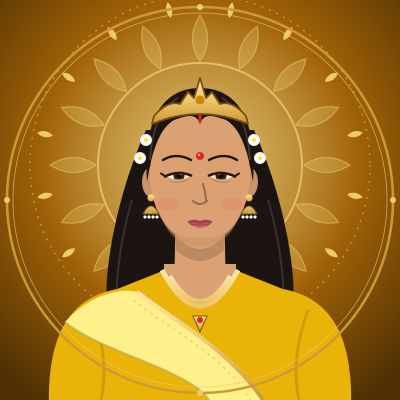
Sumitra was one of the three chief queens of King Dasharatha and the mother of the twin princes Lakshmana and Shatrughna. She speaks only a few times in Valmiki’s Ramayana, but each time her words are full of wisdom and courage. She sent Lakshmana to the forest with Rama, gently comforted the grieving Kaushalya, and raised two sons who became the most loyal brothers in the epic.
A queen of Ayodhya
Sumitra was one of the three chief queens of King Dasharatha, along with Kaushalya and Kaikeyi. She lived peacefully in the royal palace of Ayodhya, and the epic often shows her close to Kaushalya, at her side in both joy and sorrow.
Valmiki tells little about Sumitra’s own family or childhood. What he shows instead is her character, which shines through the few moments when she speaks: she is calm when others are shaken, and she sees what dharma asks even in the middle of grief.
Like the other queens, Sumitra shared the king’s long sorrow at having no son. She took part with him in the sacred rites of the Ashvamedha sacrifice and of the yajna for sons that the sage Rishyashringa performed on the bank of the Sarayu.
Two shares, two sons
When the radiant being rose from the sacred fire with the vessel of divine payasa, Dasharatha divided it among his queens. He gave half to Kaushalya and a quarter to Sumitra. Of what remained, he gave half to Kaikeyi, and then, after thinking for a moment, he gave the last portion to Sumitra as well. So Sumitra received two separate shares.
In time Sumitra gave birth to twin sons, Lakshmana and Shatrughna, born under the Ashlesha star. The family priest Vashishtha named them together with their brothers Rama and Bharata, and all of Ayodhya celebrated the birth of the four princes.
From childhood, Sumitra’s sons chose their companions. Lakshmana was always with Rama, as if he were Rama’s second life walking outside his body; Rama would not eat or sleep without him. Shatrughna was devoted in the same way to Bharata. So Sumitra’s two sons became the faithful shadows of the two elder princes.
Her blessing to Lakshmana
When Rama was sent to the forest, Lakshmana insisted on going with him and Sita. Before leaving, he came to say goodbye to his mother. Sumitra did not try to hold him back. Instead, with tears in her eyes, she gave him one of the most beloved blessings in the whole Ramayana.
“You were born to live in the forest, my son, for you are devoted to Rama,” she said. “Never be careless in serving your brother, whether he is in good times or in trouble. It is the dharma of good people to follow the elder brother.”
Then she said the words that devotees still repeat: “Think of Rama as your father Dasharatha. Think of Sita, the daughter of Janaka, as me, your mother. Think of the forest as Ayodhya. Go happily, my son.” With this blessing Lakshmana served Rama and Sita for fourteen years.
Lakshmana bowed to his mother and went to Rama. Throughout the exile he guarded the couple day and night, built their huts in the forest and followed his elder brother into every danger. Each act of service fulfilled the blessing Sumitra had given him that morning.
Comfort for Kaushalya
After Rama left, Kaushalya was overcome with grief. It was Sumitra who sat with her and comforted her with wise and loving words. She reminded Kaushalya that Rama had gone to protect his father’s truth, that Lakshmana was with him, and that Sita had chosen to follow him out of love.
“Rama is the sun of the sun and the fire of fire,” Sumitra said. “Glory and goodness go with him wherever he goes. You will soon see him return and bow at your feet.” Her words gave Kaushalya the strength to bear the long years ahead.
Sumitra also told Kaushalya not to fear for Rama’s comfort in the forest. The sun would not scorch him, she said, the wind would blow on him gently, and the cool moon would soothe him at night like a father. Hearing this, Kaushalya’s tears slowly stopped, and the two queens waited together for Rama’s return.
Waiting and reunion
Sumitra went with Bharata to Chitrakuta and saw her son Lakshmana once more, living simply in the forest in Rama’s service. She returned to Ayodhya with the other queens, while Shatrughna stayed close to Bharata and helped him look after the kingdom.
When the fourteen years were over, Sumitra went out to Nandigram with Kaushalya and Kaikeyi to receive Rama. Lakshmana, who had stood beside Rama through every danger, came home a hero. In the war of Lanka he had fought bravely and defeated the mighty Indrajit.
Sumitra lived to see Rama crowned and her sons honoured. In the years that followed, Shatrughna defeated the demon Lavana and ruled from Madhura, and Lakshmana’s sons Angada and Chandraketu received kingdoms of their own. In the Uttara Kanda, Valmiki tells that Sumitra and the other queens, after long lives of devotion, joined Dasharatha in heaven.
Character and qualities
Sumitra is the picture of a calm and generous heart. She never asked anything for herself or for her sons. Instead she gave her son to the service of dharma, and she gave her strength to another queen in sorrow.
Her words to Lakshmana teach that love and duty can make any place a home. For devotees, Sumitra is the mother whose blessing made Lakshmana the ideal brother.
In Sumitra we see a mother who rejoiced in her sons’ goodness rather than in their power. Neither of her sons sat on the throne of Ayodhya, yet both are honoured for their loyalty, and that was the honour she wished for them.
Did you know?
- Sumitra received two separate portions of the divine payasa, and she became the mother of twins.
- Lakshmana and Shatrughna were born under the Ashlesha star.
- Sumitra told Lakshmana to see Rama as his father Dasharatha, Sita as his mother and the forest as Ayodhya.
- When Kaushalya was grief-stricken, Sumitra comforted her by calling Rama “the sun of the sun and the fire of fire”.
What we learn from Sumitra
Sumitra teaches us that true love does not hold on tightly; it sends loved ones to do what is right. Her calm words show how a few wise sentences can give courage to a whole family.
Sumitra in the story
Read the kandas where Sumitra plays a part.