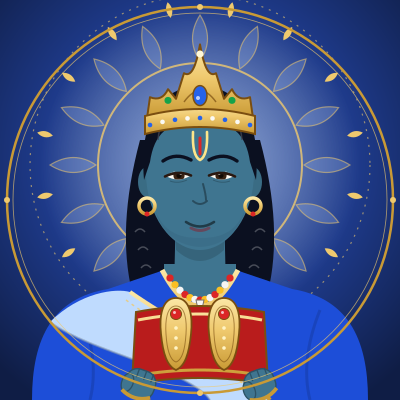
Bharata was the second of King Dasharatha’s four sons, born to Queen Kaikeyi. His mother used her two boons to send Rama to the forest and to make Bharata king, yet Bharata wanted no part of it. He went to the forest to bring Rama back, and when Rama would not break their father’s word, Bharata carried Rama’s sandals home on his head and ruled for fourteen years only as Rama’s servant. In the whole Ramayana there is perhaps no clearer picture of a brother’s love.
Birth and family
Bharata’s story begins with the great sacrifice of King Dasharatha of Ayodhya. The king had no son, and at the end of the putrakameshti yajna a shining being rose from the fire holding a vessel of sacred payasa. Dasharatha shared it among his three queens. Kaushalya gave birth to Rama, Kaikeyi to Bharata, and Sumitra to the twins Lakshmana and Shatrughna. Valmiki says that each prince carried a portion of Lord Vishnu’s own glory.
Bharata was born under the star Pushya. As the four boys grew up, they paired off in love. Lakshmana was always at Rama’s side, like a second self, and in the same way Shatrughna was devoted to Bharata. All four learned the Vedas and the use of weapons, and all four were known for their good manners, their respect for elders and their kindness to the people of Ayodhya.
When Rama won Sita by breaking Shiva’s bow at Mithila, the other brothers were married in the same ceremony. Bharata married Mandavi, the daughter of Kushadhvaja, who was King Janaka’s younger brother, so she was Sita’s cousin. Soon afterwards Bharata’s maternal uncle Yudhajit came to take him to visit his grandfather, the king of Kekaya. Shatrughna went with him, and the two brothers stayed there for a long time.
Coming home to an empty palace
While Bharata was away in Kekaya, everything changed in Ayodhya. Kaikeyi, stirred up by her maid Manthara, asked Dasharatha for two boons he had once promised her: that Bharata be crowned, and that Rama live in the forest for fourteen years. Rama left with Sita and Lakshmana, and the old king died of grief. The sage Vashishtha sent swift messengers to Kekaya, telling them not to say what had happened.
In Kekaya, Bharata had a frightening dream about his father, and his heart was uneasy. When the messengers came, he hurried home. Ayodhya looked silent and sad. He went to his mother first, and Kaikeyi told him, as if it were good news, that his father had died and that Rama was in the forest, so the kingdom was now his. Bharata was struck to the heart.
He spoke very harsh words to his mother, saying that she had brought ruin on the family and that he would never accept a kingdom gained in this way. Then he went to Queen Kaushalya, who in her grief thought he might have wanted all this. Bharata fell at her feet and took solemn oath after oath that he had known nothing. Kaushalya held him close, and they wept together.
When Shatrughna found Manthara dressed in fine jewels and seized her in anger, it was Bharata who stopped him. He said that a woman must never be killed, and that Rama would never speak to them again if they did such a thing. After this, Bharata performed his father’s funeral rites with deep sorrow, as a son should.
The journey to Chitrakuta
When the ministers and Vashishtha asked Bharata to take the throne, he refused in front of the whole assembly. He said the kingdom belonged to Rama, the eldest, and announced that he would go to the forest and bring him back. A road was made through the forest, and Bharata set out with his mothers, the priests, the army and crowds of citizens who longed to see Rama again.
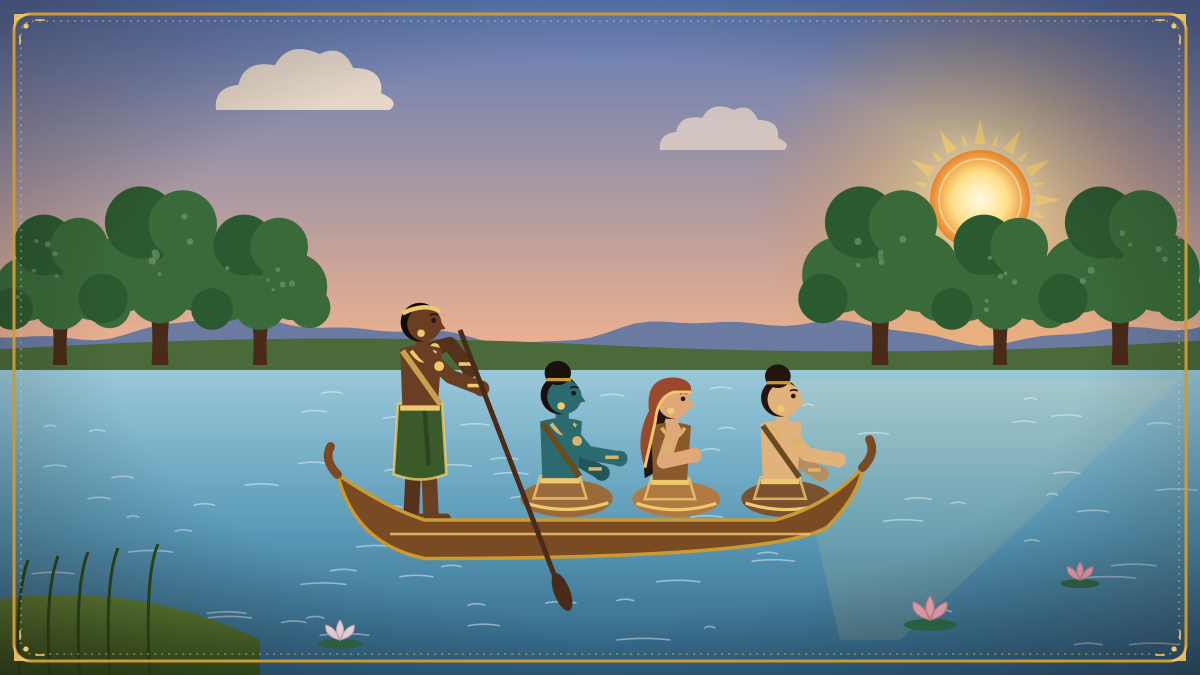
At the river Ganga the boatman king Guha, Rama’s friend, first feared that Bharata had come to harm Rama. When he saw Bharata’s tears and heard his words, he was won over and showed him the place where Rama and Sita had slept on a bed of grass under an ingudi tree. Bharata was overcome, and he resolved that he too would sleep on the ground and wear bark until Rama returned.
The sage Bharadvaja also tested Bharata’s heart before showing him the way, and then, by the power of his penance, welcomed the whole army with a wonderful feast. At Chitrakuta, Lakshmana saw the army approaching and thought Bharata had come to fight. Rama calmed him at once: Bharata, he said, had never done them any wrong and had surely come out of love.
The sandals
Bharata ran to Rama and fell weeping at his feet. He told him that their father had died, and Rama offered water to his father’s spirit. Then Bharata begged Rama to come back and rule. Vashishtha, the queens and the citizens all joined him. Rama gently answered that their father’s word had to be kept, and that Bharata too must obey it and rule Ayodhya.
Bharata even lay down in front of Rama’s hut, saying he would fast until Rama agreed, but Rama told him this was not right for a king’s son. At last Bharata asked for Rama’s sandals, adorned with gold. Rama stepped onto them and gave them to him. Bharata bowed to them and said they would rule Ayodhya until Rama returned.
Then he made a vow before everyone. For fourteen years he would wear bark clothes and matted hair, eat fruits and roots, and live outside the city, carrying the burden of the kingdom on Rama’s behalf. If Rama did not return on the very first day after the fourteen years were over, Bharata said, he would enter the fire.
Fourteen years at Nandigram
Bharata returned with the sandals placed on his head, but he did not live in the palace. He settled in the village of Nandigram near Ayodhya, set the sandals on the throne and held the royal umbrella over them himself. Every matter of the kingdom was first laid before the sandals, and only then did Bharata act.
For fourteen years he lived like a hermit while governing a great kingdom. When Rama was returning victorious from Lanka, he sent Hanuman ahead to Bharata, partly to see whether Bharata had come to love the throne. Hanuman found him thin, dressed in bark and still ruling only in Rama’s name. Overjoyed by the news, Bharata gave Hanuman rich gifts.
When Rama arrived in the Pushpaka, Bharata placed the sandals back on his brother’s feet with his own hands. He said, “The kingdom you left with me as a trust, I now give back to you.” At the coronation Rama wished to make Lakshmana the crown prince; when Lakshmana would not accept, Rama gave that honour to Bharata.
Later life and character
In the Uttara Kanda, Bharata led an army at Rama’s command to the land of the Gandharvas on both banks of the Indus, conquered it and founded two cities for his sons: Takshashila for Taksha and Pushkalavata for Pushkala. When Rama thought of performing the Rajasuya sacrifice, Bharata gently advised against it, since it could bring war and ruin on many royal families, and Rama praised his wisdom.
When Rama decided to leave the world, Bharata refused to stay behind, even as king. He asked that Rama’s sons Kusha and Lava be given the kingdom, and he went with Rama into the river Sarayu, returning with him to the divine world. Bharata’s life shows that true greatness lies not in getting power but in refusing what is not rightly yours.
Did you know?
- Valmiki says Bharata was born under the star Pushya, while Rama was born under Punarvasu.
- When Hanuman brought the news of Rama’s return, Bharata recalled an old saying: joy comes to a living man even after a hundred years.
- Bharata vowed to enter the fire if Rama did not come back on the very first day after the fourteen years ended.
- According to the Uttara Kanda, the famous city of Takshashila was founded by Bharata for his son Taksha.
What we learn from Bharata
Bharata teaches that love for family and loyalty to what is right are worth more than any throne. A kingdom given to him unfairly was, in his eyes, no gift at all, and he kept it only as a trust for its true owner.
Bharata in the story
Read the kandas where Bharata plays a part.