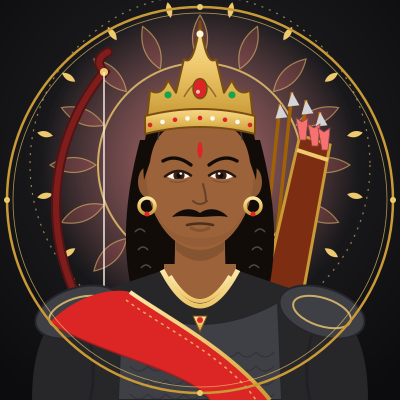
Indrajit was the eldest son of Ravana and Mandodari. At birth he roared like a thundercloud, and so he was named Meghanada. He became a master of magic, able to fight unseen from the clouds, and after he captured Indra, the king of the gods, Brahma named him Indrajit, the conqueror of Indra. In the war of Lanka he was Ravana’s greatest warrior. Twice he struck down Rama and Lakshmana, and he was finally killed by Lakshmana.
Birth and the sacrifices
The Uttara Kanda tells that soon after Ravana married Mandodari, she gave birth to a son. The baby cried with a voice like rolling thunder, and the whole of Lanka seemed to stop and listen. So Ravana named him Meghanada, “the one who roars like a cloud.” He grew up among the rakshasa women of the palace, strong and fearless.
Once, when Ravana returned from his travels, he found his son at the shrine of Nikumbhila, a grove of sacrifices outside Lanka. Under the guidance of Shukracharya, the teacher of the asuras, Meghanada had completed seven great sacrifices. Through them he had won a chariot that could move through the sky, the power of the dark illusion called tamasi maya, and quivers that never ran empty.
Meghanada was the eldest and the most famous of Ravana’s sons. His younger brothers included Akshakumara, Atikaya, Trishira, Devantaka and Narantaka, all of whom also fought for Lanka. But none was as feared as Meghanada, whose skill in sacrifice and magic made him almost unbeatable.
How he became Indrajit
Later Ravana went to war with the gods in heaven. In that fierce battle Ravana was surrounded by Indra and his army. Meghanada then made himself invisible with his magic, attacked Indra unseen, bound him and carried him off to Lanka as a prisoner.
Brahma came to Lanka with the gods and said to the young prince, “Because you have conquered Indra, you will be known as Indrajit. Now let Indra go.” Indrajit asked for immortality, but Brahma said that no living being can have it. So Indrajit asked another boon.
He said, “Whenever I am about to go to battle and pour offerings into the sacred fire, may a chariot with horses rise from the fire for me. While I fight from it, may no one kill me. But if I go to battle without finishing my prayers and offerings, let that be the time I die.” Brahma granted this, and Indra was set free.
Capturing Hanuman
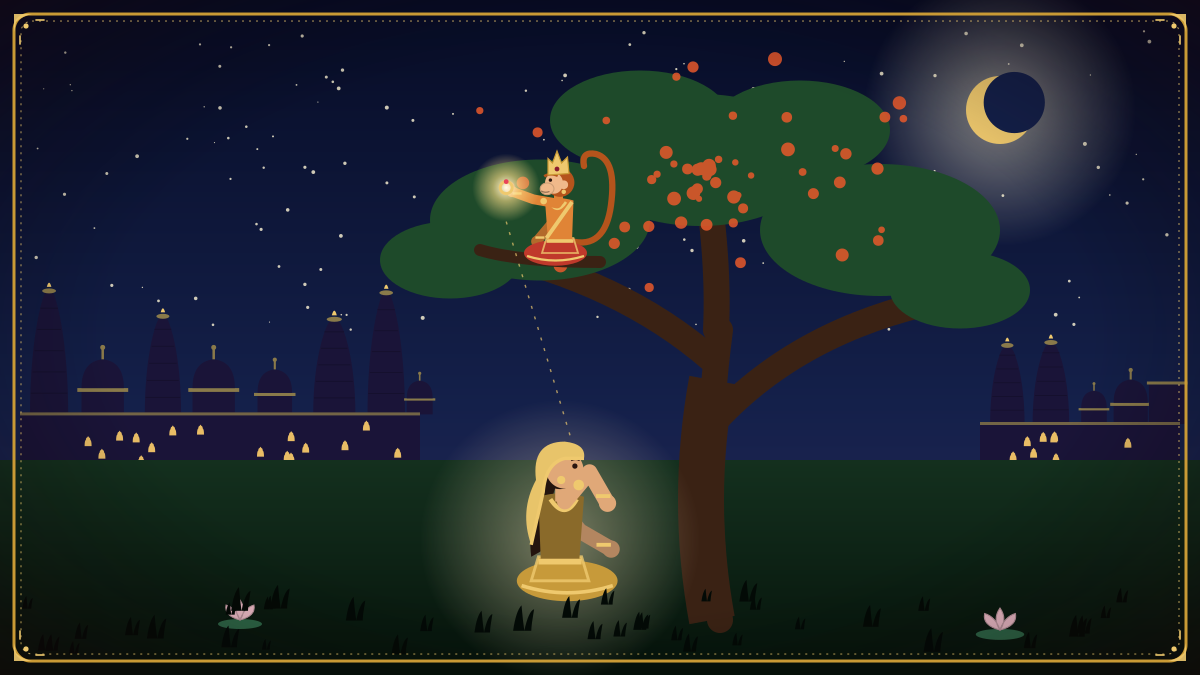
When Hanuman came to Lanka and destroyed the Ashoka grove, Ravana sent warrior after warrior against him. Hanuman defeated them all, including Ravana’s young son Akshakumara. Then Ravana sent Indrajit.
After a long fight, Indrajit used the Brahmastra, the weapon of Brahma, and Hanuman fell bound by it. Hanuman knew that Brahma had blessed him so that this weapon would hold him only for a short while. Out of respect for Brahma, and because he wanted to meet Ravana, he let himself be captured.
The rakshasas then tied Hanuman with ropes and bark. Indrajit was dismayed, for the Brahmastra does not stay when other bonds are added, and so Hanuman was in truth already free.
So the young prince who had conquered Indra could not hold the messenger of Rama for long. In Ravana’s court Hanuman warned the king to return Sita, and later he set Lanka on fire with his burning tail.
Twice he struck down the princes
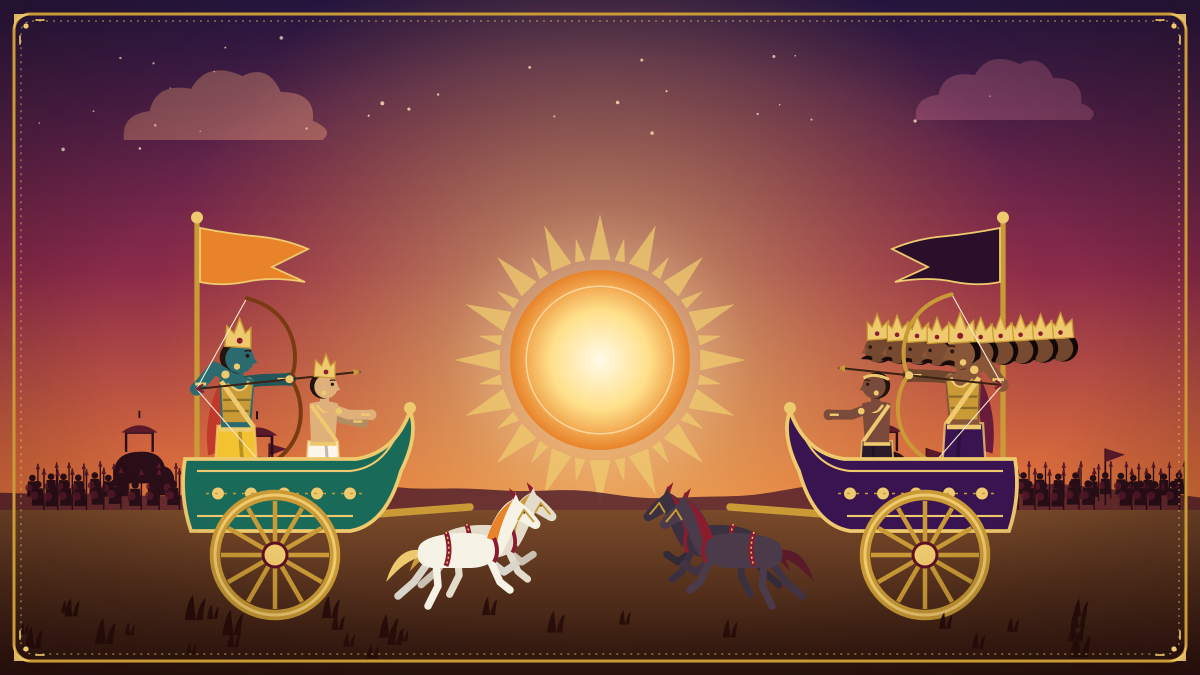
In the war, Indrajit fought from the sky, hidden by magic. In his first great battle he bound Rama and Lakshmana with his arrows that turned into serpents, and the brothers fell, unable to move. The vanaras despaired, and Ravana rejoiced. Then Garuda, the king of birds, came flying, and at his arrival the serpents fled, and the princes rose up healed.
After the first of these battles, Indrajit went proudly to Ravana and announced that the two princes were dead. Ravana had Sita taken in the Pushpaka over the battlefield to see them lying there, hoping she would give up hope. But the rakshasa woman Trijata, who was kind to Sita, told her that the princes were only stunned and still alive, and Sita took comfort.
In another battle Indrajit used the Brahmastra, and Rama, Lakshmana and a vast number of vanaras fell unconscious. Vibhishana and Hanuman searched the battlefield and found the old Jambavan, who asked, “Is Hanuman alive?” He sent Hanuman to the Himalayas, and Hanuman brought back a whole mountain of healing herbs. Their scent alone revived Rama, Lakshmana and the army.
The illusion and the sacrifice at Nikumbhila
Then Indrajit tried a cruel trick. He made an illusory figure of Sita in his chariot and, in front of Hanuman and the vanaras, pretended to kill her. Hanuman, heartbroken, brought the news to Rama, who fainted with grief.
Vibhishana explained that this was only an illusion. “Ravana would never let Sita be killed,” he said. “Indrajit has done this to distract you while he performs a sacrifice at Nikumbhila. If he finishes it, he cannot be defeated. But Brahma has said that whoever stops him before he finishes it will kill him.”
Rama sent Lakshmana with Vibhishana, Hanuman and the vanaras. They broke up the rakshasa army and interrupted the sacrifice. Indrajit came out to fight, and Lakshmana faced him in a long and terrible battle.
His fall
At last Lakshmana fitted the weapon of Indra to his bow and said, “If Rama, son of Dasharatha, is devoted to dharma and true to his word, and if there is no hero like him, let this arrow kill the son of Ravana.” He released it, and Indrajit fell dead on the battlefield.
The gods and sages rejoiced, for the warrior who had once captured Indra was gone. In Lanka, Ravana heard the news and was overcome with grief, and soon afterwards he went out himself to his final battle.
Indrajit was brave, learned in sacrifice and devoted to his father. But he used his great gifts for deceit and cruelty, and he fought for a cause that was not just. His fall came, as Brahma had said, when his sacrifice was left unfinished.
Did you know?
- His birth name, Meghanada, means “the one who roars like a cloud”, because he cried like thunder when he was born.
- Brahma gave him the name Indrajit after he captured Indra and took him to Lanka.
- When Indrajit bound Hanuman with the Brahmastra, the rakshasas added ropes, and that freed Hanuman, because the Brahmastra will not stay with other bonds.
- Brahma had decreed that Indrajit would be killed by whoever stopped him before his sacrifice at Nikumbhila was complete.
What we learn from Indrajit (Meghanada)
Indrajit had courage, skill and powerful boons, but he used them for deception and an unjust cause. His story teaches that talent and strength are not enough; they must be joined to truth and dharma. Lakshmana won by calling on Rama’s truthfulness, not by trickery.
Indrajit (Meghanada) in the story
Read the kandas where Indrajit (Meghanada) plays a part.