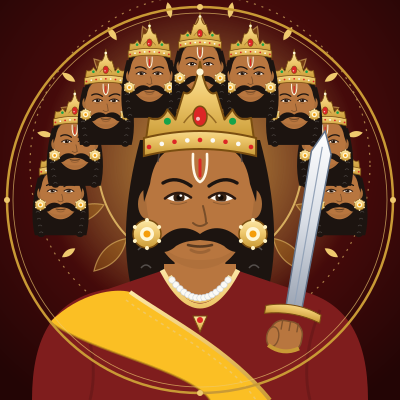
Ravana was the king of the rakshasas who ruled from the golden city of Lanka in the middle of the southern ocean. Valmiki describes him with ten heads and twenty arms, shining with power, learned and brave, but ruled by pride and desire. He won great boons through long penance, defeated gods and kings, and took the city of Lanka and the Pushpaka chariot from his own half-brother Kubera. His decision to carry away Sita, the wife of Rama, brought the war that ended his life and his line. His story shows how great gifts can be lost when they are not guided by dharma.
Birth and family
The Uttara Kanda tells Ravana’s story from the beginning. Long ago the rakshasa chief Sumali and his brothers had lived in Lanka, a city built by Vishvakarma, the architect of the gods. Defeated by Lord Vishnu, they fled to the underworld. Later the city became the home of Kubera, the lord of wealth, who was the son of the great sage Vishrava.
Sumali wished to win back the glory of his people. He sent his daughter Kaikasi to the sage Vishrava, and she asked to bear his children. Vishrava told her that because she had come at a fearful hour of the evening, her sons would be cruel rakshasas. When she pleaded, he blessed her that her last son would be righteous.
So Kaikasi had four children. The first was born with ten heads, and he was named Dashagriva, the ten-necked one; later he became famous as Ravana. After him came the giant Kumbhakarna, then a daughter, Shurpanakha, and last the gentle Vibhishana. Kubera, the son of Vishrava by another wife, was their elder half-brother.
Penance and Brahma’s boon
One day Kaikasi saw Kubera flying past in his splendid chariot and said to her eldest son, “Look at your brother’s glory. You too must become as great as he is.” Stung by these words, Dashagriva went with his two brothers to the forest of Gokarna, and all three began a fierce penance to please Lord Brahma.
Valmiki says that Dashagriva fasted for ten thousand years. At the end of each thousand years he cut off one of his heads and offered it into the sacred fire. Nine heads had been offered in this way, and he was about to offer the tenth, when Brahma appeared before him, pleased, and asked him to choose a boon.
Dashagriva asked that no bird, serpent, yaksha, daitya, danava, rakshasa or god should be able to kill him. He did not even mention human beings, for he thought them far too weak to harm him. Brahma granted the wish, gave him back all his heads, and added the power to take any form he wished. That proud silence about humans would one day decide his fate.
Lanka, the Pushpaka and the name “Ravana”
With the boon in hand, Dashagriva asked Kubera to give up Lanka. Their father Vishrava advised Kubera to avoid a quarrel, and Kubera left the city and settled near Mount Kailasa. Dashagriva became king of Lanka, and the rakshasas gathered around him. Later he attacked Kubera himself, defeated him in battle and took his wonderful flying chariot, the Pushpaka.
Flying back in the Pushpaka, he came near a mountain where Lord Shiva was resting, and the chariot suddenly stopped. Shiva’s attendant Nandishvara asked him to turn back. Dashagriva laughed at Nandi’s monkey-like face, and Nandi warned him that creatures like him, monkeys, would one day destroy his race. In his anger Dashagriva put his arms under the mountain and began to lift it.
Shiva simply pressed down the mountain with his toe, and Dashagriva’s arms were trapped beneath it. He cried out so loudly that the three worlds shook. Then, on his ministers’ advice, he praised Shiva for a long time. Shiva was pleased, freed him and said, “Because you made the worlds cry out, you will be called Ravana.” He also gave him the shining sword Chandrahasa.
Conquests and curses
Ravana married Mandodari, daughter of Maya, the great architect of the danavas, and their son Meghanada was born. Then Ravana set out to conquer the world. He defeated kings, nagas and yakshas, and even fought the gods in heaven. In that war his son Meghanada captured Indra himself, and from then on the prince was called Indrajit.
Not everyone could be conquered. Valmiki tells that the thousand-armed king Kartavirya Arjuna held Ravana captive until the sage Pulastya asked for his release. The vanara king Vali once caught him and carried him under his arm across the four oceans while he said his prayers. After that Ravana made friends with Vali.
Ravana also earned curses through his treatment of women. The ascetic Vedavati, who was praying to have Lord Vishnu as her husband, entered a fire after he insulted her, saying she would be born again to bring about his end. And when he forced himself on the apsara Rambha, Kubera’s son Nalakubara cursed him: if he ever forced an unwilling woman again, his head would break into pieces.
Valmiki also shows Ravana as a king of great splendour. Lanka under his rule was a city of golden palaces, gardens and gateways, full of music, and in its houses Hanuman later heard the chanting of the Vedas. Ravana was learned and powerful, yet he could not control his desire, and this one weakness led him to his greatest wrong.
The taking of Sita
Years later, in the Dandaka forest, Rama killed the rakshasas Khara and Dushana and their army of fourteen thousand. A survivor, Akampana, told Ravana and advised him to carry away Rama’s wife Sita. Ravana went to the old rakshasa Maricha, but Maricha warned him against it, and Ravana went home. Then Shurpanakha came to Lanka, wounded and angry, scolded her brother before his court and praised Sita’s beauty.
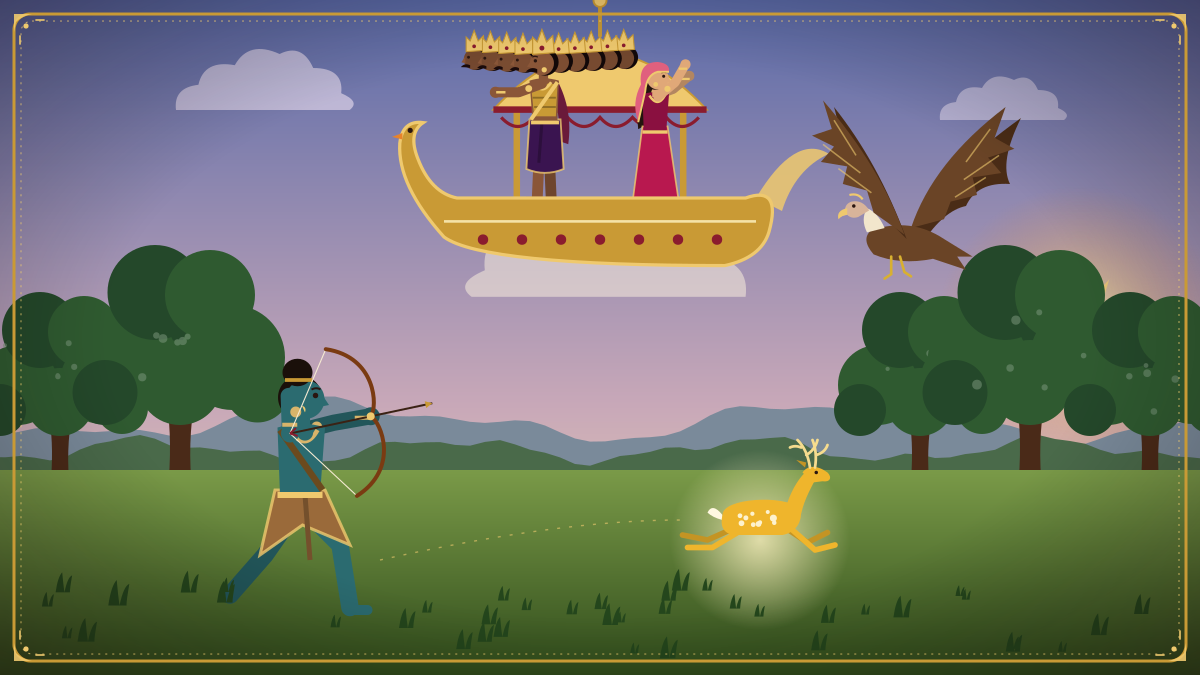
This time Ravana did not listen to good advice. He forced Maricha to take the form of a golden deer and draw Rama away from the hut at Panchavati. When Lakshmana too had gone, Ravana came to Sita disguised as a wandering holy man. She welcomed him as a guest. Then he showed his true form, seized her and carried her away in his golden chariot.
The old vulture-king Jatayu fought bravely to save her and broke the chariot, but Ravana cut down his wings with his sword and flew on. In Lanka he gave Sita twelve months to accept him, and kept her in the Ashoka grove under the guard of rakshasa women. Because of Nalakubara’s curse, he never dared to force her, but he threatened her again and again.
The war of Lanka
When Hanuman found Sita and burned Lanka, Ravana called his council. His brother Vibhishana begged him to return Sita to Rama and make peace. Ravana insulted him, and Vibhishana left Lanka and went over to Rama. The old rakshasa Malyavan, an elder of Ravana’s mother’s family, gave the same advice, and was also refused. Ravana chose war.
As Rama’s army approached, Ravana also tried to break Sita’s heart with tricks. He had a magician make a false head of Rama and a bow like his, and showed them to Sita, saying that Rama had been killed in his sleep. Sita wept, but Vibhishana’s wife Sarama came to her secretly and told her it was only an illusion, and that Rama was alive and near.
Rama’s army crossed the ocean by the bridge that Nala built. In the first great meeting of the two kings, Ravana struck Lakshmana with a mighty spear, but Hanuman carried Lakshmana away. Then Rama broke Ravana’s chariot, bow and crown, and, seeing him tired and without weapons, let him go. “Go home and rest,” he said. “Come back when you are ready to fight again.”
Ashamed, Ravana woke his brother Kumbhakarna and sent him into battle, and then his sons and generals, one after another. Kumbhakarna fell, and so did Atikaya, Narantaka, Devantaka and Trishira. At last his dearest son Indrajit was killed by Lakshmana. Ravana grieved terribly, and finally went out himself for the last battle.
The last battle and how he is remembered
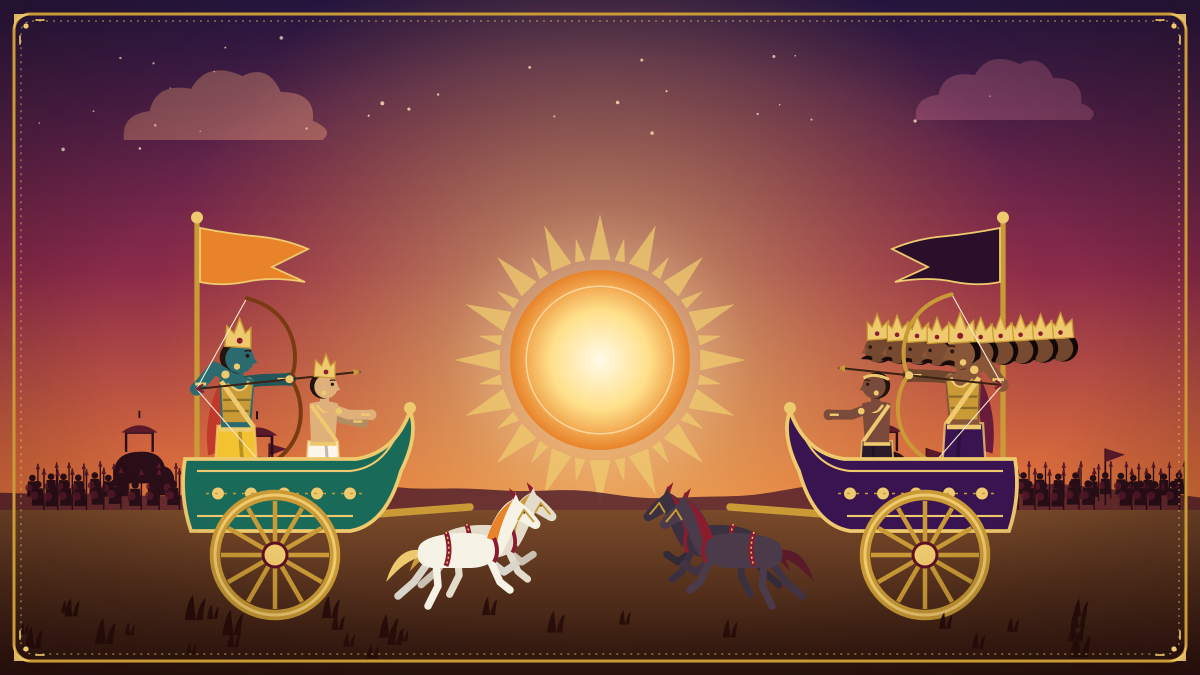
Indra sent his own chariot and his charioteer Matali to Rama. The sage Agastya came to the battlefield and taught Rama the Aditya Hridayam, the hymn to the Sun. The fight between Rama and Ravana was so fierce that Valmiki says it could be compared only to itself. Each time Rama cut off one of Ravana’s heads, a new one grew in its place.
Then Matali reminded Rama of the Brahmastra, an arrow made by Brahma for Indra, which Agastya had given him. Rama fired it with a sacred mantra, and it struck Ravana in the heart. The king of Lanka fell from his chariot and died. Vibhishana and Mandodari wept for him, and Rama told Vibhishana, “Enmity ends with death. Perform his last rites; he is now as much mine as yours.”
Valmiki does not hide Ravana’s greatness. When Hanuman first saw him in his court, he thought, “If this king were not so unrighteous, he could even protect the world of the gods.” But Ravana used his strength to take what was not his, and he would not listen to those who loved him. His fall shows that power without self-control destroys even the mightiest.
Did you know?
- When Ravana asked Brahma for protection, he did not include human beings, because he thought them too weak to matter; he fell to Rama, a man.
- The name “Ravana” was given to him by Lord Shiva, because his cry made the three worlds cry out when his arms were trapped under the mountain.
- The Pushpaka chariot that carried Rama home to Ayodhya had first belonged to Kubera, Ravana’s half-brother, from whom Ravana took it.
- In his first fight with Ravana, Rama did not kill him but let him go home to rest, because Ravana was tired and without weapons.
What we learn from Ravana
Ravana had learning, courage and the blessings of the gods, yet his pride and desire brought ruin on himself and on Lanka. He shows that it is not enough to be strong or clever. We must also control our desires, respect others and listen to those who give us good advice.
Ravana in the story
Read the kandas where Ravana plays a part.