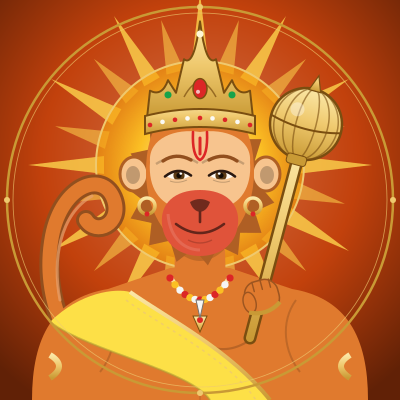
Hanuman is the son of Vayu, the wind god, and one of the wisest and strongest of the vanaras of Kishkindha. He was a minister of the vanara prince Sugriva, and it was he who first met Rama and Lakshmana in the forest and brought them to Sugriva as friends. Hanuman crossed the ocean to Lanka, found Sita, gave her Rama’s ring and brought back her jewel. In the war of Lanka he fought bravely and twice carried a mountain of healing herbs to save Rama’s army. Valmiki shows him as strong and humble, learned and gentle, and completely devoted to Rama.
Birth and childhood
Hanuman’s mother Anjana had once been an apsara, a heavenly dancer named Punjikasthala. Because of a curse she was born on earth as a vanara woman, and she became the wife of the vanara chief Kesari. One day, as she stood on a mountain top, Vayu, the wind god, was drawn to her. He told her that she would have a son as strong and swift as the wind itself. That son was Hanuman.
As a little child Hanuman once saw the rising sun and thought it was a ripe fruit. He sprang into the sky to catch it. Indra, the king of the gods, threw his thunderbolt at him, and the child fell on a mountain and his jaw (hanu) was hurt. From this he got the name Hanuman. Vayu was so upset that he stopped blowing, and all living beings began to suffer.
To calm Vayu, Brahma and the other gods blessed the child. Brahma made him safe from all weapons, and Indra granted that he would die only when he himself chose. The Uttara Kanda adds that the playful boy troubled the sages in their hermitages, so they laid a gentle curse on him: he would forget his great strength until someone reminded him of it.
Minister of Sugriva and meeting Rama
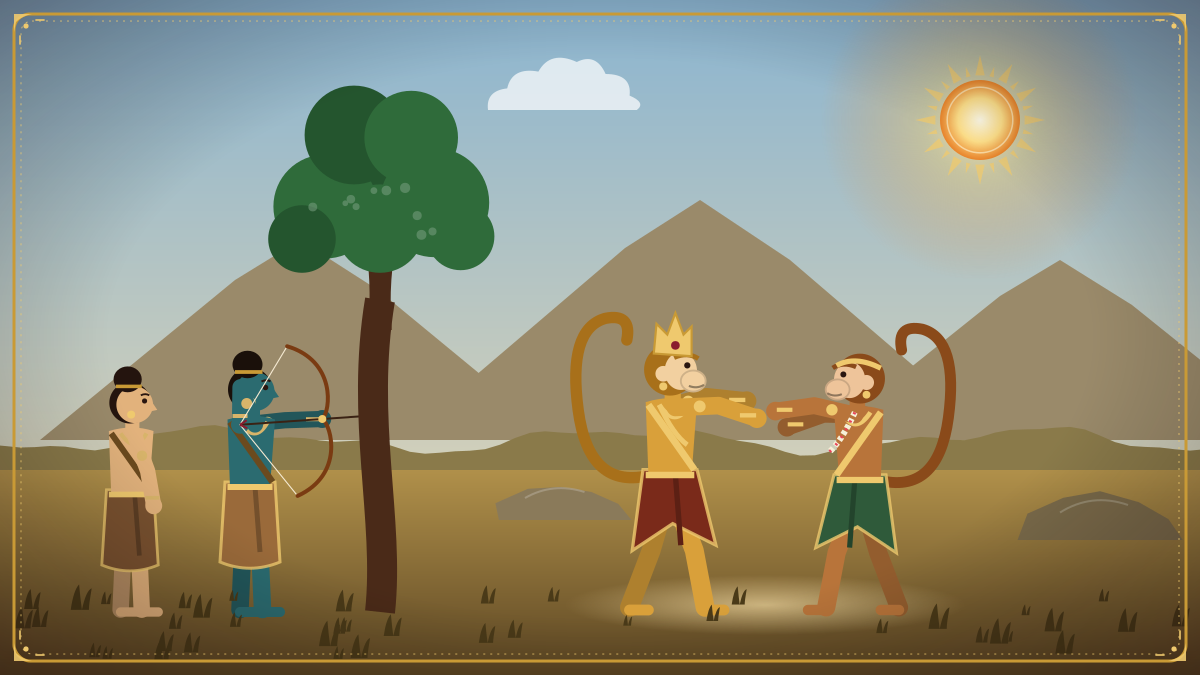
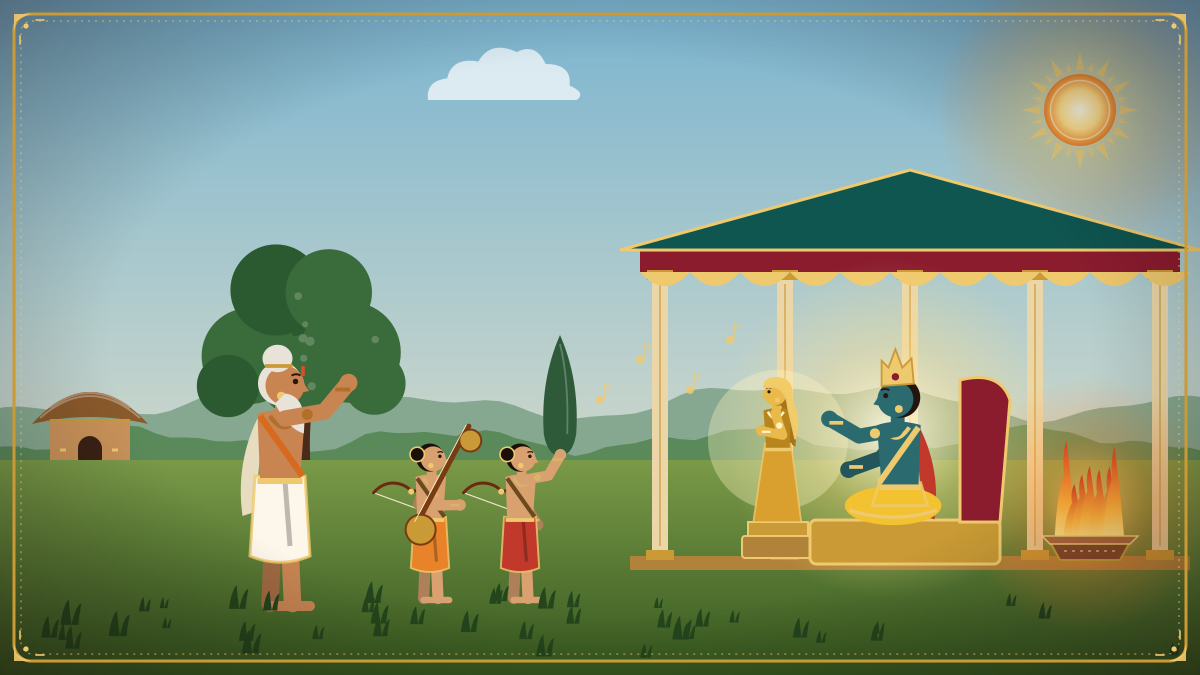
When Sugriva was driven out of Kishkindha by his elder brother Vali, Hanuman stayed loyally beside him on the Rishyamuka hill. One day Sugriva saw two tall, armed men walking near Lake Pampa and was afraid that Vali had sent them. He asked Hanuman to go and find out who they were. Hanuman took the form of a wandering ascetic and spoke to them with great courtesy.
The two men were Rama and Lakshmana, searching for Sita. Rama was deeply impressed by Hanuman’s speech. He told Lakshmana that this vanara must know the Rig, Yajur and Sama Vedas, for he had spoken at length without a single mistake, neither too fast nor too slow, in a voice that pleased the heart. Then Hanuman showed his true form, lifted the two brothers onto his shoulders and carried them to Sugriva.
It was Hanuman who lit the sacred fire before which Rama and Sugriva promised lifelong friendship. Rama would help Sugriva win back his kingdom and his wife, and Sugriva would help Rama find Sita. After Vali’s death and Sugriva’s crowning, when Sugriva forgot his promise during the rainy season, Hanuman was the first to remind him of his duty.
The search and the great leap
Sugriva sent search parties in all four directions. The strongest went south, led by Vali’s son Angada, with Hanuman and the wise old bear Jambavan. Rama trusted Hanuman most of all, so he gave him his own ring, marked with his name, to show Sita as a sign. After a long, hard search the party reached the southern ocean, and the vulture Sampati told them that Sita was a prisoner in Lanka, a hundred yojanas across the sea.
The vanaras sat on the shore, each saying how far he could jump. No one could be sure of crossing and coming back. Then Jambavan turned to Hanuman, who sat silent. He reminded him of his birth from Vayu and of his childhood leap towards the sun. As Hanuman heard this, his old strength woke up. He grew huge, climbed the Mahendra mountain and, calling on Rama, leapt over the ocean.
On the way the mountain Mainaka rose from the sea and offered him rest, but Hanuman only touched it with his hand and flew on. The gods sent Surasa, the mother of the nagas, to test him. She opened her mouth wide to swallow him; he made himself tiny, went in and out again in a moment, and she blessed him. He also overcame the shadow-catching demoness Simhika, and at last he landed on a peak in Lanka.
Finding Sita in Lanka
Hanuman waited for night, became as small as a cat and entered the city. At the gate the guardian spirit of Lanka stopped him, and he struck her with his left fist. She remembered Brahma’s words that when a vanara defeated her, Lanka’s end would be near. Hanuman searched the palaces, the drinking halls and even Ravana’s own chamber. For a moment he took the sleeping queen Mandodari for Sita, but then he thought, “Sita would never sleep in comfort or wear jewels while she is parted from Rama,” and he searched on.
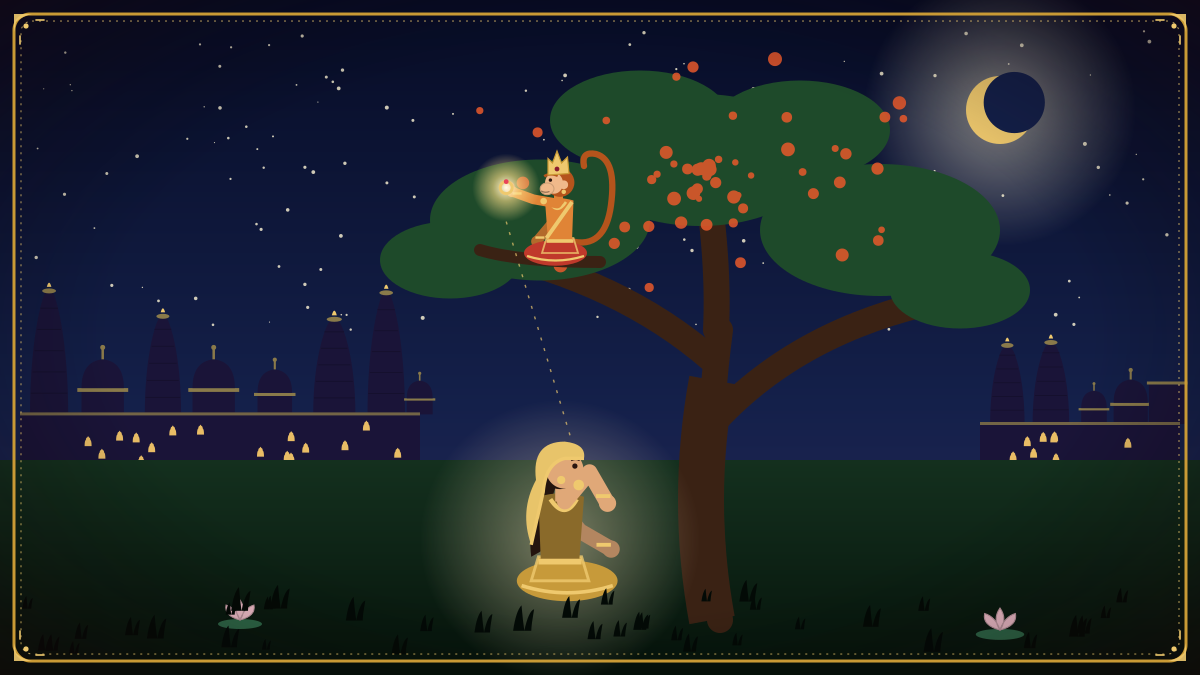
At last, in the Ashoka grove, he saw Sita sitting under a shimshapa tree, thin and sad, guarded by rakshasa women. Hiding in the branches, he watched Ravana come and threaten her, and saw how bravely she refused him. When the guards slept, Hanuman softly recited the story of Rama so that Sita would not be frightened. Then he came down, bowed and gave her Rama’s ring. Sita held it and felt as happy as if she had met Rama himself.
Hanuman offered to carry her on his back to Rama at once. Sita gently refused. She did not wish to touch any male other than Rama by her own will, and she wanted Rama himself to defeat Ravana and win her back with honour. She gave Hanuman her precious hair jewel, the chudamani, and told him a private story about a crow at Chitrakuta, which only Rama knew, as a sign that he had truly met her.
Lanka burns, and the return
Before leaving, Hanuman decided to test Ravana’s strength. He broke the trees of the Ashoka grove and defeated the rakshasas who rushed at him, including Ravana’s young son Akshakumara. At last Indrajit bound him with the Brahmastra. Out of respect for Brahma, Hanuman let himself be tied and taken to Ravana’s court. There he fearlessly advised Ravana to return Sita to Rama and save his life and kingdom.
Ravana ordered Hanuman’s tail to be wrapped in cloth, soaked in oil and set on fire. Sita prayed to Agni, the fire god, to be cool to Hanuman, and the flame did not burn him. Hanuman shook off his bonds, leapt from roof to roof and set Lanka ablaze. Then he grew afraid that Sita might be harmed, but he heard and saw that she was safe. He met her once more and leapt back across the ocean.
On the northern shore the vanaras shouted with joy. On the way home they feasted in Sugriva’s honey garden, the Madhuvana, and Sugriva understood from this that they had good news. Hanuman went before Rama and said, “I have seen Sita.” He gave him the chudamani and told him everything. Rama embraced him and said that he had nothing equal to give in return for such service.
In the war of Lanka
When Ravana’s brother Vibhishana came to seek shelter, some vanaras doubted him, but Hanuman advised Rama to accept him. In the war Hanuman was everywhere. He defeated great rakshasa warriors such as Dhumraksha and Akampana, and Ravana’s sons Devantaka and Trishiras. Several times he carried Rama on his shoulders in battle, as Angada carried Lakshmana.
One night Indrajit struck Rama, Lakshmana and a huge part of the vanara army with the Brahmastra. Jambavan, badly wounded, asked first of all, “Is Hanuman alive?” He sent Hanuman to the Himalayas to bring four healing herbs from a mountain between the Rishabha and Kailasa peaks. Hanuman could not pick out the herbs, so he lifted the whole peak and carried it to Lanka. The fragrance alone healed the brothers and the army.
Later, when Ravana struck Lakshmana down with a powerful spear, the vanara physician Sushena again sent Hanuman for healing herbs, and once more he brought a whole mountain peak. Sushena gave Lakshmana the herb, and he rose healed. After Ravana’s fall, Rama sent Hanuman to give Sita the news of victory, and later to Nandigram to tell Bharata that Rama was coming home.
Later life and character
At Rama’s coronation in Ayodhya, Sita took a shining pearl necklace from her own neck and, at Rama’s sign, gave it to Hanuman, the one in whom courage, wisdom and humility were always present. In the Uttara Kanda, when Rama’s friends were leaving for home, Hanuman asked only one thing: that his love for Rama would never fail, and that he would live on earth as long as Rama’s story is told. Rama embraced him and granted it.
Hanuman’s greatness lies in how his strength, wisdom and humility work together. He thought carefully before every step, spoke wisely, and never claimed credit for himself. All his power was offered to Rama’s service. That is why devotees remember him as the ideal servant and devotee, and why the Sundara Kanda, the book of his journey, is so dear to them.
Did you know?
- The name Hanuman comes from “hanu”, the jaw, which was hurt when Indra’s thunderbolt struck him as a child.
- When Rama first heard Hanuman speak, he praised his speech as perfect in grammar and said he must have studied all three Vedas.
- In Valmiki’s Ramayana Hanuman brings a mountain of healing herbs twice: once after Indrajit’s Brahmastra, and once when Lakshmana is struck by Ravana’s spear.
- Hanuman let himself be bound by Indrajit’s Brahmastra out of respect for Brahma, even though he could have escaped.
What we learn from Hanuman
Hanuman teaches that true strength is joined with humility and wisdom. He also shows that often we already have the power we need; we only have to remember it and use it in the service of what is right.
Hanuman in the story
Read the kandas where Hanuman plays a part.