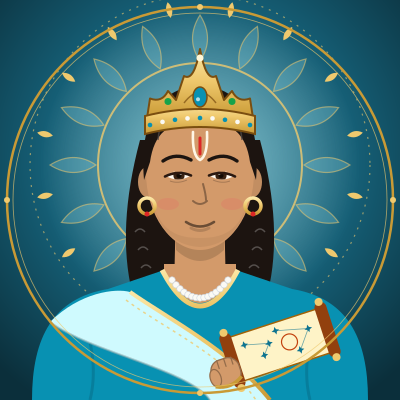
Sahadeva was the youngest of the five Pandava brothers. Like his twin brother Nakula, he was the son of King Pandu and his second wife Madri, born by the blessing of the Ashvini Kumaras. Yudhishthira, Bhima and Arjuna, sons of Kunti, were his elder half-brothers, and Kunti loved the twins as her own, Sahadeva perhaps most of all. King Shalya of Madra, Madri’s brother, was his maternal uncle. Sahadeva was a skilled swordsman, but he was best known for his wisdom, his knowledge of dharma and his good judgement. He spoke little, but when he spoke, his words were firm. He conquered the kingdoms of the south for Yudhishthira, offered the first honour to Krishna at the Rajasuya, and kept his vow to defeat Shakuni, the man whose cheating at dice had caused all the Pandavas’ suffering.
Birth and his mother’s trust
Because of a curse, King Pandu could not father children. Kunti, his first wife, shared with Madri the mantra she had received from the sage Durvasa. Madri called upon the Ashvini Kumaras, the twin physicians of the gods, and was blessed with twin sons, Nakula and Sahadeva. Sahadeva was the younger of the two, the last of the five Pandavas.
When Pandu died in the forest, Madri chose to follow him on the funeral fire. Before she went, she asked Kunti to look after her sons as her own. Kunti kept that promise all her life and gave the twins the same love as Yudhishthira, Bhima and Arjuna. The elder brothers treated their youngest brother with special tenderness.
Kunti then brought all five boys to Hastinapur, where they grew up with their cousins, the sons of Dhritarashtra.
Like his twin, Sahadeva was handsome and gentle. Since he was the youngest, his brothers often kept him close to them, and he in turn served them with great humility. Yet behind that quiet face was a sharp and thoughtful mind.
Learning and marriage
Sahadeva studied under Kripacharya and Dronacharya and became a fine swordsman. When the Pandavas attacked King Drupada as Drona’s fee, he and Nakula guarded the wheels of Arjuna’s chariot. But he was known above all for his wisdom. He understood dharma, the duties of kings and the right way to act, and his elder brothers trusted his advice.
He shared all the dangers of his family: the escape from the house of lac, the hidden life at Ekachakra and the journey to Draupadi’s swayamvara. When Arjuna won Draupadi, Yudhishthira quietly left the gathering with the twins and went home ahead of the others. Draupadi became the wife of the five brothers, and Sahadeva’s son with her was Shrutasena.
Sahadeva also married Vijaya, the daughter of King Dyutimat of Madra, whom he won at her swayamvara. Their son was Suhotra.
When the Pandavas received half the kingdom and built their capital, Indraprastha, Sahadeva stood beside Yudhishthira in the work of ruling. He was patient, careful and fair, and his brothers knew that whatever task they gave him would be done well.
Conquest of the south and Krishna’s honour
For Yudhishthira’s Rajasuya sacrifice, Sahadeva led an army to the south. He won over the Matsyas, the kings of Avanti and King Bhishmaka of Bhojakata, and travelled as far as Kishkindha, where the monkey heroes Mainda and Dvivida welcomed him with gifts.
At Mahishmati, King Nila was protected by Agni, the god of fire, and flames rose up against Sahadeva’s army. Sahadeva purified himself, sat down and prayed to Agni with great devotion. Pleased, Agni withdrew the fire, and Nila accepted Yudhishthira’s rule. From the southern coast Sahadeva sent his nephew Ghatotkacha as messenger to Vibhishana, king of Lanka, who sent rich gifts. Sahadeva then returned home to Indraprastha and laid all the wealth he had won at his eldest brother’s feet.
At the Rajasuya, the first honour had to be given to the most worthy guest. Bhishma named Krishna, and Sahadeva offered Krishna the first worship. When Shishupala angrily objected, Sahadeva declared before all the kings that he stood by this choice, and flowers fell from the sky in approval.
On this long campaign Sahadeva won some kings in battle, but many more through respect, patience and friendship. Like his twin in the west, he showed that the quiet youngest brothers were true leaders too.
The dice hall, the vow and the forest
In the dice game Yudhishthira staked and lost Sahadeva right after Nakula, and in the end lost Draupadi too. When he staked him, Yudhishthira said that Sahadeva was a teacher of dharma, known in the world as a learned man. The whole game had been planned by Shakuni, Duryodhana’s maternal uncle, who won every throw with his cunning.
When Draupadi was insulted, Sahadeva, usually so quiet, made a solemn vow: he would kill Shakuni in battle. It was a promise he carried in his heart for thirteen years.
In the forest Sahadeva served his brothers and Draupadi faithfully. When Jayadratha tried to carry Draupadi away, he rode out with his brothers and fought bravely until she was rescued. When the rakshasa Jatasura tried to carry them away, Sahadeva managed to slip free and stood ready to fight until Bhima arrived.
At the enchanted lake Sahadeva was the second to go looking for water. He too drank without answering the Yaksha’s questions and fell lifeless, and was brought back to life when Yudhishthira answered with wisdom and fairness.
Tantipala, and keeping his vow
In the year of disguise Sahadeva lived at King Virata’s court as Tantipala, a cowherd who knew everything about cattle. He told the king that he had once looked after Yudhishthira’s countless herds and could tell the qualities of every bull and cow. Under his care Virata’s herds grew healthy and large. He also fought beside his brothers when the Trigartas raided the kingdom.
When the brothers discussed Krishna’s peace mission, most of them hoped to avoid war. Sahadeva spoke with fire. He said that even if the Kauravas wanted peace, he could not forget how Draupadi had been treated in the court, and that they must fight for justice. Everyone was surprised to hear the gentle youngest brother speak so strongly. When the brothers proposed commanders for the army, Sahadeva suggested King Virata.
Sahadeva fought bravely through all eighteen days of the great war. With Nakula he more than once held back their uncle Shalya, who fought for the Kauravas. Once Karna defeated him but let him go unharmed, because of his promise to Kunti.
On the eighteenth day Sahadeva found Shakuni and his son Uluka on the battlefield. Shakuni tried to escape, but Sahadeva followed him. He first killed Uluka, then faced Shakuni himself. Reminding him of the cheating in the dice game, he told him that now the fruit of that wrong had come, and struck him down. So the youngest Pandava kept the vow he had made in the gambling hall thirteen years before.
That same night, in Ashwatthama’s attack on the sleeping camp, Draupadi’s five sons were killed, and Sahadeva lost his son Shrutasena.
After the war and the last journey
After the war, when Yudhishthira wished to give up the throne in grief, Sahadeva gave him wise advice. He said that the real bondage is the feeling of “mine”, and real freedom is in “not mine”; so a king could rule without attachment and still be free. Yudhishthira was comforted. When he became king, he asked Sahadeva to stay always by his side as his closest helper and protector, for there was no one whose judgement and loyalty he trusted more. Sahadeva served the king faithfully for the rest of his life.
When Kunti later went to the forest with Dhritarashtra and Gandhari, Sahadeva wept and begged to stay with her and serve her, but she lovingly sent him back to his duties. As she left, Kunti told Yudhishthira, “Always be kind to Sahadeva. He loves you and me dearly.” Her words showed how close the youngest son of Madri was to her heart.
At the end of their lives the Pandavas set out with Draupadi on the final journey towards the Himalayas. A faithful dog followed them all the way. Draupadi fell first, and then Sahadeva, the first of the brothers. Bhima asked, “Our youngest brother always served us without pride. Why has he fallen?”
Yudhishthira replied, “He thought that no one was as wise as he was. That is why he has fallen.” Yet Sahadeva had lived with honour, serving his family humbly all his life, and in heaven Yudhishthira later found the twins shining with glory beside the Ashvini Kumaras.
Did you know?
- Sahadeva was the youngest of all the Pandavas; his twin Nakula was born just before him.
- At Yudhishthira’s Rajasuya sacrifice, it was Sahadeva who offered the first honour to Shri Krishna.
- In disguise at King Virata’s court, Sahadeva worked as a cowherd named Tantipala, looking after the royal cattle.
- Sahadeva kept his vow from the dice game for thirteen years and finally defeated Shakuni on the last day of the war.
What we learn from Sahadeva
Sahadeva shows that real knowledge makes a person calm, patient and devoted to what is right. He kept his promise for many years without giving up, and he honoured Krishna before all the kings. His fall reminds us that even great learning should never make us think we are better than others.