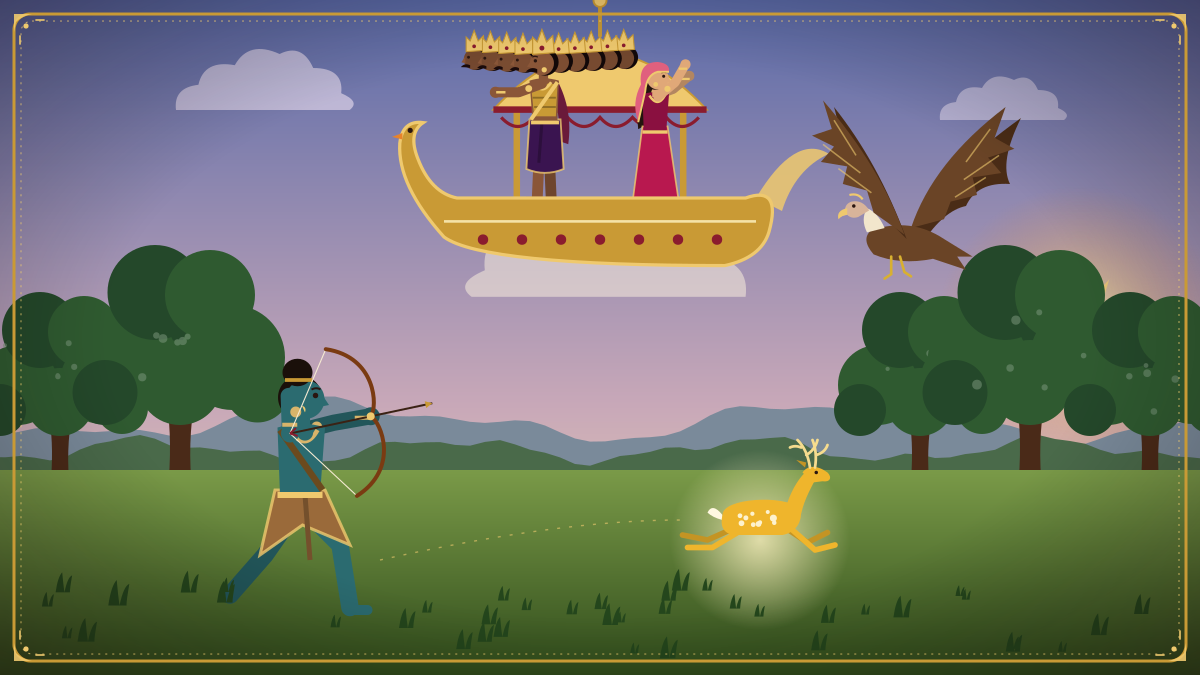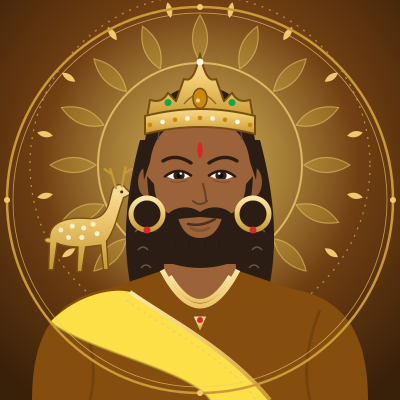
Maricha was the son of the yakshini Tataka. Cursed by the sage Agastya, he became a rakshasa and troubled the sages of the forest. As a boy, Rama threw him far into the ocean with a single arrow, and from then on Maricha was terrified of Rama. When Ravana came to him for help in carrying away Sita, Maricha warned him earnestly against it. But Ravana threatened him, and Maricha took the form of the golden deer and was killed by Rama’s arrow.
Son of Tataka
In the Bala Kanda, the sage Vishvamitra tells Rama the story of Maricha’s family. There was a yaksha named Suketu who received from Brahma a daughter, Tataka, as strong as a thousand elephants. Tataka married Sunda, and their son was Maricha.
When Sunda died, Tataka and young Maricha rushed angrily at the great sage Agastya. Agastya cursed Maricha to become a rakshasa, and Tataka to become a fearful man-eater. From then on Tataka laid waste the land where Agastya had once lived, and Maricha became a troubler of sages.
Vishvamitra told this story to the young Rama before Rama faced Tataka. At the sage’s command, Rama fought her, and with his arrows he ended her life. So Maricha lost his mother to Rama, and this was only the beginning of his meetings with the prince of Ayodhya.
Rama’s first arrow
When Vishvamitra brought the young Rama and Lakshmana to his ashram, the two princes guarded his sacrifice for six days and nights. On the sixth day Maricha and Subahu came flying with their rakshasa band to spoil the sacrifice and defile the altar.
Rama fitted the Manava weapon to his bow and struck Maricha in the chest. He did not intend to kill him. The arrow threw Maricha a hundred yojanas away into the ocean, where he fell unconscious but alive. With the weapon of Agni, Rama then killed Subahu, and the sacrifice was completed in peace.
Vishvamitra and the other sages praised Rama. Maricha, far away in the ocean, woke up and slowly made his way back to land. He had learned for the first time how strong this young prince was.
Maricha later told Ravana that he did not change his ways at once. Once, with two other rakshasas in the form of deer, he attacked Rama in the Dandaka forest. Rama shot three arrows; the two companions died, and Maricha barely escaped.
A frightened hermit
From then on Maricha gave up his old life. He went to live in a lonely hermitage on the shore of the ocean, wearing bark and deerskin, with matted hair, eating simply and performing penance.
When Ravana first came to him after the death of Khara, asking for help to carry away Sita, Maricha begged him to give up the idea, and Ravana, calmed, returned to Lanka.
But fear of Rama never left him. When Ravana came to him a second time, after Shurpanakha’s visit to Lanka, Maricha told him, “I see Rama in every tree. In my dreams I see him holding his bow. Even words that begin with ‘Ra’, like ratna and ratha, fill me with terror.”
He also warned Ravana that Rama was not cruel or greedy, as Ravana imagined, but truthful, kind and devoted to his father’s word. “He went to the forest only to keep his father’s promise,” Maricha said. “Such a man is dharma in human form. Do not make him your enemy.”
Ravana’s second visit
This time Ravana had come with a plan: Maricha must take the form of a golden deer and draw Rama away. Maricha warned him once more, at great length. He spoke of Rama’s goodness and strength and said, “It is easy to find people who always say pleasant things. Rare is the one who speaks words that are unpleasant but good for us, and rare is the one who listens to them.”
Ravana would not listen. “If you refuse,” he said, “I will kill you now.” Maricha thought, “If I go, Rama will kill me; if I stay, Ravana will kill me. It is better to die at the hands of Rama.” With a sad heart he agreed, and rode with Ravana in his chariot to Panchavati.
Before leaving, Maricha said sadly that he could already see Lanka destroyed and Ravana killed with all the rakshasas, because a king who acts against dharma brings ruin on his whole people. His words came true.
The golden deer
Near Rama’s hut, Maricha became a wonderful deer. Its body was golden, dotted with silver, and its horns shone with jewels. It wandered among the trees, eating leaves, sometimes coming close and sometimes leaping away. Sita saw it and was enchanted, and she asked Rama to catch it for her.
Lakshmana warned, “This must be Maricha. No real deer looks like this.” Rama replied that if it was Maricha, he would kill him, and if it was a real deer, he would bring it to Sita. He told Lakshmana to guard Sita and went after the deer, which led him far away into the forest.
At last Rama shot an arrow that struck the deer. As Maricha fell, he took back his own form and, imitating Rama’s voice, cried out, “Ha Sita! Ha Lakshmana!” Then he died. Rama understood the trick at once and hurried back, full of worry. But the cry had done its work: Sita sent Lakshmana after Rama, and Ravana came to the empty hut.
His character
Maricha is one of the few rakshasas in the Ramayana who clearly saw Rama’s greatness and spoke the truth to Ravana. He had learned from his own suffering and tried to change his life.
His advice to Ravana is among the wisest words spoken in Lanka. He praised Rama as dharma in human form and told Ravana that by touching Sita he would bring death upon himself.
Yet in the end, out of fear, he helped Ravana do a great wrong. His story shows how hard it is to stand firm when a powerful person demands something unjust, and how one weak moment can serve a great evil.
Did you know?
- Rama’s Manava weapon threw Maricha a hundred yojanas into the ocean without killing him, when Rama was still a boy protecting Vishvamitra’s sacrifice.
- Maricha said he was so afraid of Rama that even words beginning with “Ra”, such as ratna and ratha, frightened him.
- Maricha told Ravana that people who speak pleasant words are easy to find, but rare is one who speaks unpleasant but helpful words, and rare is one who listens.
- Lakshmana guessed at once that the golden deer was really Maricha.
What we learn from Maricha
Maricha learned from his mistakes and gave Ravana honest advice, which is a good thing. But he gave in to fear and helped in a wicked plan. His story teaches us to speak the truth and also to have the courage to refuse what is wrong.
Maricha in the story
Read the kandas where Maricha plays a part.