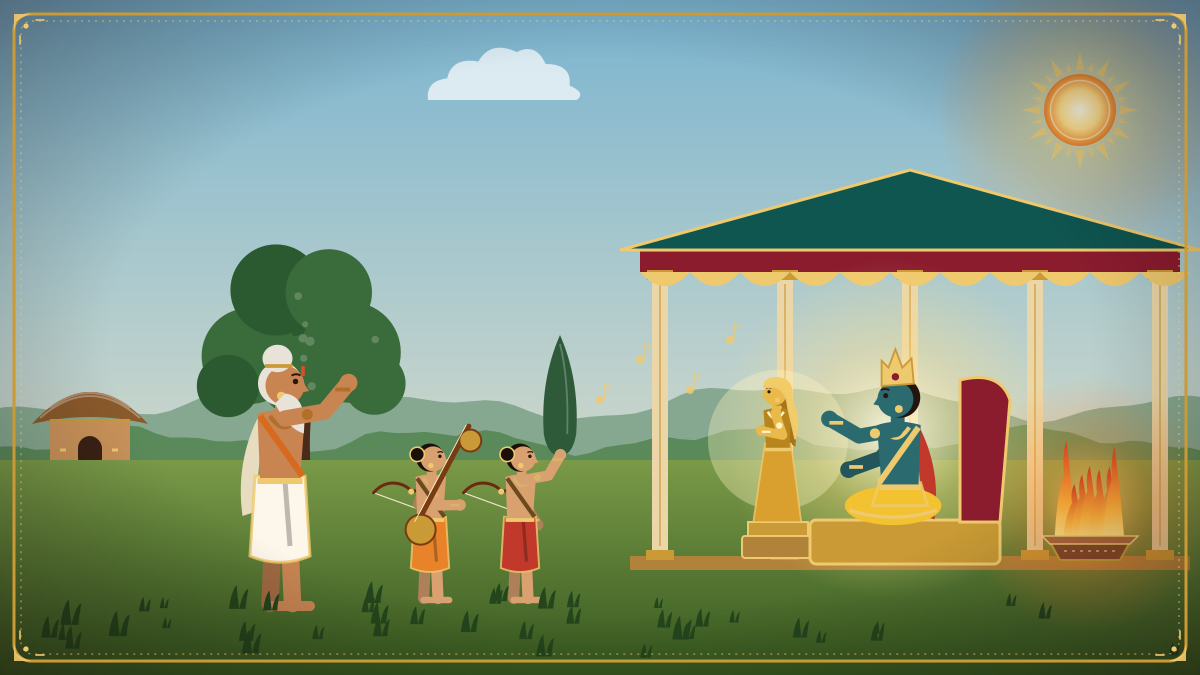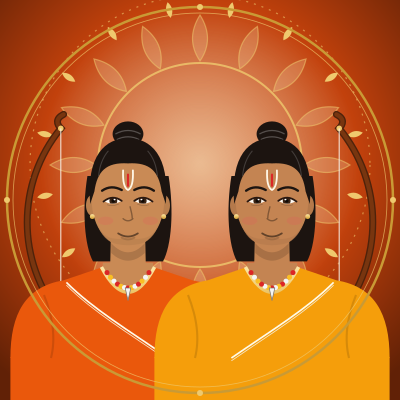
Lava and Kusha were the twin sons of Shri Rama and Sita. They were born not in a palace but in the forest ashram of the sage Valmiki, where Sita lived after leaving Ayodhya. Valmiki taught them his great poem, and they became the first to sing the Ramayana, at last singing it before Rama himself. Through their song, Rama came to know his own sons.
Why Sita lived in the forest
After Rama became king of Ayodhya, he and Sita lived happily for many years, and Sita came to expect a child. Then Rama learned from his companion Bhadra that people in the city were talking about Sita, wondering how the king could take back a wife who had lived in Ravana’s Lanka. Rama knew Sita was pure, but he felt that a king must never let his people lose faith in the throne.
With a heavy heart he told Lakshmana to take Sita across the Ganga and leave her near the ashram of Valmiki. Sita had earlier said that she wished to visit the holy ashrams by the Ganga, so she set out happily. Only on the far bank did Lakshmana, weeping, tell her the truth. Sita grieved deeply, yet she sent loving words back to Rama and asked Lakshmana to look after him.
Valmiki’s young disciples saw Sita weeping on the river bank and told their teacher. The sage came to her, knew by the power of his penance who she was, and comforted her. He led her to the women ascetics who lived near his ashram, and they received her with love. There Sita lived simply, waiting for the birth of her children.
Birth in the ashram
Some months later, Sita gave birth to twin sons in Valmiki’s ashram. That night, by chance, Rama’s youngest brother Shatrughna was staying at the ashram on his way to fight the rakshasa Lavana. The young disciples ran to Valmiki at midnight with the happy news, and the sage came at once to bless the babies and protect them.
Valmiki took a handful of sacred kusha grass, recited protective mantras over it and gave it to the elderly women of the ashram. The twin born first was to be gently wiped with the tips of the kusha, so he was named Kusha. The younger was to be wiped with the lower part, called lava, so he was named Lava. In this way the grass itself gave the brothers their names.
Disciples of Valmiki
The boys grew up in the peace of the forest, among sages, students and gentle animals. They learned from Valmiki with love and attention, and they were gifted in music. Their voices were as sweet as the voices of the Gandharvas, the singers of heaven, and they were as alike as two reflections of the same face.
Valmiki had composed the story of Rama, and the Bala Kanda says he chose these two princes, wise in dharma and blessed with fine memory, to learn it all by heart. Lava and Kusha learned the whole poem and sang it to the music of strings, in the proper notes and rhythm, full of every feeling: love, courage, sorrow, wonder and peace.
They first sang it before gatherings of sages. The sages were so moved that tears came to their eyes, and they praised the boys warmly. Each gave them a small gift from his simple forest life: a water pot, a bark garment, a deerskin, a sacred thread, a girdle of munja grass and other such things.
Singing before Rama
Years later, Rama performed a great Ashvamedha sacrifice in the Naimisha forest, and kings, sages and people came from everywhere. Valmiki arrived with his disciples. He told Lava and Kusha to sing the Ramayana everywhere — in the sages’ huts, in the streets and before the king — singing twenty cantos each day.
He gave them more instructions. If the king offered them wealth, they should not accept it, for what use is gold to those who live on forest fruits and roots? And if anyone asked whose sons they were, they should say only that they were disciples of Valmiki.
Rama heard the two young singers and was enchanted. He sat among the sages, kings and his brothers and listened day after day. He ordered eighteen thousand gold coins to be given to them, but the boys politely refused. When Rama asked about the poem, they told him that the sage Valmiki had composed it, that it told the whole story of Rama’s life, and that it had twenty-four thousand verses.
Their mother’s farewell
From their faces, their voices and the song itself, Rama understood that these boys were his own and Sita’s sons. He sent messengers to Valmiki, saying that if Sita was pure, she should come and declare it before the whole gathering. The next day Valmiki brought Sita into the assembly, her head bowed and her hands folded.
Valmiki declared that Lava and Kusha were Rama’s sons, twins born to Sita, and that in thousands of years of penance he had never spoken a lie. Rama accepted his words. He said he had always known Sita was pure, and that the twins were his sons, but that he had acted for the sake of the people.
Then Sita, dressed in ochre robes, prayed: if she had never thought of anyone but Rama, let Mother Earth make room for her. The Earth opened, a divine throne rose up, and the goddess of the Earth took Sita into her arms and down into the ground, while flowers fell from the sky. The twins had found their father, and on that same day they said farewell to their mother.
Kings of Kosala and their character
Many years later, when Rama decided to leave the world, he divided the kingdom of Kosala between his sons. Kusha, the elder, was crowned king of southern Kosala, with his capital at Kushavati near the Vindhya hills. Lava became king of northern Kosala and ruled from the city of Shravasti.
The twins carry the qualities of both their parents — Rama’s nobility and Sita’s gentleness — together with the learning and simplicity of Valmiki’s ashram. Their greatest gift to the world was their song. Through them, the Ramayana first passed from the poet’s heart to the ears of the people, and it has never stopped being sung.
Did you know?
- Kusha was the elder twin; both brothers were named after the kusha grass Valmiki used to protect them at birth.
- The sages who first heard them sing gave them simple gifts such as a water pot, a bark garment and a deerskin.
- Lava and Kusha refused eighteen thousand gold coins from Rama, saying that forest-dwellers have no use for gold.
- Valmiki told them to sing twenty cantos of the Ramayana each day at Rama’s Ashvamedha.
What we learn from Lava and Kusha
Lava and Kusha remind us that what we learn with love and humility can reach even a king’s heart. Raised simply in a forest ashram, they valued truth and their teacher’s word above gold.
Lava and Kusha in the story
Read the kandas where Lava and Kusha plays a part.