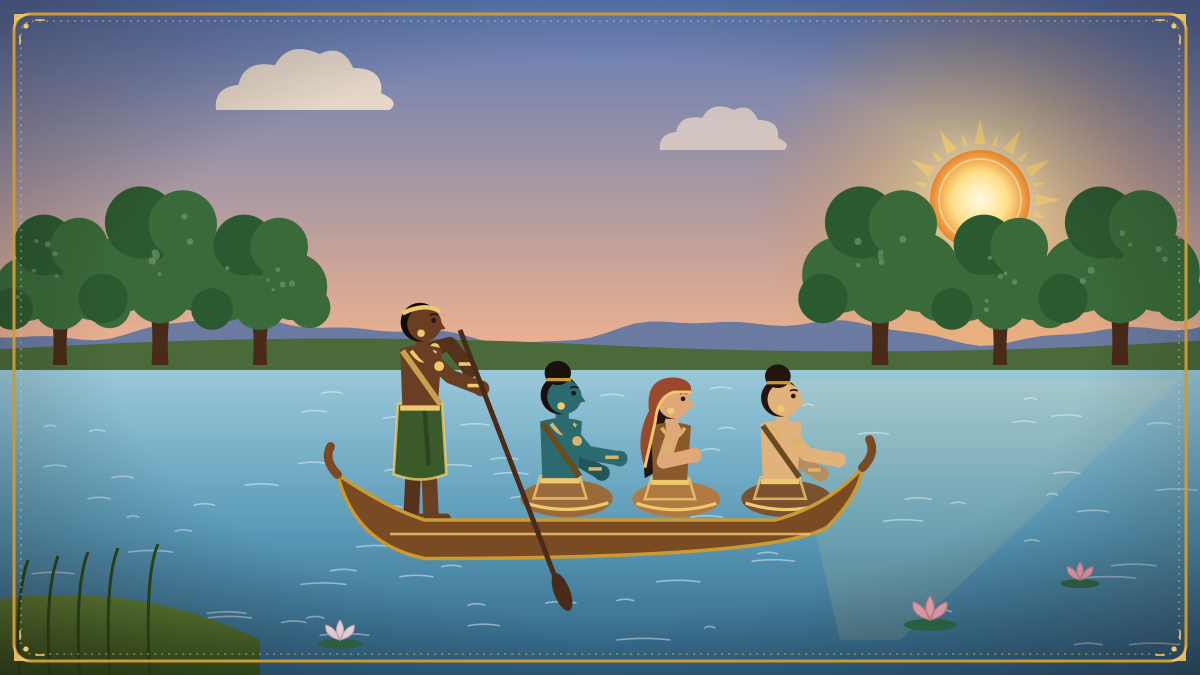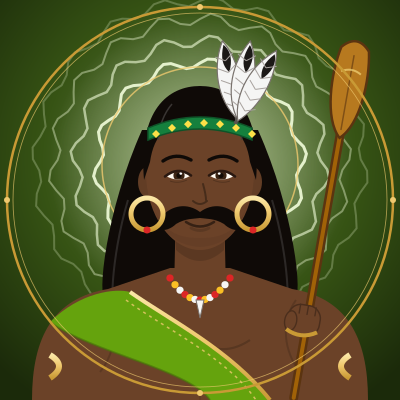
Guha was the king of the Nishadas, a forest people who lived along the river Ganga, and his town was Shringaverapura. Valmiki calls him Rama’s friend, as dear to Rama as his own self. On the first nights of the exile Guha welcomed Rama, Sita and Lakshmana, kept watch over them and arranged the boat that carried them across the Ganga. When Bharata came later with a great army, Guha’s loyalty made him ready to stop him, until he understood Bharata’s pure heart.
King of the Nishadas
The Nishadas were a people of the forest and the river. They knew the waters of the Ganga well, fished, hunted in the woods and travelled by boat. Guha was their king, strong and respected, with many relatives and warriors around him. His town, Shringaverapura, stood on the bank of the Ganga.
Valmiki does not tell us about Guha’s birth or family, but he tells us what mattered most: Guha was Rama’s friend, a friend as dear to him as his own self. Even before the exile there was a bond of love between the prince of Ayodhya and the king of the forest people.
Welcoming Rama at Shringaverapura
When Rama left Ayodhya with Sita and Lakshmana, the charioteer Sumantra drove them to the Ganga. They stopped near Shringaverapura under a large ingudi tree. As soon as Guha heard that Rama had come, he hurried there with his ministers and relatives. Seeing Rama dressed for the forest, Guha was deeply sad. Rama embraced him warmly, and Guha bowed and asked how he could serve him.
Guha said, “Just as Ayodhya is yours, this land is yours too. Who could have a guest as dear as you?” He brought rice, sweets and many kinds of food and drink, and offered soft beds for the night. But Rama gently refused. “I have taken the vow of a forest hermit,” he said. “I will live on fruits and roots. Please feed only the horses of my father, which are dear to him.” Guha gladly did so.
That night Rama and Sita slept on a bed of grass under the ingudi tree. In the morning Rama asked Guha for the milky sap of the banyan tree, and he and Lakshmana used it to mat their hair like sages. Guha brought a fine boat with skilled boatmen. Rama sent Sumantra back to Ayodhya, said goodbye to his friend and crossed the Ganga with Sita and Lakshmana.
A night of watch with Lakshmana
While Rama and Sita slept, Lakshmana stayed awake with his bow. Guha said to him, “I have made a comfortable bed for you. We forest people are used to hardship. Sleep in peace; I will guard Rama with my people, for no one in the world is dearer to me than he.”
Lakshmana thanked him but would not rest. “How can I sleep, or think of my own comfort, when Rama lies on the ground with Sita?” he said. All night long the two sat together, and Lakshmana spoke of their father’s grief and the sorrow of Ayodhya. He feared that the old king would not survive the sorrow of parting from Rama. Guha listened and wept with him until dawn.
Testing Bharata
Some time later a huge army appeared on the bank of the river. It was Bharata, coming from Ayodhya with the queens, the priests and the people. Guha grew suspicious. He told his relatives, “If Bharata means harm to Rama, we will not let him cross.” He ordered five hundred boats to be made ready, each carrying a hundred young warriors.
Then Guha went to meet Bharata with gifts of fish, meat, honey and other foods of his people, to find out what was in his heart. Bharata asked him the way to the ashram of the sage Bharadvaja. Guha replied honestly, “My people will guide you. But seeing such a great army, I fear you may mean harm to Rama.” Bharata answered, “May such a time never come. Rama is like a father to me. I am going to bring him back.” Guha’s face lit up with joy, and he praised Bharata, saying that no one in the world was like him, for he was giving up a kingdom that had come to him without effort.
That night Guha told Bharata everything about Rama’s stay: how Rama had refused rich food, how he had slept on grass under the ingudi tree and how Lakshmana had kept watch. When Bharata heard that Rama and Lakshmana had matted their hair like hermits, he fell down in grief. Guha showed him the grass bed, still pressed down where Rama and Sita had slept. In the morning Guha’s boats carried Bharata and his whole army across the Ganga.
News of Rama’s return
Guha’s friendship was not forgotten. At the end of the exile, after the victory in Lanka, Rama flew back towards Ayodhya in the Pushpaka and stopped at Bharadvaja’s ashram. From there he sent Hanuman ahead with a message, and he told him to go first to Shringaverapura and tell his friend Guha that Rama was well and coming home.
Rama said that Guha, his friend as dear as his own self, would be overjoyed at the news, and that Guha would tell Hanuman the way to Bharata and the news of Ayodhya. Hanuman flew to Shringaverapura and told Guha, “Your friend Rama is at Bharadvaja’s ashram; you will see him tomorrow,” and then flew on to meet Bharata. So the king of the Nishadas was among the very first to hear that Rama was returning.
Character and qualities
Guha was simple, warm and deeply loyal. He did not care that Rama had lost his kingdom; he loved him just the same, as a hermit as much as a prince, and was proud to be his friend. He offered everything he had, and when Rama refused it, he served him in the ways Rama would accept.
His loyalty was also wise. He was ready to fight for his friend, yet he did not attack Bharata blindly. He tested him first, listened to his answer and then helped him with all his heart. Valmiki shows that a true friend protects us, but also judges others fairly.
Did you know?
- Rama refused Guha’s royal food because of his hermit’s vow and asked only that his father’s horses be fed.
- Guha kept five hundred boats ready, each with a hundred young warriors, in case Bharata meant harm to Rama.
- Rama and Lakshmana matted their hair with the milky sap of a banyan tree at Guha’s town before crossing the Ganga.
- On his way home from Lanka, Rama sent Hanuman to give the good news to Guha first, before going on to Bharata.
What we learn from Guha
Guha teaches that true friendship does not depend on wealth, rank or good fortune; it shines most brightly in hard times. He also shows that loyalty should go together with good judgement, so that we protect our friends without being unfair to others.
Guha in the story
Read the kandas where Guha plays a part.